



Airfield intelligence

Embracing AI on the airfield will play a key role in the pursuit of the intelligent airfield and take FOD detection and proactive maintenance to the next level, writes Illuminex AI’s CEO, Brian Freed.
At Illuminex.ai, we are building the future of airfield intelligence one that prioritises safety, operational continuity, and real-world practicality.
Our flagship FODAI solution, along with the broader platform, embodies five core design principles that, far from being abstract ideals, are deliberate choices shaped by collaboration with airfield operators, from bustling hubs to remote general aviation (GA) fields.
The goal is simple: deliver AI that educates, augments, and empowers rather than complicates or disrupts. These principles guide every decision we make, ensuring technology serves the unique demands of airfield operations.
In an industry where downtime costs thousands per minute and human lives depend on split-second judgment, the right design philosophy makes all the difference. Here’s how we approach it and why it matters for every airfield.
HUMAN-CENTRIC DESIGN: AI AS A FORCE MULTIPLIER, NEVER A REPLACEMENT
In the active operations area of any airfield, there is no substitute for human judgment. Technical inspectors, and ground crews bring contextual awareness, experience, and accountability that no algorithm can fully replicate.
We ascribe to the belief that technology bends to the will of its maker, hence our design philosophy centres on augmentation and support and reject the notion that AI should displace humans in core airfield operations.
Our ‘detectors’ do not issue autonomous commands or seize control of critical decisions; they equip human operators with superior insight. The system highlights potential issues, provides high-resolution context, and lets the trained professional make the final call. This approach preserves safety, maintains accountability, and builds trust.
When AI acts as a reliable co-pilot rather than an autopilot, adoption accelerates, and outcomes improve. Human-centric design is not a limitation; it is the foundation of responsible airfield intelligence.
GEOAI: CONTEXT-AWARE INTELLIGENCE BEYOND SIMPLE COMPUTER VISION
Many AI vision systems analyse pixels in isolation, delivering detections without spatial or temporal understanding.
Airfields, however, demand more. Every square foot is georeferenced, every movement has trajectory implications, and every detection must answer four critical questions: What is it? Where exactly is it? When did it appear? And if it is moving, where is it headed?
Our GeoAI architecture fuses computer vision with precise detection positioning and real-time mapping through the fusion of GPS, Point Cloud, and IMU data into the computer vision data flow.
This is not ‘bolt-on’ geolocation that tells you the location of a vehicle, it is foundational to our entire platform to support precise temporal and geo-referenced data specific to each logged detection.
As a result, our detections are not vague alerts but pinpointed, geo-tagged insights overlaid directly onto the airfield’s operational map.
Inspectors see the object’s exact co-ordinates, and size, enabling immediate informed response. This level of intelligence transforms raw data into actionable knowledge, reducing search time, minimising exposure in the AOA, and preventing small issues from becoming major disruptions.
GeoAI is what elevates detection from ‘interesting’ to Airfield Intelligence capable of delivering heatmaps, and predictive decision support.
EASE OF USE: SEAMLESS INTEGRATION AND MINIMAL OPERATIONAL DISRUPTION
Airfields run on tightly defined standard operating procedures (SOPs). The cost of change; training, workflow redesign, regulatory approval can far more costly than the technology purchase.
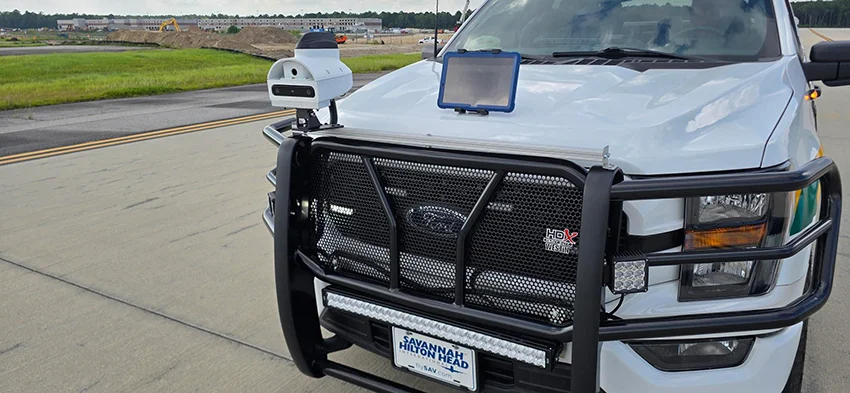
Consider these scenarios. During routine inspection, a system flags potential FOD. The inspector reviews the provided image on an in-vehicle screen, resolves it in seconds, and continues without any unplanned disruption. Operations proceed without a ripple, no alerts to the AOC or ATC.
Contrast this to fully automated approach which can trigger electronic alerts which require human dispatch, resulting in potential runway closures.
These are particularly painful for false detections. AC 150/5220-24 provides allowance for 1–3 x daily false-alarms for automated FOD detection systems, which can lead to significant operational costs from unplanned and unnecessary closures. Our human-in-the-loop validation occurs at the point and time of detection and integrates directly into current SOPs, empowering rather than potentially interrupting operations.
MOBILE SOLUTIONS FOR LOWER COST AND HIGHER RESILIENCE
Installing fixed sensors along runways, taxiways, and aprons complete with power, networking, and frangible bases can easily exceed a million dollars in capital expenses per runway.
Then come the ongoing realities of airfield life: snowploughs, drifts, and routine maintenance that can damage or obscure fixed sensors.
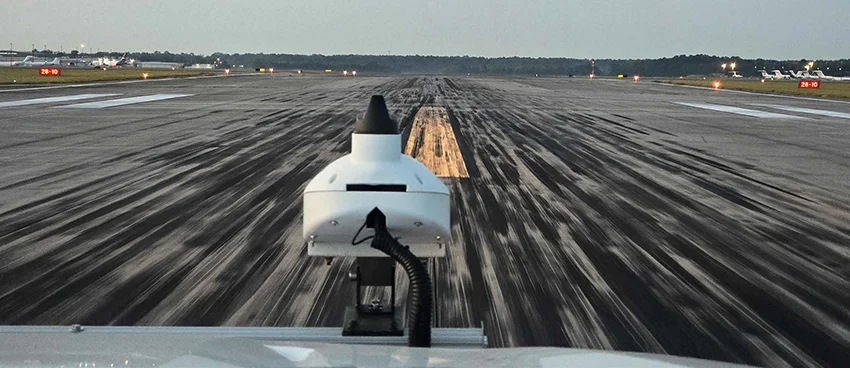
We chose a different path. Our solutions such as FODAI are fully mobile, mounted on standard airfield inspection vehicles. A single sensor array, leveraging GeoAI and edge processing, covers the entire airfield during normal inspection routes.
No fixed infrastructure. No massive upfront CAPEX. No vulnerability to ploughs or snow accumulation. The system travels with the very teams already responsible for routine inspections, delivering continuous, high-fidelity coverage without adding new airfield assets to maintain or protect.
AIRFIELD INTELLIGENCE FOR EVERY AIRPORT, NOT JUST THE LARGEST HUBS
Too often, cutting-edge aviation technology emerges from the innovation labs of major hubs, organisations with dedicated teams and budgets in the tens of millions yielding solutions with cost and scale that effectively sidelines small airports.
We designed our platform to scale both ways. Small airports receive the same core capabilities, GeoAI, mobile deployment at price points suited to limited budgets and staffing.
Diverse testing sites including Morristown Municipal Airport, Cambridge Bay Airport alongside hubs like Savannah/Hilton Head International Airport and Toronto Pearson International Airport forced resilience, affordability, and simplicity into every layer, ensuring intelligence that truly serves all airports.
The resulting solutions are powerful, but priced and scaled exclusively for those environments. Small and non-hub airports, as well as GA facilities, are left watching from the sidelines.
These five principles human-centric design, GeoAI, ease of use, CAPEX avoidance, and democratisation, form the philosophical and technical foundation of Illuminex Ai’s airfield intelligence.
These foundations should be considered, not just for our solutions, but for every airfield technology decision. While the relevance may seem subtle now, the choices made, will prove decisive in delivering ROI positive, resilient, human-empowered operations for years to come.