
Green pioneer: Swedavia

Share
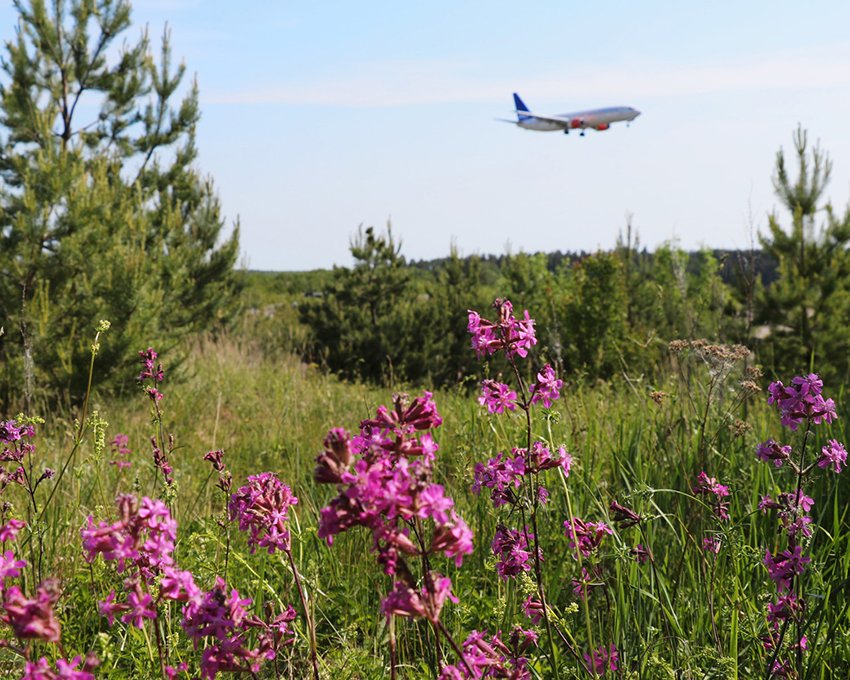
Head of sustainability, Therese Forsström, tells us more about the sustainability goals and achievements of Swedish airport operator Swedavia.
Does Swedavia agree that addressing aviation’s impact on the environment will play the biggest role in securing aviation’s licence to grow?
Yes, absolutely. Air travel enables people to meet and businesses to operate and grow – something that is essential in a geographically large country like Sweden.
A well-functioning air transport infrastructure with high accessibility strengthens Sweden’s competitiveness and connects regions, industries and international markets.
Aviation helps secure growth by linking different modes of transport, facilitating imports and exports, and providing an extensive network of connections both within and beyond Sweden’s borders. That is why it is crucial that we, together with our partners and the industry, continue working on aviation’s transition to reduce climate impact and safeguard its long-term role in a sustainable transport system.
What are the key focus areas and goals of Swedavia’s sustainability strategy?
Swedavia’s sustainability strategy is part of its strategic direction – the company’s compass – designed to ensure a competitive and sustainable business now and in the long-term. It aligns with owner objectives, customer commitments, and the UN Sustainable Development Goals (Agenda 2030).
Swedavia’s vision for 2030 focuses on three areas: future-proofing aviation by achieving fossil-free domestic flights by 2030 and all flights fossil-free by 2045; simplifying door-to-door travel through a seamless and sustainable transport system; and creating inspiring meeting places that deliver top-class customer experiences and offer inclusive, attractive workplaces.
Do these goals vary airport by airport – i.e the targets for Stockholm Arlanda, Göteborg and Malmo are different to Kiruna and Visby?
Size and traffic numbers make no difference when it comes to sustainability. We have the same strategy and goals/targets for all ten of our airports across Sweden.
What do you consider to be your major sustainabilty achievements to date?
Swedavia’s greatest sustainability achievement to date is becoming the first airport operator in the world to achieve fossil-free operations at our own airports in 2020.
Since then, we have systematically set requirements and have also made significant progress in supporting our airport partners in their transition. This is the outcome of more than a decade of dedicated work to reduce both direct and indirect emissions, from vehicles and machinery to purchased electricity and heating.
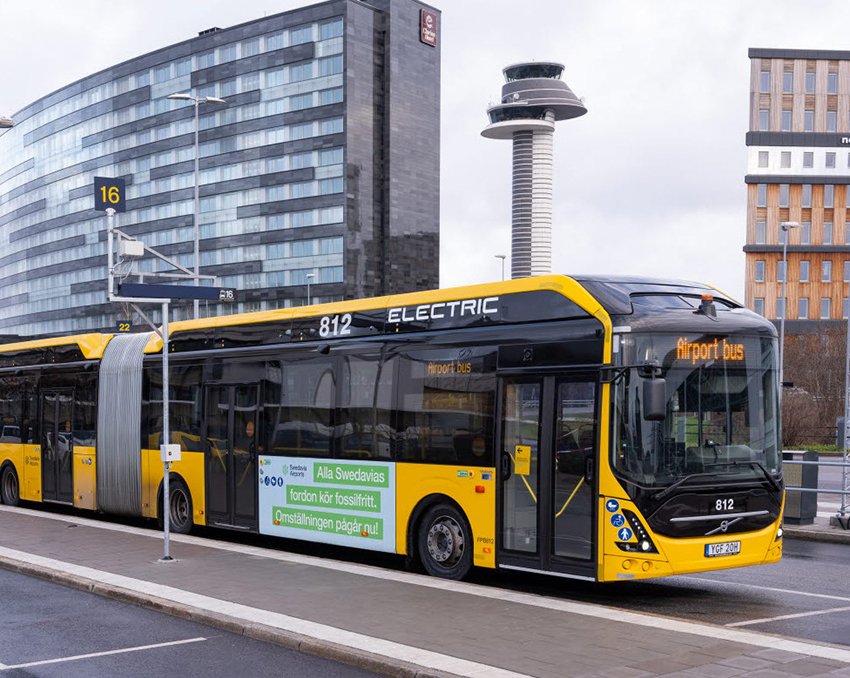
Through investments in renewable energy, electrification, biogas for buses, and renewable fuels for fire training, we have reached our goal.
In addition, seven of our airports have achieved the highest level of ACI’s Airport Carbon Accreditation programme (Level 5), meaning zero emissions from our own operations and a plan for the entire value chain to reach net zero by 2050.
The remaining three airports will be certified during the year. This is an important step in the climate transition and demonstrates that we are leading the way toward fossil-free aviation.
Are the airlines onboard with Swedavia’s SAF incentive schemes?
The response has been very positive. Swedavia’s SAF programme has been well received by the airlines and has been utilised during the years we have run the programme.
Sustainability isn’t just about the environment, it’s also about having the facilities, financial power, route networks and staff to continue to operate and grow. Is staff recruitment an issue in Sweden?
Skills supply is a high priority, and we recruit continuously based on existing competence needs. As an example of our efforts, Swedavia is organising a series of Recruitment Days for the fourth consecutive year together with the airport’s partners. The purpose of the initiative is to create a meeting place between Swedavia, our partners, and potentialemployees.
Can you tell us more about your green financing initiatives?
Swedavia’s green bonds are issued under the company’s existing Medium Term Note (MTN) programme, with the purpose of financing investments and projects related to climate transition and sustainability.
Our green framework has been designed in line with industry standards – the Green Bond Principles and Green Loan Principles. Furthermore, the framework has been reviewed by CICERO Shades of Green AS, which highlights Swedavia as a global role model for airports and gives the framework’s governance structure the highest rating – ‘Excellent’.
STOCKHOLM ARLANDA ADOPTS NEWAIR TRAFFIC APPROACH CONCEPT
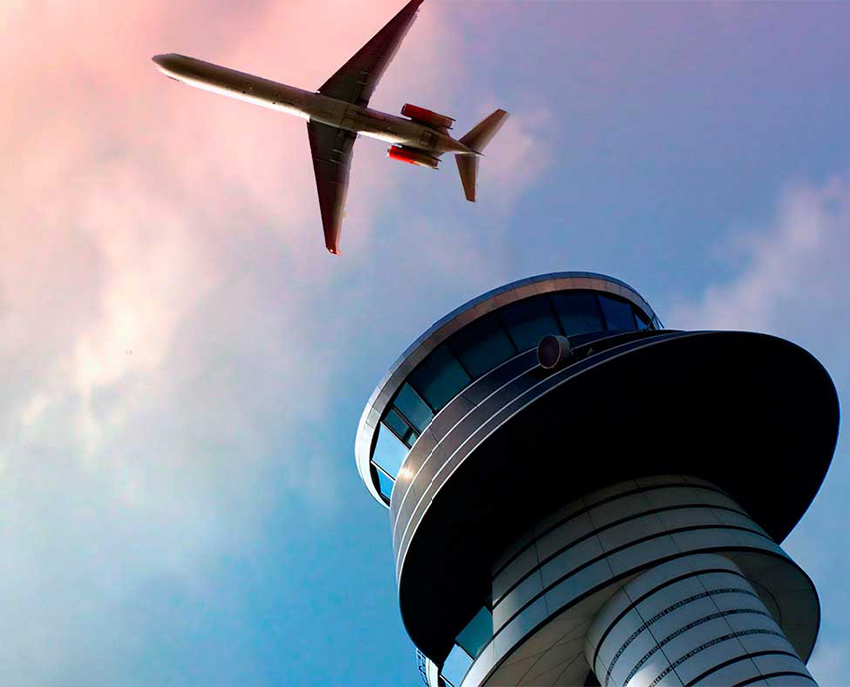
In Q4 of 2025, Stockholm Arlanda and Luftfartsverket (LFV) became thefirst in Europe to introduce a new air traffic approach concept.
The new concept is commonly referred to as Established on RNP (EoR)and makes it possible for aircraft arriving at Stockholm Arlanda Airportto fly with curved approaches to a greater extent than before.
The concept is seen as an important step towards increasing thecapacity, efficiency and sustainability of air traffic.
“For us, it is of course gratifying that Swedavia will be the first in Europeto apply the new concept for managing arrivals,” notes Susanne Norman,currently the interim president and CEO of Swedavia.
“Enabling more curved approaches is also the most effective way tosupport airlines in their transition work, in addition to facilitating increased use of sustainable aviation fuel (SAF).”
The new approach concept allows the airport to increase the landing rate per hour and reduces emissions, both for the aircraft flying the shorter, curved approach and for those flying the standard instrument landing approach.
This is because fewer aircraft have to use the runway dedicated for arrivals, reducing the queue for that runway. To be able to fly curved approaches, airlines must have a special permit from their National Supervisory Authority.
“The modernisation of the airspace by Luftfartsverket shows how air traffic control can help reduce the environmental impact of aviation,” says LFV’s director of operations, Anna Granberg. “The traffic flow into Stockholm Arlanda Airport becomes more efficient during peak hours, and arriving aircraft have shorter flight paths with reduced emissions.”