

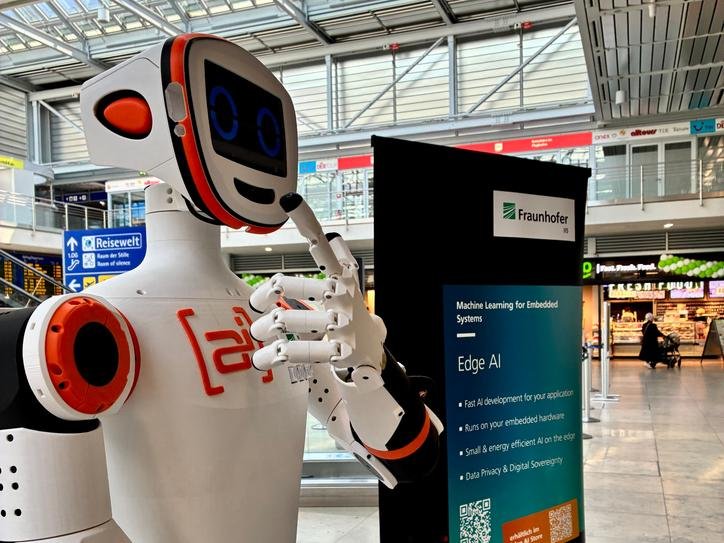
In collaboration with the Fraunhofer Institute for Integrated Circuits IIS, Nuremberg Airport has tested the ability of a mobile, AI-based robot to help travellers on their journey through the German gateway.
The robot successfully answered questions ranging from the location of parking, restaurants, and check-in counters at the airport, and seemed to pass the test of whether the travelling public would be willing to accept the help of a humanoid assistant.
And it was able to do so in multiple languages as an edge AI solution, without cloud access.
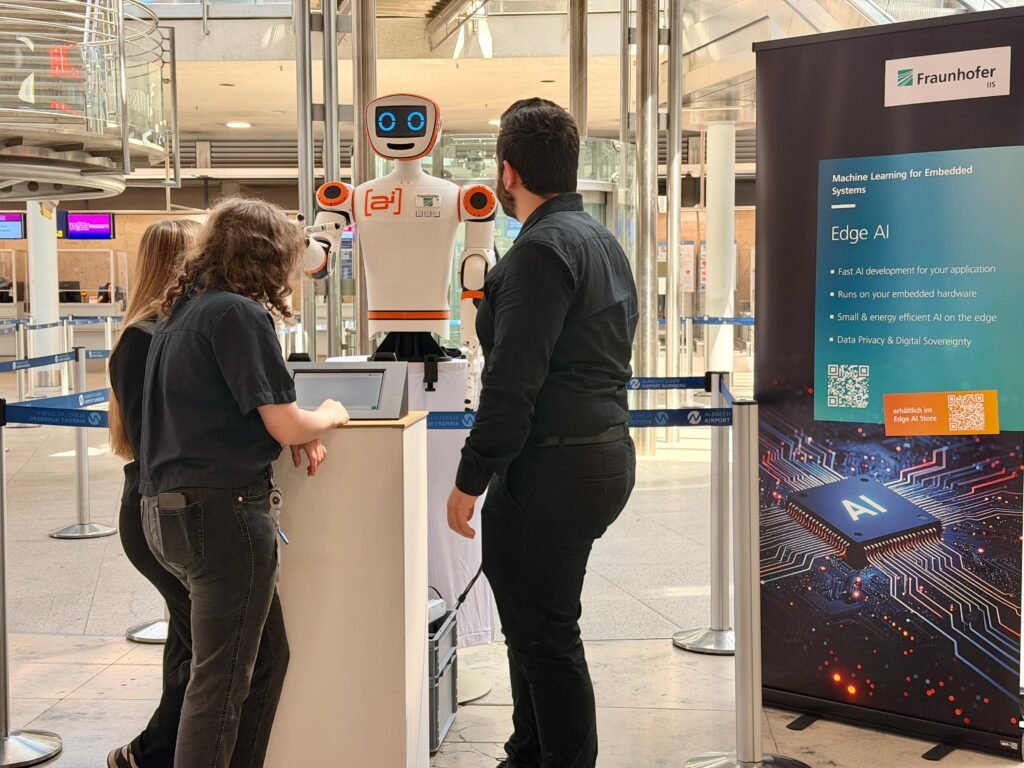
Edge AI (edge artificial intelligence), notes Nuremberg Airport, refers to running machine learning algorithms and models directly on local devices or machines rather than in the cloud.
All this meant that travellers and waiting visitors were able to obtain information about the airport from the information robot in the departure hall without needing to take out their smartphones.
Many people are familiar with voice-based digital systems from cars or interactive call systems, as well as AI chatbots on websites. These are typically implemented using large AI models that run in data centres via cloud connections.
However, for the trial Nuremberg Airport, three AI models were specifically reduced in size to operate locally and quickly: one model for multilingual speech recognition, one for understanding and answering questions, and one for generating spoken responses in the user’s language.
Normally, requests are transmitted to large, computationally intensive AI models in the cloud and processed in data centres.
In this case, however, audio inputs are transcribed into text, the request is answered using a compressed local large language model (LLM) connected to a Retrieval-Augmented Generation (RAG) system also developed at Fraunhofer IIS, and the response is then output via speakers using a text-to-speech model.
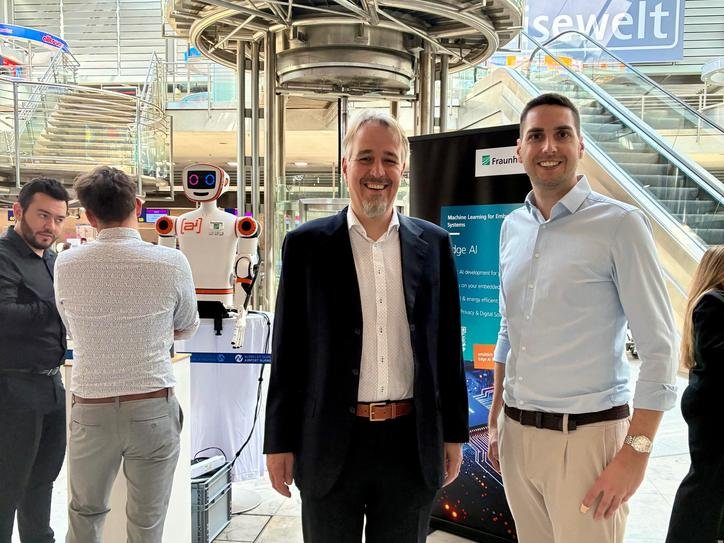
The key feature: all models run locally on an edge device, and no sensitive audio data leaves the device.
For the project in Nuremberg, researchers at Fraunhofer IIS integrated extensive airport-specific information into these models to provide travellers with precise and context-aware answers.
“AI experts at Fraunhofer IIS in Nuremberg have developed a robot that serves as an autonomous information assistant,” enthused Christian Albrecht, Head of Corporate Communications at Nuremberg Airport.
“As a company rooted in the region, we are very pleased to be a partner. We offer Fraunhofer IIS a platform to gain practical experience and provide our guests with an exceptional, innovative information experience.”
While Dr Axel Plinge, head of the efficient AI Group at Fraunhofer IIS, said: “With our edge AI expertise, we were able to design a highly efficient LLM and speech processing models compact enough to run directly on an embedded platform without the need for internet or cloud connectivity.
“This means that questions are processed and answered directly on the platform without needing to be transmitted or stored. This is a major advantage for data security and sovereignty. It is a real stroke of luck for our region to not only develop future technologies through this partnership but also make them immediately tangible on site.”