


Efficiency driver

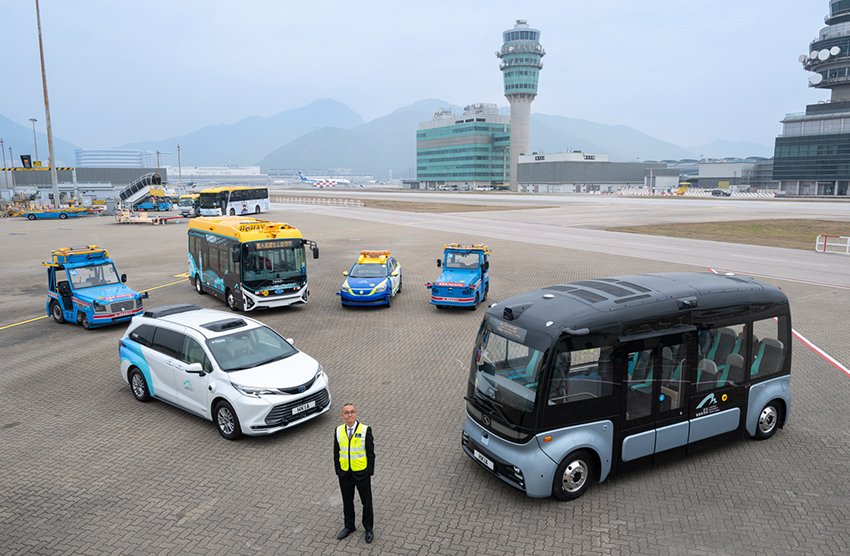
Its fleet of autonomous vehicles for operations across the airport site ensure that Hong Kong International Airport is a global leader in the use of the technology.
It currently operates more than 70 driverless vehicles, including more than 56 autonomous electric tractors (AETs), eight patrol cars and six staff shuttle buses.
Between them they have run more than three million kilometres, equivalent to circumventing the earth 76 times.
The Hong Kong gateway is also the world’s first airport to utilise Level 4 autonomous technology on all its autonomous vehicles, allowing them to operate safely in the complete absence of manual intervention in a designated environment.
This, it notes, is a big step forward from Level 3, where human supervision is required.
And more is to come as HKG operator, Airport Authority Hong Kong (AAHK), is set to break further new ground this year by extending the operation of its autonomous vehicles from airside to landside to carry passengers on public roads.
This remarkable journey is part of AAHK’s continuous quest for ever smarter operations and improved efficiency, and the ambition to reinvent the way airports do business.
AUTONOMOUS ELECTRIC TRACTORS
It all started in 2019, when Hong Kong International Airport introduced autonomous tractors for the delivery of baggage.
The tractors are programmed to achieve end-to-end automation. At the baggage hall, the tractors are tasked to tow multiple baggage dollies along three programmed routes of 2.7km to 3.5km each.
Using various smart devices, such as 32-Channel LiDAR, DGPS antenna, bumper sensor and dolly monitor cameras, the tractors operate smoothly alongside other vehicles driven by airport personnel.
In addition to avoiding obstacles and detecting overloads, the tractors are able to switch between fast and slow lanes within tunnels or designated road sections to minimise disruptions during temporary lane closures.
Upon arrival in a safe position at the aircraft’s parking stand, the tractors release their towed dollies without manual intervention. They then automatically return to a designated handover area to wait for their next assignments.
These tractors have been further upgraded recently with an Auto-Charging Robotic Arm (ACRA) to enable automated charging.
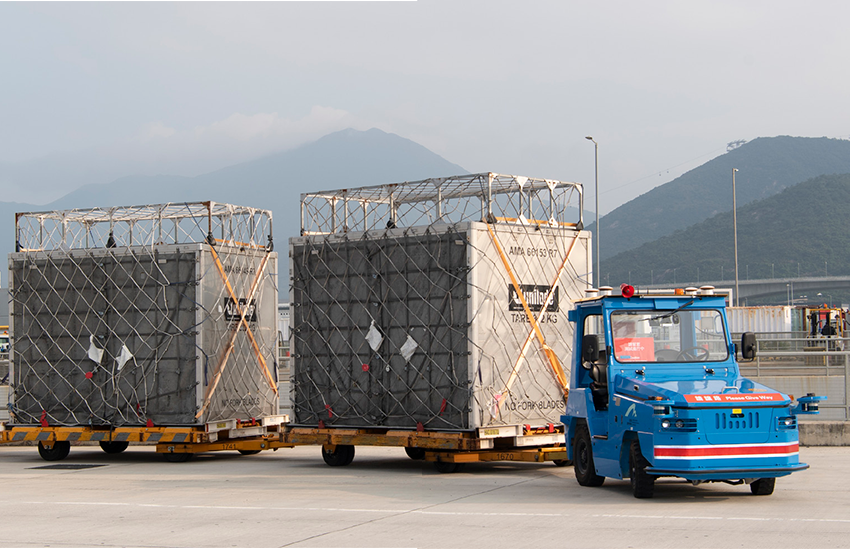
According to HKG, the “into-stand operation and point-to-point delivery” of the tractors enhance operational efficiency and save hundreds of driving positions.
Next up, the operation of autonomous tractors will be further extended to the air cargo terminals and other locations at Hong Kong International Airport.
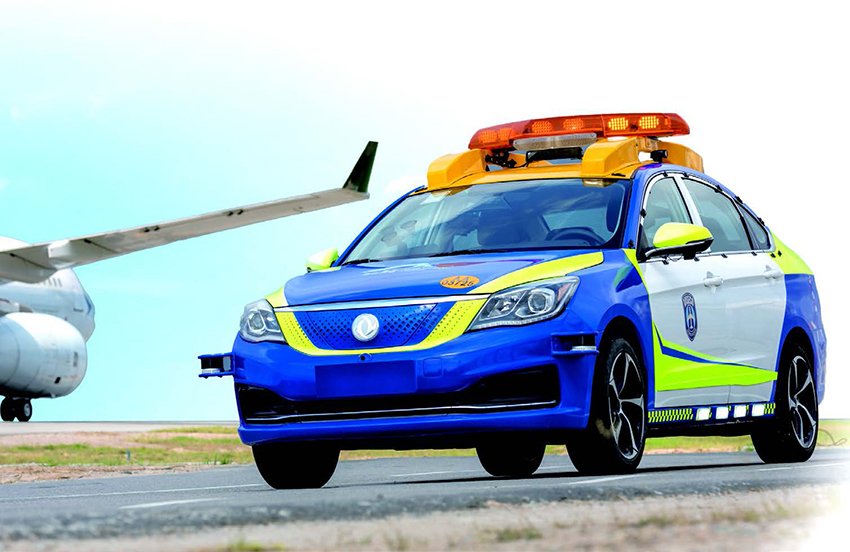
Another important group of the autonomous vehicle family at HKG are its Airport Patrol Cars, which perform duties on the perimeters of the airfield under all weather conditions.
These can automatically identify potential intruders within three metres of the security fences and trigger alerts at the integrated airport control centre.
The patrol cars are also able to detect abnormalities on the apron roads, especially irregularities on the razor wire fences, and alert the control centre.
NOVEL BUSINESS MODEL
AAHK’s executive director for airport operations, Steven Yiu, said: “When we first introduced autonomous vehicles to our operation in 2019, we didn’t only consider technical feasibility, but also the model of working with our business partners to make sure that the new solution would help their business.
“We realised that the crux was about helping business partners to save cost and increase efficiency.”
“With each autonomous tractor, on average, we can save four manual driving positions. Therefore 56 autonomous tractors would mean saving the cost of more than 200 drivers.
“In addition, the application of autonomous tractors and patrol cars helps to eliminate the risk of human error and miscommunication, ensure consistent and predictable service, and offer flexibility in adjusting daily operations capacity, thus enhancing safety and efficiency.”
Yiu said AAHK invested into the development of the technology behind the autonomous vehicles and built the fleet, all without asking airlines or ground handling agents for funding.
The autonomous vehicles can then be rented for “a reasonable cost”, enabling speedy take-up by business partners.
“This is a new model of running the airport business. AAHK as the airport operator built a platform, not for making profit but to enable our business partners to lower cost and gain efficiency. The efficiency gain will, in turn, benefit everyone,” added Yiu.
AAHK notes that the introduction of autonomous vehicles is also fundamentally changing the nature of some jobs at the airport.
With fewer drivers behind the wheel, for example, the airport can deploy more technical staff in control centres, while also nurturing talent for professional, managerial and software development roles.
AAHK collaborated with technology company UISEE Technologies from Mainland China to develop its autonomous driving solutions.
AUTONOMOUS BUSES
AAHK notes that its autonomous vehicle journey will go to another level later this year when passengers get to ride on autonomous buses on public roads at HKG.
The autonomous buses will shuttle passengers between the new Terminal 2 and the Hong Kong Port of the Hong Kong-Zhuhai-Macao Bridge (HZMB), a major link between Hong Kong and the Chinese Mainland and Macao.
Each vehicle will be able to carry 16 passengers and are initially expected to carry up to 500 passengers in each direction per hour before the figure rises to up to 2,000 people in the next phase of the technology’s development.
AAHK notes that it is developing the infrastructure to extend the service to connect with the mass transit system in the nearby town centre.
The airport’s confidence in its ability to extend the system is based on the fact that it has used autonomous technology to transport staff in restricted landside areas of HKG since 2023.
Indeed, for the last three years a fleet of highly safe and intelligent autonomous buses has been taking staff and employees to more than 20 working positions on the apron.
The six buses run on three designated routes on the apron, with lengths ranging from 2.8km to 5.5km each.
“Just like other members of our family of autonomous vehicles, these autonomous buses are equipped with state-of-the-art technology combining high performance, precision, and intelligence to deliver a smooth and reliable ride for passengers,” enthused Yiu.
“We are committed to building a safe, smart, and connected environment for all airport users.”