

Artificial Intelligence in Airports: Dawn of a new era

Share
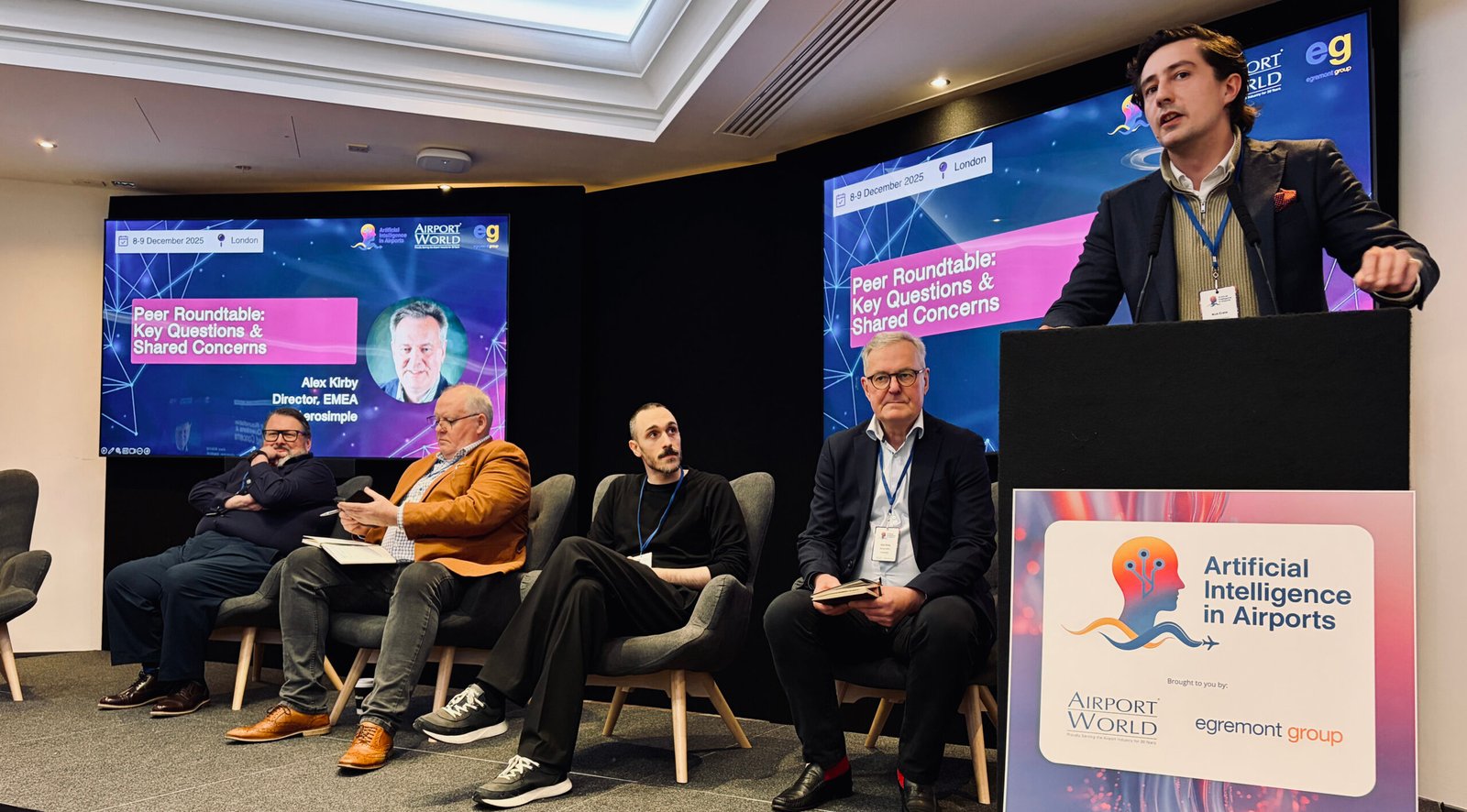
The power of AI, recognising that it isn’t all about replacing staff, and ensuring its safe adoption were just a few of the topics covered at the inaugural Artificial Intelligence in Airports summit in London.
A host of technology experts, start-ups, airports and AI solution providers gathered in Twickenham in London in December for the inaugural Artificial Intelligence in Airports summit.
Hosted by Airport World and the Egremont Group, the event set out to create clarity, form connections, and instil commitment around the role of artificial intelligence in airport operations, and it didn’t disappoint.
Indeed, many opinions were shared and much was learnt at the summit, including the revelation from one speaker that they know some airport CIOs who struggle with their home Wi-Fi!
The summit began with a welcome address from Nick Crane, Egremont Group’s senior consultant for airport operations transformation, who emphasised the transformative potential of artificial intelligence in reshaping airport operations and passenger experiences.
He was also quick to note that successful AI adoption depends not only on technology but also on leadership, timing, flexibility, and openness to change.
“AI is moving very quickly. Even some of the founding fathers don’t really know where this is going to end up, or where it’s going to take us,” Crane told delegates.
“But don’t fear, we’re all in it together, and let’s let this energise us, not fear us and scare us from what could be. Because we aren’t the spectators in this. We are the people making this happen.
“We decide how airports will be reshaped by new technologies. In this room today, we’ve got operators, innovators and strategists. We’re the ones who are running the world’s most complex operations day-to-day. We aren’t the people who should be shying away from this. We are the ones who are building it, and we have a say in how this will go.
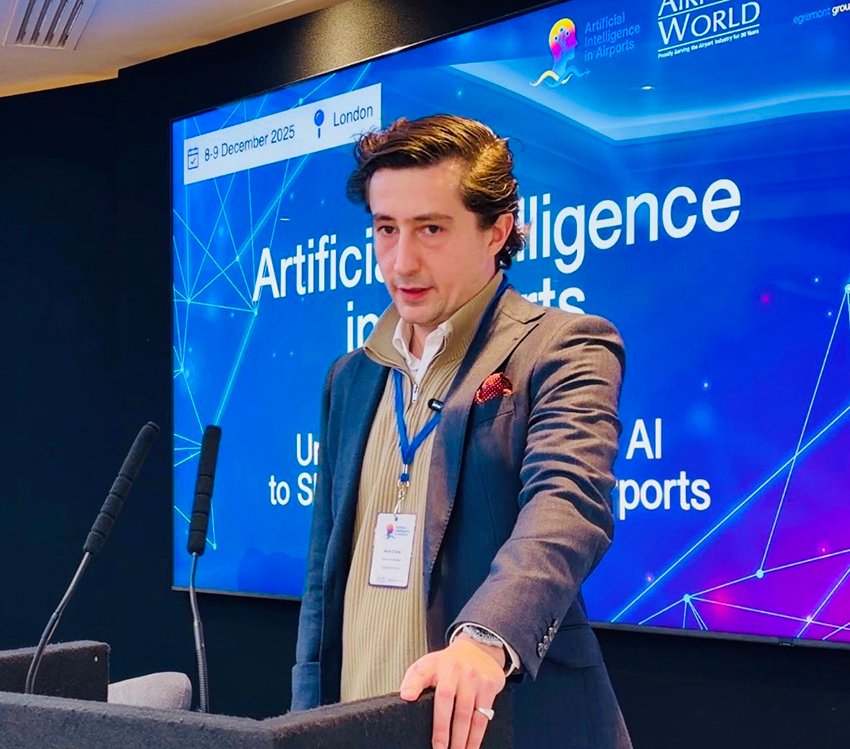
“AI is already here. It’s been here for many years, many decades, in fact, far earlier than most people believe and understand. But it’s more accessible now, it’s more visible, and it’s reshaping not just how behind the scenes operate, but how we all function and engage with services.
“It’s not just about the tech, it’s about people, the processes and how we lead. It’s the leadership, it’s the energy, it’s the timing, and it’s also the flexibility, not being too rigid, but also being open to what’s new and what’s possible.
“AI is already changing the expectations of passengers. It’s redefining how we expect things to happen, what we want and what value looks like.”
He was followed by Nikola Loncar, a self proclaimed ‘freelance technologist’ and former chief software engineer who stressed the importance of picking the right AI tools for specific tasks and understanding their limitations.
These tools, he explained, included machine learning, deep learning, large language models (LLMs) and Generative AI.
Loncar also discussed the evolution of artificial intelligence, its practical applications, limitations, and the importance of strategic leadership, infrastructure, and collaboration in implementing AI responsibly and effectively.
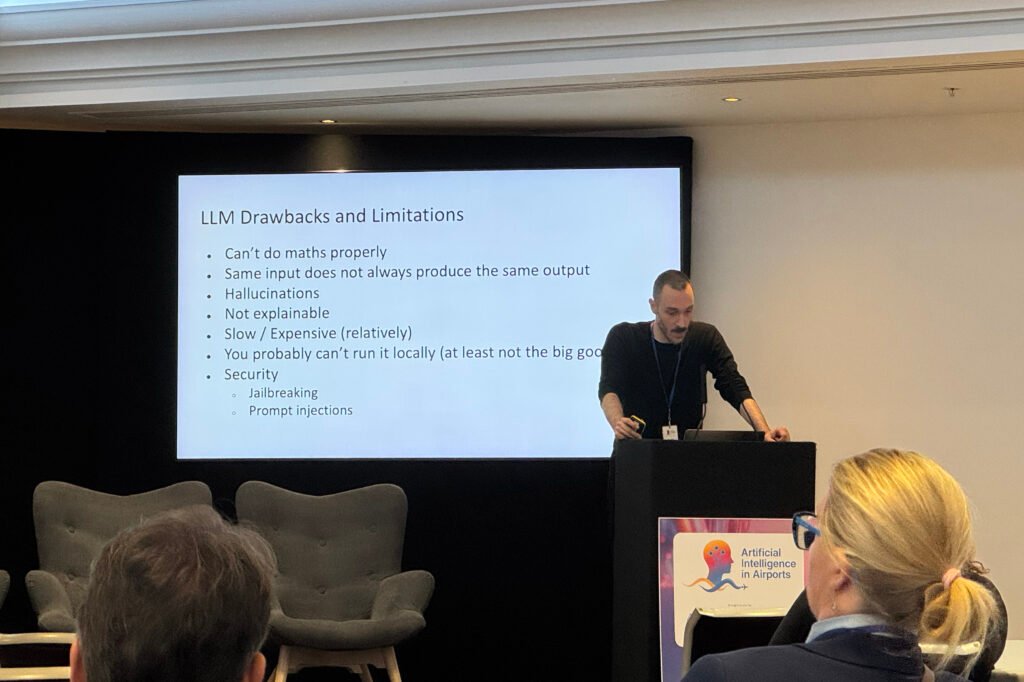
Key points included the importance of selecting the right AI tools, understanding their limitations, and integrating them into broader systems. Addressing the the capabilities and challenges of large language models (LLMs), Loncar – head of engineering at CleverChain – pointed out their inability to perform precise calculations, non-deterministic nature, and potential to hallucinate.
He said: “AI is not a silver bullet. There are still significant trade-offs to be considered when choosing your AI tools, or even if you use them at all. You know, what is the relative performance compared to other tools, especially non-AI. If you look at the cost per task and outcome, are you still getting a good deal?
“And also, very importantly, how much effort will it take to maintain it, especially in comparison with alternative options? Pick the right tool for the job.”
Next up was Auj’s chief technology and information officer, Brian Roche, who discussed the integration of AI in airports, emphasising the importance of data centres in powering AI and cloud services, and the need for airports to take control of their data and infrastructure to achieve better outcomes and improve efficiency.
He noted the potential for using AI to improve the passenger experience and boost non-areonutical revenues, highlighted the challenges of siloed procurement, and the need for a unified approach to using machine learning and software-defined networking (SDN) to improve the conectivity of the whole airport.
He also discussed the potential of biometric systems, such as India’s Digi Yatra facial recognition system, and the benefits of using low-power networks like LoRaWAN for cost-effective sensor management.
In addition, he warned of the risks of going for quick fixes and outsourcing contracts where airports weren’t in control of their own data as taking control of the data and infrastructure would achieve better outcomes and improve efficiency.
He said: “Maybe I’m a bit too practical, but I look for profit. I look for return on investment. So, what we look for as a company is to ensure that the clients own their own network, and that’s the whole network, everything. Facilitation, everything, black box solutions.
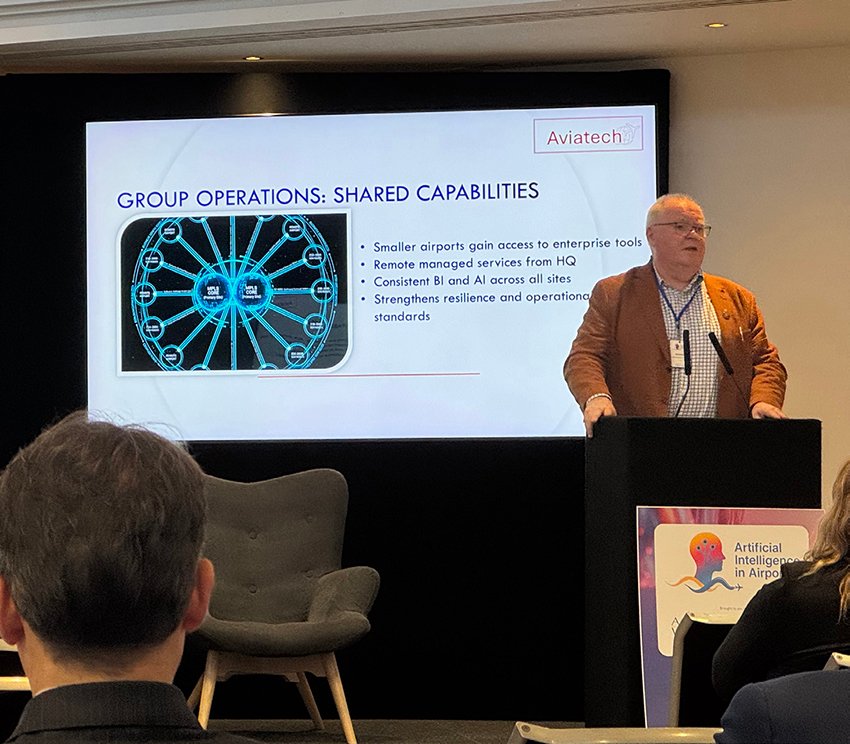
“Think of those people that run Heathrow and Gatwick right now, the operational systems, the black boxes. You guys don’t own the data, the outsourcer does.”
Giving an example of the savings that could be made by making better use of technology, Roche said: “I can give you some realistic stuff here. Take an airline with a fleet of 900 airplanes. If you can save them one minute on their flight, one minute on their turnaround, at a conservative shout you could save them $50 million a year.
“You could push it higher, because what we never do is measure the benefits. We measure a solid number, which is the cost of the turnaround, which is the cost of maybe losing a slot. But actually, when you look at the fuel that can be saved, when you look at the cost of the electricity, because obviously we’ve got chillers to the airplane and condition of power, it’s about $90 million a year, just for a one-minute saving, across the entire fleet.”
Giving another example of why airports need to be more on top of and in control of the technology installed in their facilities, Roche revealed that although sensors cost as little as £75 to install in an airport, it can cost upwards of £7,000 to replace each one due to the equipment and manpower needed to do the job.
And a big international airport may have as many as 22,000 sensors that do everything from monitoring passenger flows, enhancing security operations and sending messages to passengers to heating or cooling buidings across the airport campus.
“You can guarantee that 5% of an airport’s sensors are out at any one time,” he noted. “Why? Because the contracts were bought in silos, and they were on 15-year contracts. Five years parts and labour, the first five years. Second one was parts only. Third one is call us and we’ll do a call out for you.
“So, what happens when you’ve got 22,000 sensors and you’ve got 5% or 10% of them out. The cost of repair is staggering.”
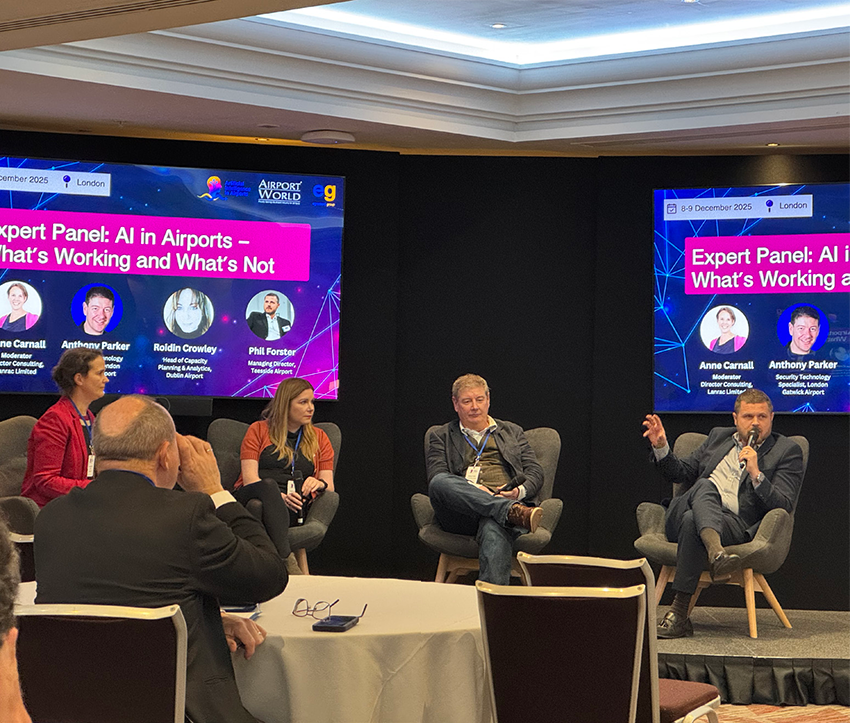
The first panel of the day was an all-airport affair that comprised London Gatwick’s security technology specialist, Anthony Parker; Teeside Airport’s managing director, Phil Forster; and Dublin Airport’s head of capacity planning and analytics, Roidin Crowley.
And, as you would expect, the discussion focused on AI deployments in aviation. Dublin Airport is using AI for its short-term forecasts, Phil Forster revealed that Teeside Airport is a test bed for cargo and logistics technology, and London Gatwick’s Parker looked at the challenges and opportunities of AI from a security perspective.
Dublin’s Crowley admitted that her airport was “fairly immature” in the implementation of AI installations, although one of the things it does use it for is to make short-term forecasts.
“It’s the biggest success we’ve had with AI to date,” she enthused. “We get our forecast yearly for the budget, and we use machine learning to get a 30-day short-term forecast.
“It has an awful lot of inputs from the operation. But then it also brings in recent trends in terms of presentation times, different passenger profiles, and all of the booking information, and predictive booking information from the airlines as well.
“It’s working really well. It learns from the passengers andby terminal, so that’s absolutely made our forecast perform an awful lot better. Before, we had a kind of 7% swing either side in terms of the numbers, whereas now it’s within 2%. So big credit.”
Crowley revealed that the airport operator also uses machine learning algorithms to predict staff performance and optimise staffing levels. She noted that the regulatory environment in Ireland limited the use of AI in threat detection at security lanes.
Teeside Airport’s Forster explained how his airport is located within Teeside Freeport, and this has led to it becoming a ‘digital trade testbed’ for new technologies such as autonomous vehicles and cargo and logistics software/equipment to enhance operations, particularly to six Amazon fufilment centres within 10 miles of the gateway.
From a security perspective, Gatwick’s Parker revealed that the heavily regulated nature of security meant that the gateway could only use AI for the things that it has control over, which he noted was very limited.
“Basically, we look at things like staff on screen, understanding how many lanes we need to have open, and how many people are needed on each lane, all of which is very important as we actually get fined by the CAA if our queues become too long,” said Parker.
“So, just by being able to invest in AI to help develop the model and to make the models better by having the right number of people on at any particular time, saves money in itself.
“The biggest area where we’d like to see AI come in is in the areas where we don’t have control, and that’s on algorithms that could automatically detect threats.
“The development of neural networks and machine learning means that there’s a lot of algorithms out there now that will look at the X-ray image and identify a threat. They can do the job of a screener, but because it’s a regulated area, and the government actually owns the risk, although we are using machine learning to train the algorithm, once the government tests that algorithm, it’s no longer using AI.
“So, every time it makes an error and says that something is a threat and it isn’t, it’s not allowed to learn that, so it just stays in place until we give data to the manufacturer. Then, they have to go through a process of retraining, then reapplying to the regulator for testing, then that has to get approved.
“So, whether we’d like to see automation come in, between an algorithm being deployed and a new algorithm coming in, it could be a year, and in that year, you’ve just got all this data that’s not being used.”
Talking about some of the biggest potential benefits of AI for Dublin Airport, Crowley said: “For me, the biggest opportunity we have with AI when it comes to security is for people profiling. Whether that’s using sensors or training CCTV to pick up whether you’re a passenger, a security officer or member of staff, for example, among the swarm of people that arrive in the airport.
“I want to know where they are, who they are, how many of them there are, and how many of our staff need to be there to process them. If we know a swarm is coming, we can send the cleaning team to make sure that the toilets are spick and span for them, and then to come in clean them again after they’ve left.
“It’s all about following the passengers through with all of our assets, people and physical assets to make sure that they’re all absolutely tip top for when the passenger is actually going to be in that area.”
Overall challenges for airports include data integration, stakeholder engagement, and regulatory constraints.
The conversation highlighted the need for responsible AI adoption, emphasising the importance of clear governance, ethical considerations, and continuous monitoring to ensure safety and efficiency.
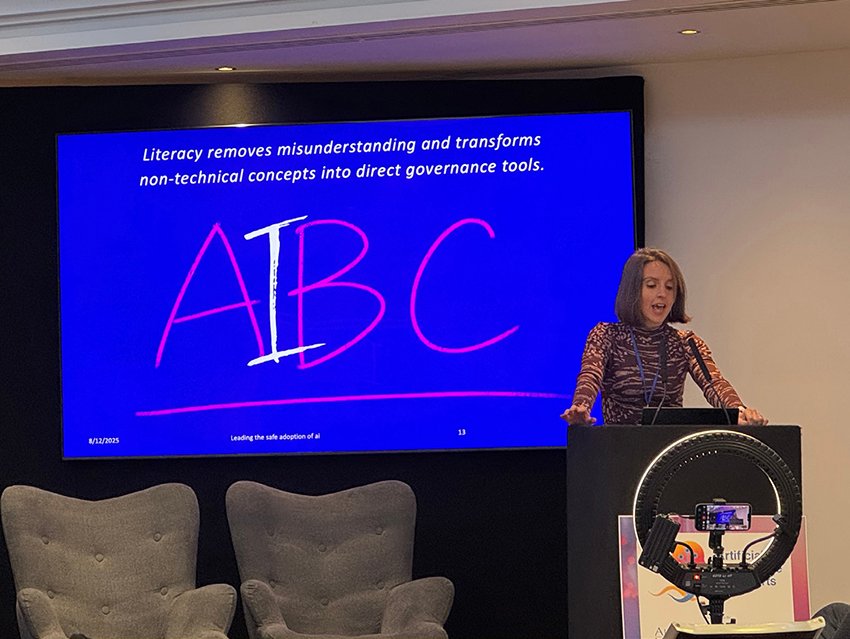
Member of the Digital Responsibility Forum, Rebecca Rothwell, took centre stage in the last session of the morning when she addressed the critical issue of the safe adoption of AI, and how humans have to ensure that we are always the ones in control of technology.
Summimng up, she noted: “AI is our co-pilot. It handles the data, the patterns, the consistency. The human leader remains the captain.
“They command the context, the ethics and therefore the ultimate operational authority. And this is the model for safe AI adoption in aviation. Safe adoption means putting AI in a supporting role and keeping humans in unambiguous control.
“AI is advancing rapidly and will continue to do so. It offers genuine gains for your businesses. But the path to realising these benefits isn’t found in mastering algorithms. It’s found in mastering governance and leadership.
“Your challenge is not technical. It’s strategic and cultural, guided by ethics. It’s enforcing governance and accountability from the start. It’s promoting clarity and literacy on AI’s limits.
“It’s about establishing the ethical framework iteratively and using that to guide safe, high-value deployment. And it’s cementing the message that AI is a partner to human expertise, never a replacement for it. Safe adoption is not a barrier to innovation. It’s the only stable foundation upon which transformative innovation can be built.
“By leading with foresight and prioritising governance, you’re going to unlock the immense benefits of AI, while protecting the trust and safety that underpin global aviation.”
In the Innovation Slot that followed, NW PRO’s managing director Jay Richards used his time on the podium to highlight the benefits of integrating the thousands of sensors spread across airport sites and combining them with AI to “generate real value” for operators in terms of operational efficiency, security optimisation and revenue generation.
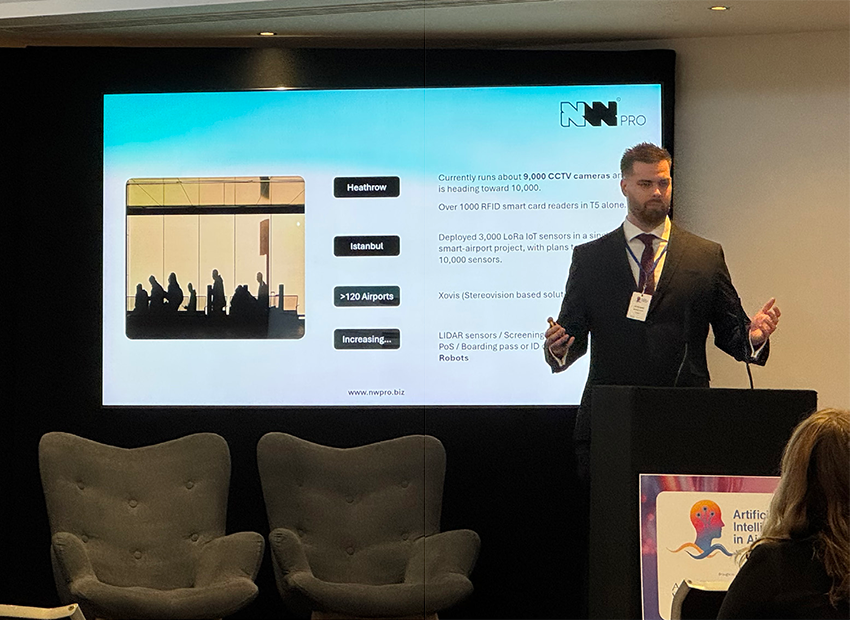
Revenue wise, he reminded delegates that ACI World’s ASQ survey showed that a 1% increase in passenger satisfaction levels at airports effectively equated to a 1.5% rise in non-aeronautical income.
He also noted a US study that found that if you can increase the dwell time in retail areas by around 10%, you typically get a 5% increase in non-aero revenue.
NW PRO’s solution for airports is called SensorSync, a real-time digital twin and sensor platform that connects CCTV, LiDAR, RFID and other systems into a single intelligent 3D replica – enhanced with AI for tracking, understanding and operational insights.
All eyes were then on Jesús Caballero Pinto, CEO of Sofia Airport (SOF), who told the audience more about the planned growth and development of Bulgaria’s main gateway to the world, with new technology and the holistic roll out of AI set to play a big role in its journey.
Central to SOF’s future is a new €250 million Terminal 3 that Pinto described as a “game changer” and “Europe’s 5-Star regional hub” built around high efficiency and a superior passenger experience.
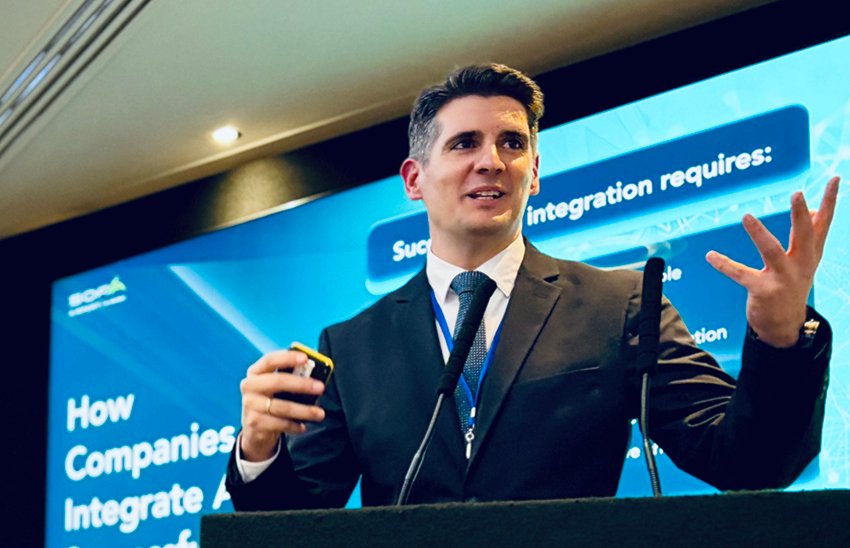
The integration of 5G technology and autonomous vehicles in airport operations are on the agenda, along with the use of drones for security and efficiency and the potential of AI to automate processes like baggage handling and predictive maintenance.
On the revenue generation side, Pinto highlighted the importance of mapping passenger flows to enhance retail strategies and detect fraud.
He felt that the location of the Instutute for Computer Science, Artificial Intelligence and Technology (INSAIT) in Sofia gave the airport an edge in its AI ambitions, noting that a supportive aviation ecosystem was key to helping SOF achieve its goals.
Next up was Simon Wilcox, the CEO of Wordsworth Consulting and former transformation lead for Heathrow Airport, who covered approaches to embracing AI in airports, from concept to impact.
A highly enjoyable first day ended with an impromtu roundtable chaired by Aerosimple director, Alex Kirby, with Dean Willard, a partner with Imagine Wireless, joining earlier panelists Nikola Loncar and Brian Roche to address some of the key points of the day.
All agreed about the huge potential of AI to improve airport processes, the need for a holistic approach to connectivity, and the importance of understanding and mitigating supply chain risks.
They also touched on the challenges of adopting new technologies while maintaining safety and security, and the potential impact of AI on future airport operations.
Willard noted the importance of thinking about connectivity holistically and matching use cases with the appropriate connectivity. He also highlighted the regulatory differences between the US, UK, and EU, with the UK and EU having more spectrum reserved for private LTE and 5G.
Aerosimple is a cloud-based digital transformation platform for airports and airlines currently is use at 150 plus airports cross tne world today, including more than 100 in the United States.
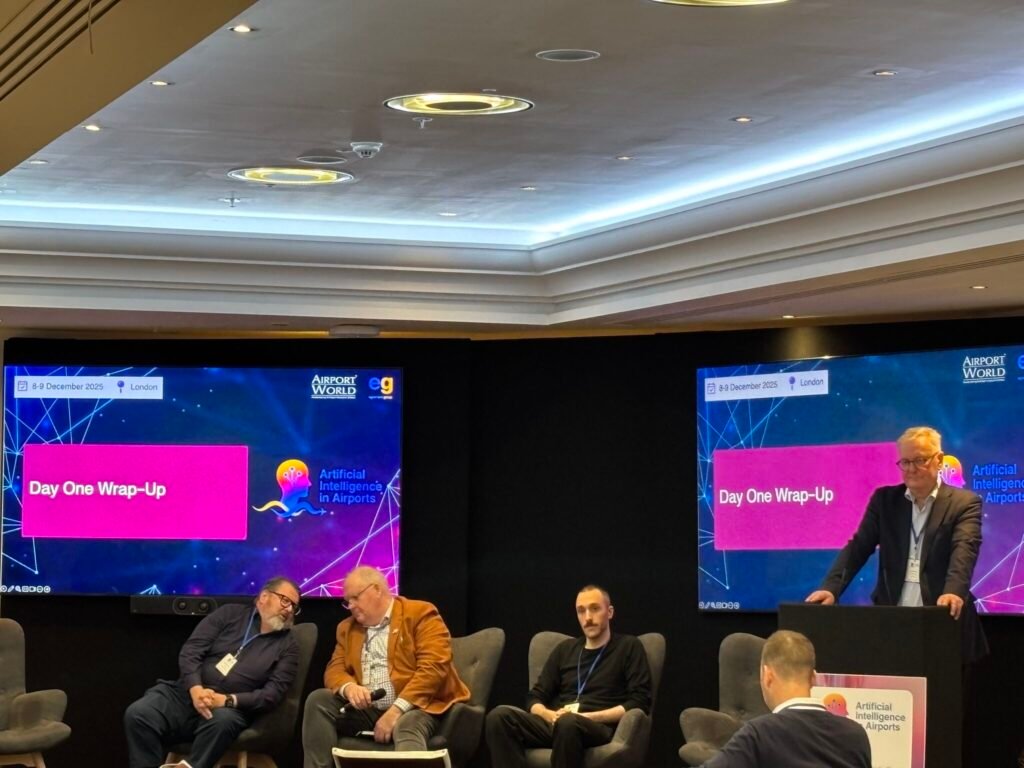
Introducing his company, Kirby said: “Aerosimple plays an important role, I think, in preparing airports to be ready for a high in terms of digitising every single facet of the airport’s operation, putting it onto a single platform, and allowing each of those areas of the airport to speak to one another and report to one another.
“So, it does away with silos. As far as I’m aware, there’s no airports in the world that have got to this point yet, but there are a number that are a long way down that road.”
Day 2 of the summit featured presenations from Inovivo founder and CEO Sharon Prior; Dimitri French, the former AI and data lead for Google and Amazon; and Alex Devine, manager with Egremont Goup. Prior, Heathrow’s former director of technology, spoke about ‘The Future Intelligent Airport: From Vision to Reality’; French covered the topic of ‘Navigating Strategically in an AI-Driven Future’; and Devine told delegates more about ‘The DNA of Change: Transforming Airports in the Age of AI’.
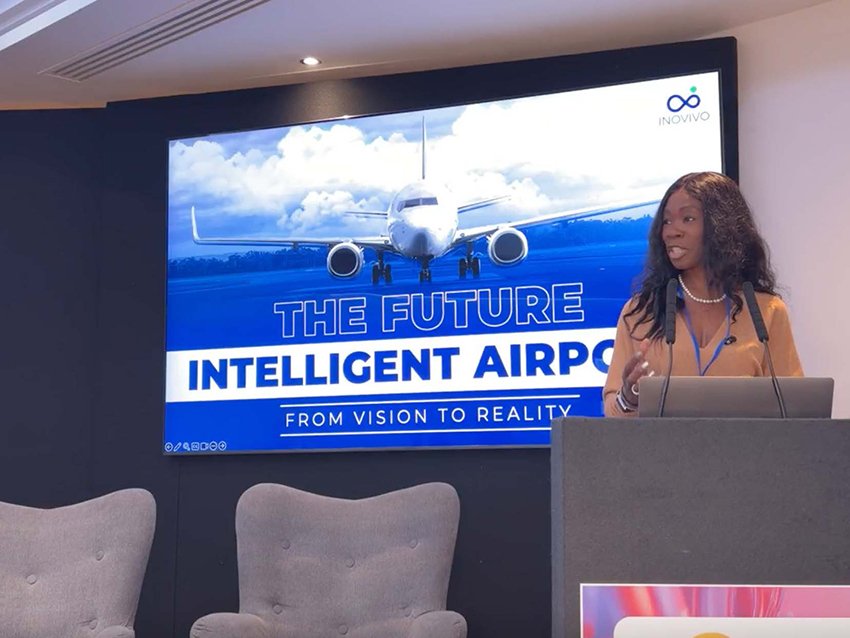
In her presentation, the Prior examined how data, AI, and systems design will create frictionless passenger experiences; drive operational efficiency and resilience; and enable cleaner, safer, ethical, sustainable aviation.
In between them Illuminex AI and Danlex took centre stage by telling delegates more about their impressive industry solutions in separate Innovation Showcase presentations.
Illuminex AI’s chief innovation officer, Daniel Connolly, shared insights from deploying FOD AI in complex, data-scarce airside environments.
He highlighted how airside teams can leverage AI to maintain safety and operational efficiency, even when data is limited, and the challenges of integrating machine vision into live airport operations.
Indeed, deploying AI in these environments demonstrates how technology can adapt to operational constraints and deliver actionable insights that help teams make faster, smarter decisions on the ground.
Danlex turned the conversation towards AI-driven maintenance solutions for X-ray systems, more specifically the PM4X which can predict equipment failures before they happen, reducing downtime and boosting efficiency.
Summing up, Egremont’s Crane noted: “The discussions across the two days showed a clear direction of travel: airports are moving beyond early exploration and into more structured, deliberate adoption of AI, grounded in shared learning and real operational needs. We look forward to building on this progress in 2026!”