



Incheon International Airport: Hydrogen hub

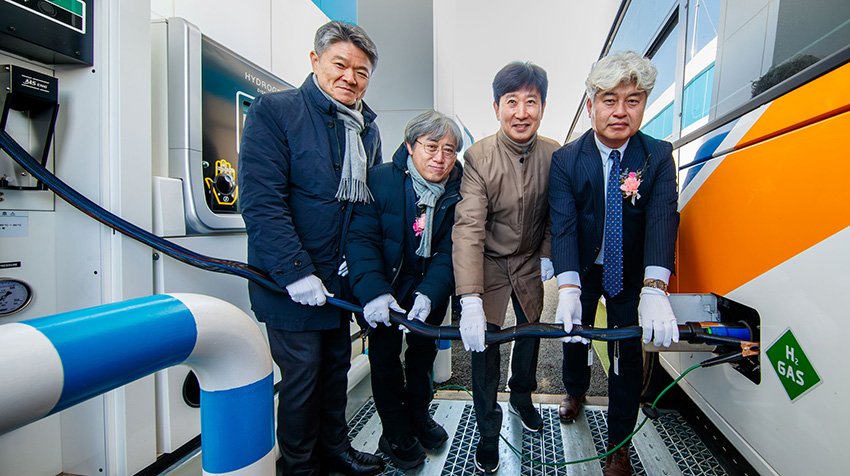
Ever innovative Incheon has more liquid hydrogen charging stations for vehicles than any other airport on the planet, writes Joe Bates.
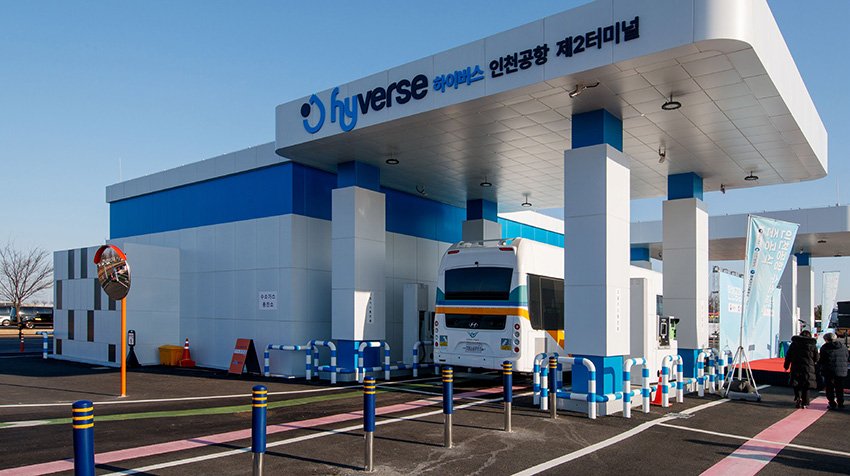
When Incheon International Airport (ICN) embraces a challenge, it does so whole heartedly and without compromise, which is why nobody should be surprised to learn that it is now home to the largest liquid hydrogen hub at an airport with more charging stations than any other gateway.
And, according to operator Incheon International Airport Corporation (IIAC), it is making a real difference at the South Korean hub.
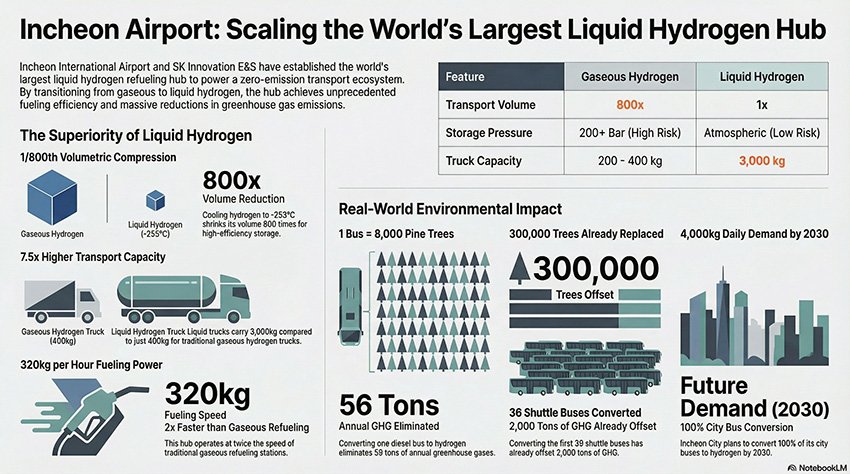
The brand new facility features a liquid hydrogen charging station capable of fuelling up to 240 hydrogen buses per day, which combined with two existing stations means that ICN can now deliver a world-first of 420 kilogrammes of hydrogen per hour.
The $200 million public-private partnership (PPP) project involved the participation of South Korea’s Ministry of Land, Incheon Metropolitan City, and major energy companies.
Located at Terminal 2’s bus garage, the new state-of-the-art liquid hydrogen fuelling hub is currently handling around 40 buses daily, easing congestion and wait times across the airport for the airport fleet of 115 hydrogen powered vehicles.
To date, 36 of ICN’s 68 shuttle buses have been converted to hydrogen from petrol or diesel, the move alone reducing more than 2,000 tons of greenhouse gasses every year, the equivalent of planting 288,000 pine trees.
Looking ahead, the airport plans to add seven more hydrogen buses this year and expand its charging facilities by 2028 to meet growing traffic demand projected for 2030.
Explaining a little about the airport’s renewable energy strategy, IIAC’s director for international relations, Vin Kim, says: “To keep pace with global efforts to become more eco-friendly, we have established and implemented a management strategy focused on energy transition.
“Our goals are to transition to solar-electric renewable energy for airport buildings in line with our commitment to the RE100 initiative led by Climate Group, and transition to hydrogen-powered vehicles and buses for transportation.
“Hydrogen offers shorter refuelling times and longer driving ranges compared to electric vehicles (EVs).
“We have initially prioritised converting general shuttle buses to hydrogen, with the added benefit that it allows passengers to directly experience the airport’s eco-friendly initiatives.
“As a result of this strategy, we are actively installing and operating hydrogen refuelling stations as critical infrastructure to support the transition of route buses connecting the airport to the Seoul Metropolitan Area.
Converting so many vehicles to hydrogen and investing in its own transport hydrogen hub is certainly a bold step forward for the airport and a strong signal that Incheon Airport is serious about leading the global shift to cleaner, greener aviation.
And with 172,000 vehicles travelling to and from the airport every single day, IIAC is more than aware of the need to reduce CO2 emissions.
Is the long-term plan to make revenue from the hydrogen hub by selling liquid hydrogen to third party customers on, and possibly off airport?
Vin Kim says: “This is not a consideration at the moment as the production and sale of liquid hydrogen is a business that requires specialised production facilities.
“Currently, these activities are being managed and operated by specialised private sector companies.”
Looking at the bigger picture, is Incheon on target to reach zero emissions by 2045?
Without hesitation, Kim relies: “Yes, we are faithfully implementing our roadmap to achieve carbon neutrality.
“Key milestones and actions in this journey will include our RE100 membership, the phased transition of all shuttle buses and corporate vehicles to eco-friendly models, and the more widespread use of sustainable aviation fuel [SAF].
“SAF is core to decarbonising for the aviation industry. We are working in close co-operation with the government and the airlines to introduce SAF. This includes implementing policies to gradually increase the fuel blending ratio.”