

The future is now

Share
Ambitious plans for new terminals, imminent openings and longer term airport projects ensure that it has been a busy end to the year for infrastructure development, writes Joe Bates.
With traffic growth now firmly back on the agenda, the race is well and truly on to ensure that the world’s airports are equipped with the infrastructure they will need to handle increased demand, and raised passenger expectations, over the coming decades.
In most cases this means new or upgraded terminals, runways and cargo facilities as well as embracing technology that will improve operational efficiency, simplify passenger journeys and enhance the airport experience.
But it also includes new airports, such as the under construction Western Sydney International Airport (WSI) in Australia, CPK megahub in Poland, and the soon-to-open Noida International (DXN) and Navi Mumbai (NMI) in India, as well as other infrastructure such as new ATC towers, parking garages, Consolidated Rent-a-Car (CONRAC) facilities, Ground Transportation Centre’s and access roads.
It is not always the case, but when passenger numbers are on a steep upward trajectory, the timing of building and opening new infrastructure can make the difference between an airport struggling to cope with demand or flourishing, with new facility’s often proving the catalyst for growth.
Below are some examples of new facilities that are either planned, being built, newly opened, about to open or are possibly a pipe dream. They include the proposed new airport on the outskirts of Bucharest, Romania, and Cambodia’s new state-of-the-art Techno International Airport.
ON THE DRAWING BOARD
Despite plans to build a new terminal at Bucharest’s existing Henri Coanda International Airport (OTP), investors have unveiled plans to construct a second gateway for the Romanian capital in Adunatii-Copaceni in Giurgiu County, approximately 40 kilometres from the Bulgarian border.
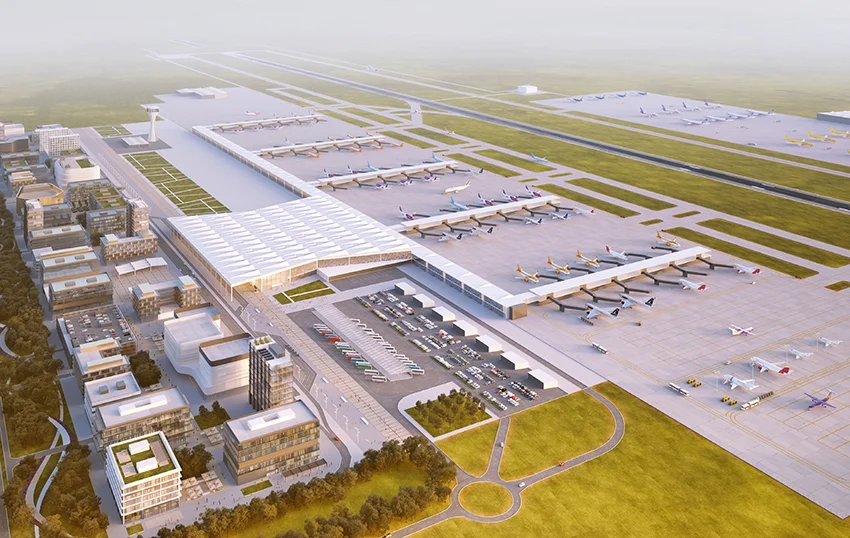
Provisionally called Binghatti Aerocity, the proposed new international airport (pictured above) in the southern metropolitan area of Bucharest is moving forward with strong governmental backing and international collaboration, including design input from leading UK firm Scott Brownrigg.
This ambitious project, initially aimed at alleviating capacity constraints at OTP before potentially replacing it, promises to transform Romania and Eastern Europe’s connectivity and economic growth by developing an airport ultimately capable of handling up to 40 million passengers and 500,000 tonnes of cargo per annum.
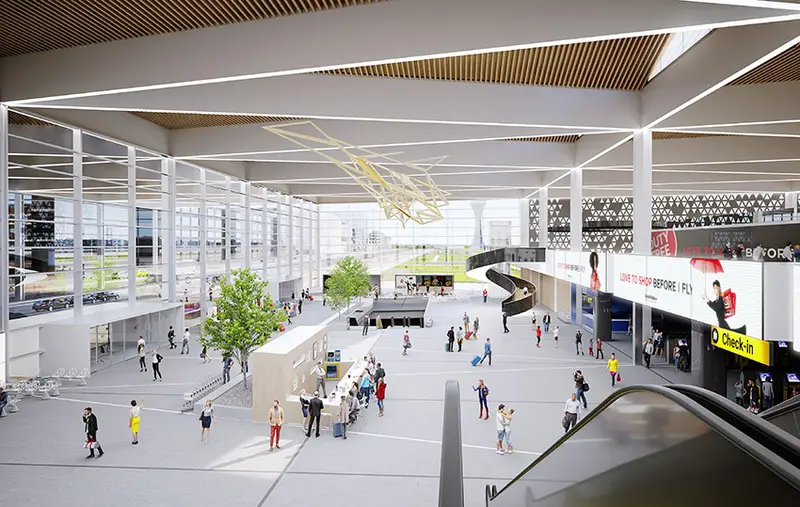
Being developed by a joint venture between Jetstream and the Property Sud Invest, the plan is to construct the airport in three phases over the coming decades, opening with an initital capacity of 12-15mppa and 100,000 tonnes of cargo in 2028.
To date, over 2,000 hectares of land have been secured for the airport, plus an additional 35 hectares for an associated port facility, with no major objections from key landowners.
It is reported that the project enjoys widespread support from the relevant local authorities, including the host municipality, Giurgiu County Council, Bucharest General Municipality, and Sector 4 Municipality.
Investment in the project has already surpassed €150 million, with a total projected commitment of €2.5 billion required to bring the full vision to life.
Site work is expected to commence once initial funding milestones are met. Its developers claim that major airlines operating in Romania have shown keen interest, including market leader Wizz Air (over 50% share), Ryanair, and Turkish Airlines.
Additionally, international carriers such as Indigo, Scoot, and other Asian airlines have expressed enthusiasm for launching new routes from the facility.
Project director, Dorin Catana, says: “Binghatti Aerocity will be positioned as the principal airport of Bucharest and of Romania, serving as the country’s new international gateway.
“We estimate that the construction permit will be obtained by mid-2026, with construction expected to take approximately two years. Accordingly, the targeted opening is around 2028, with subsequent expansion phases aligned with the projected future growth in passenger and cargo traffic.”
To ensure seamless accessibility, the JV behind the gateway note that critical transport infrastructure is being prioritised.
For example, the recently completed southern Bucharest Ring Road will be connected directly to the new airport, and there are bold plans for a monorail project, spearheaded by the Mayor of Sector 4, to link the site to central Bucharest.
Furthermore, the nearby main railway line is undergoing modernisation, complemented by a refurbished adjacent station.
The project’s international stature is bolstered by key partners Wall Street Capital Partners and Surbana Jurong. Prominent figures from Wall Street Capital Partners, including Douglas Anderson and Stephan Moore, have been instrumental in advocating for the development through media engagements, emphasising its financial robustness and global appeal.
“This is more than an airport; it’s a gateway to Romania’s future prosperity,” says Anderson. “With the expertise of UK-based Scott Brownrigg in our masterplan, we’re ensuring world-class design that will position Bucharest as a premier European hub.”

OPEN FOR BUSINESS
Arguably the biggest of all the new openings in the second half of 2025 was Techno International Airport, which replaced Phnom Penh International Airport as Cambodia’s main international gateway in early September.
Designed by Foster + Partners, the new terminal building is said to embody Cambodia’s long-term vision for growth.
According to Foster + Partners, it also evokes a strong sense of place, drawing inspiration from one of the oldest civilisations on earth, inspired by its vernacular forms, and responsive to the tropical climate.
Its head of studio, Stefan Behling, said: “Techo International Airport is a celebration of Cambodian culture and light – forming a new gateway to the country.
“It is also one of the most sustainable airports in the region, filled with natural daylight and incredible local greenery, and offering strong visual connections to the outside.
“The terminal holistically transforms the experience of travel for the people of Cambodia and the millions of visitors who will travel through here every year.”
While Nikolai Malsch, senior partner, Foster + Partners, said: “The modular lightweight shell structure and layered soffit filters daylight into the building – allowing people to experience the evolving qualities of the external environment throughout the day.
“Our design blends technological innovation with references to Cambodia’s built heritage. Interior materials are warm and welcoming to ensure the highest level of passenger comfort, while reinforcing the country’s unique identity.”
Located 20 kilometres south of the city centre, the terminal building comprises a central head house and two aerofoil shaped piers. The first phase of the project – the head house and northern pier – opened to the public in September.
The southern pier is planned to open by 2030. The terminal layout prioritises short walking distances, clear sightlines and simple orientation, allowing passengers to navigate through the building with ease.
Passenger processing, security and immigration, and retail are sheltered by a single overarching roof canopy that stretches from the drop-off to airside.
The modular roof is supported by structural ‘trees’ that each span 36 metres. According to Foster + Partners, the roof has an undulating form that crescendos at the centre of the building, echoing Cambodia’s spectacular palaces and temples.
It adds that throughout the terminal building, soffits are inspired by traditional basket weaving. Suspended under the building’s lightweight steel grid shell structure, a latticed soffit filters daylight into the vast terminal space throughout the day.
Around 180 skylights are strategically placed around structural ‘trees,’ to bring natural light deep into the space while ensuring it is distributed evenly.
Greenery follows the passenger journey through the terminal, with native Romduol trees rising within the soaring central void, alongside local palms and flowers, which contribute to a strong sense of place.
Materials are said to be warm and welcoming, evoking the local vernacular in a contemporary manner.
A collection of 200 hand-crafted sculptures, as well as a centrepiece bronze-cast Buddha, have been carefully curated to celebrate the country’s history and evolving identity.
The project aspires to be one of the greenest airports in the world by seamlessly integrating architectural design and engineering to reduce the project’s carbon footprint significantly.
Elsewhere in the world, in the US, more than 300 guests gathered at Pittsburgh International Airport (PIT) on October 11 for a Ribbon Cutting Ceremony for its highly anticipated new state-of-the-art terminal, which opens to the public this autumn.
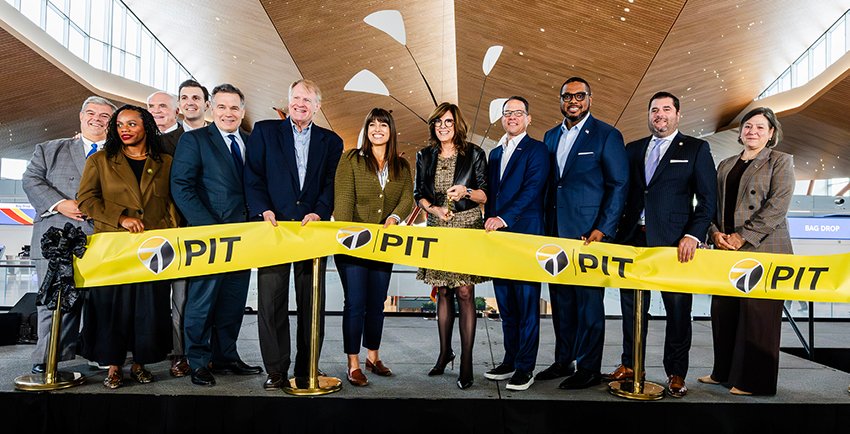
The ceremony symbolised the culmination of a collective effort to create a new PIT terminal that reflects Pittsburgh’s identity and embodies its future.
The project, which broke ground in 2021, was backed through unanimous support of PIT’s airline partners, which are covering the majority of the $1.7 billion cost. No local tax dollars were used to fund the project.
It is the centrepiece of PIT’s transition from a hub connecting passengers from around the country to an origin-and-destination (O&D) airport tailored to better serve the Pittsburgh market.
Rather than being a hub with one dominant carrier, PIT has leveraged its airline relationships to diversify its air service portfolio by adding a plethora of legacy, low-cost and ultra-low-cost carriers to align with its O&D strategy.
Inside and out, the terminal includes features that are visually striking and functionally innovative.
The terminal is designed to capture the essence of the Pittsburgh region. The rolling roofline mimics the region’s hills, and its structural tree columns and terrazzo flooring’s intricate leaf patterns, created by artist Clayton Merrell, reflect the region’s forests.
Perhaps most striking is the terminal’s constellation lighting – featuring more than 4,000 lights – that emulates the night sky, creating a spectacular effect that is visible inside and outside of the building.
Unique among US airports, the terminal includes four outdoor terraces— two pre-security and two post-security —giving travellers a chance to enjoy fresh air during their journey.
“The building design was always aspirational. It was meant and designed to work for everyone, for actual people who travel through and work in an airport,” enthused PIT CEO, Christina Cassotis.
“But the building itself, if you look at it now, I think is actually inspirational. Being in this space feels good, and that’s a pretty big statement for an airport today.”
In South America, Santiago’s Arturo Merino Benitez International Airport in Chila, a member of the VINCI Airports network for 10 years, has inaugurated the final phase of the on-time delivery of the Domestic Terminal (T1) expansion and renovation project.
The $60 million investment significantly increases the airport’s capacity, which can now accommodate up to 20 million passengers per year, in response to the 56% increase in domestic traffic since 2015, when VINCI Airports took over management of Santiago Airport.
This is the final stage of the concession contract signed by VINCI Airports with the Chilean government in 2015, aimed at positioning the country as a major hub in Latin America.
“This inauguration celebrates 10 years of successful partnership between VINCI Airports and Chile, supporting the growth of Santiago Airport as well as the country’s economic and tourism development. Since 2015, passenger traffic has grown from 17 million to over 26 million by 2024, and demand continues to grow,” notes VINCI Airports.
They new additions also include the new International Terminal at Newcastle Airport in Australia, which was officially opened in late September. The completed terminal is expected to deliver A$12.7 billion in economic benefit over the next 20 years and more than 4,000 jobs
UNDER CONSTRUCTION
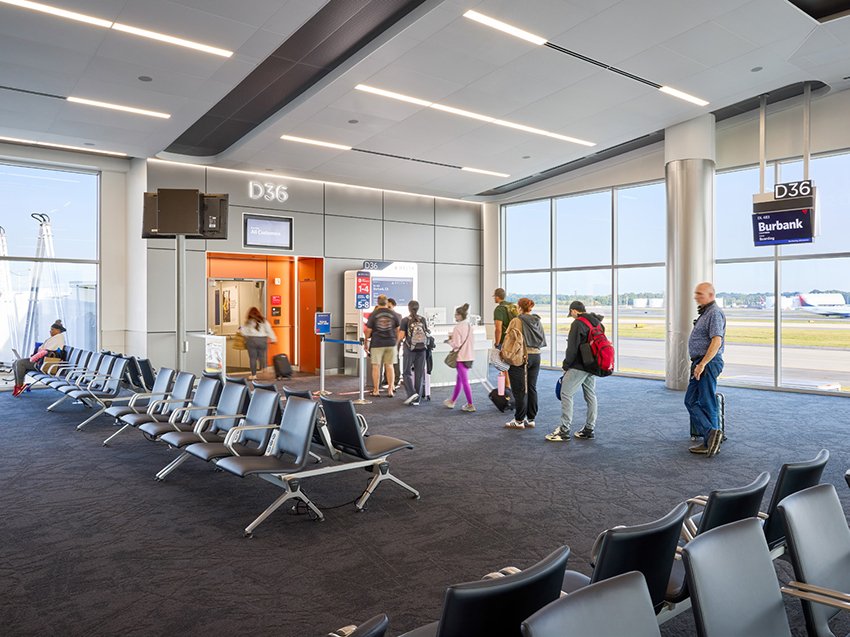
In the US, Hartsfield-Jackson Atlanta International Airport (ATL) has completed phase two of a $1.4 billion modernisation project that will increase the size of Concourse D by more than 60%.
Incorporating modular construction, the project will result in an 18% increase in available airline seats — critical for the world’s busiest airport, which transported more than 108 million passengers in 2024. Passengers are now able to experience the new design, as the first five gates have officially opened to travellers.
Built in the 1970s for small regional aircraft, Concourse D is the airport’s narrowest concourse. It is being modernised to accommodate larger airplanes and regional jets for the Delta hub.
To keep the airport fully operational – maintaining revenue and minimising disruptions – the project is using an innovative method of modular construction. Giant modular sections are prefabricated offsite and transported by high-tech equipment to comprise the concourse core and shell.
Functioning as building blocks, the steel modules are inserted into frames.
Elsewhere in the country, the Port Authority of New York and New Jersey (PANYNJ) has broken ground on a new AirTrain Newark system at Newark Liberty International Airport, launching construction of a modern, reliable 2.5-mile automated people mover.
The new $3.5 billion system will replace the existing AirTrain, which opened in 1996 and has become outdated, over capacity, and unable to accommodate Newark Liberty’s rapid growth.
The new AirTrain system will allow for expanded passenger capacity, greater reliability and flexible connectivity in conjunction with the airport’s redevelopment plan. It is expected to begin operation in 2030.
“Breaking ground on a new AirTrain system marks another milestone in the complete transformation of Newark Liberty International Airport into a world-class gateway,” said PANYNJ chairman, Kevin O’Toole. “This project is about more than just replacing outdated infrastructure. It’s about building the capacity, reliability, and customer experience that millions of travellers will depend on for decades to come as we complete a top-to-bottom reimagining of Newark Liberty.”
In Nevada, a ground breaking ceremony has been held for the new Ground Transportation Center and Consolidated Rental Car Facility at Reno-Tahoe International Airport (RNO).

The 440,000-square-foot facility will serve as a cornerstone of the airport’s $1 billion MoreRNO Infrastructure Program, transforming passenger access to ground transportation and enhancing the customer experience when it opens in 2028.
“This project embodies our vision for RNO – to be a driver of progress for our region through smart, forward-looking investments,” said Daren Griffin, president and CEO of the Reno-Tahoe Airport Authority.
The $299 million privately financed project will bring all rental car operations and ground transportation providers into a single, on-airport location with direct pedestrian access from baggage claim via a covered walkway.
Levels two through four of the facility will house 24 fuelling stations, six car washes, and 300 staging and storage spaces servicing up to 10 rental car brands.
And in North Carolina, the ongoing Park Economy 3 (PE3) Expansion Project at Raleigh-Durham International Airport (RDU) has set a new benchmark for sustainable infrastructure by earning the prestigious Envision Platinum Award.
This recognition from the Institute for Sustainable Infrastructure (ISI) highlights a shared commitment to environmental stewardship and resilient design, representing the highest level of achievement within the Envision framework.
The project, which expands public parking from 3,820 to nearly 11,000 spaces, demonstrates how large-scale infrastructure can integrate seamlessly with ambitious environmental objectives.
The expansion is a cornerstone of the airport’s long-term vision for sustainable growth.
“The PE3 project is a powerful testament to our dedication to environmental goals and responsible development,” says Delia Chi, CM, vice president of planning and sustainability at the Raleigh-Durham Airport Authority.
“This award validates our strategy of embedding sustainability into every facet of our operations. It’s not just about adding parking; it’s about creating infrastructure that serves our community and protects our natural resources for generations to come.”
A key element of the project’s success is North Carolina’s first submerged gravel wetland system for stormwater management at an airport. This innovative system naturally filters runoff, significantly improving water quality before it enters local waterways.
RS&H, the employee-owned engineering, architecture and consulting firm behind the design, navigated complex challenges to bring this vision to life.
On the other side of the globe, a major expansion and upgrade of Terminal 2 has commenced at Perth Airport in Australia as part of its multi-billion-dollar investment programme.
The works include new self-service check-in facilities, an expansion of the current passenger screening facilities and departure lounge, and an extension to the baggage make-up hall.
Perth Airport CEO, Jason Waters, noted: “We’ve seen significant growth of regional passenger numbers with with an increase of 3.7% on last year seeing numbers grow from 6 million to 6.24 million.
“This growth is positive for the Western Australian economy and the resource and regional tourism sector and showcases the importance of Perth as an aviation hub.
“This expansion is more than just additional space — it’s about enhancing the customer experience and delivering our airline partners the capacity and efficiencies they need to grow their businesses.

MASTER PLANNING
Sydney Airport has released its preliminary draft Master Plan 2045, setting out a vision for growth that forecasts 72 million passengers a year, A$70 billion in annual economic contribution and more than 105,000 direct jobs by 2045.
By 2045, Sydney Airport is expected to welcome more than 72 million passengers every year, an increase of 75% from today.
International passenger numbers are forecast to grow to 36.4 million annually, with domestic and regional passenger set to increase to 36.2 million by 2045.
International passengers as a proportion of Sydney Airport’s total passenger volumes are expected to shift from just under 40% to 50.4% by 2045.
The plan anticipates airfreight volumes will grow to 1.4 million tonnes annually, more than double current levels.
At the heart of the plan is a proposed expansion linking the T2 and T3 domestic terminals, creating a new precinct where regional, domestic and international services are brought under one roof.
The project will deliver up to 12 new international gates, alongside two additional gates at the T1 International Terminal, providing more capacity, smoother connections for passengers and greater efficiency for airlines. Capacity for domestic and regional airlines will also be expanded.
The Master Plan also includes Sydney Airport’s new five-year Airport Environment Strategy, embedding environmental goals into long-term planning. The strategy commits to taking steps to reduce emissions, build climate resilience and operate more sustainably.
Scott Charlton, Sydney Airport CEO, said: “We’re pleased to release our preliminary draft Master Plan 2045 and look forward to receiving feedback from our local community, airlines and precinct partners, government at all levels – everyone who has a stake in Sydney Airport’s sustainable growth and development.
“When Sydney Airport grows, so does business, trade, tourism and jobs. This plan is about building the future of Australia’s gateway and ensuring we are ready to play our part in NSW’s ambitious visitor economy strategy.”