

Whether installed on rooftops, in purpose-built farms or car parks across the airport site, solar can power aviation’s future, writes Tom Lloyd.
In 2024, almost one million flights departed from UK airports, producing 34.1 million tonnes of CO2 – a 6.2% increase in emissions and a 4.1% increase in flight numbers compared to 2023.
Although UK aviation hasn’t fully returned to pre‑pandemic levels, activity is rapidly climbing. In 2024, flight numbers reached around 91% of 2019 volumes, while passenger levels recovered faster thanks to airlines flying larger aircraft and operating with higher load factors.
As demand continues to rise, so too do carbon emissions and energy consumption.
Like many other industries, airports are feeling the pressure of rising energy prices with the average airport spending 10% – 15% of their entire operating budget on power.
With expansion being an expensive endeavour, saving money where possible will be vital to achieve sustainable growth.
So, how does the industry move forward? With flight demand – and energy prices – surging and reducing carbon emissions becoming less of a want and more of a requirement, the industry finds itself in a complex position.
But perhaps at the heart of this complexity is a simple truth: airports are sitting on the untapped potential of solar energy.
Solar infrastructure and its successful integration with airports can elevate the aviation industry, efficiently and sustainably, helping it to soar to greater heights.
MAKING THE MOST OF SOLAR ENERGY
Most industries have been exploring green technologies through solar photovoltaic (PV) installations on rooftops and as part of larger ground-arrays; allowing facilities to adhere to environmental goals and insulate against volatile power pricing.
However, solar carports have remained in their shadow, despite being just as practical and beneficial as solar PV.
Solar carports are structures that combine the function of a traditional carport – i.e. providing shelter for vehicles – with photovoltaic panels fitted on top to generate electricity.
Research from RenEnergy, revealed that over half a million car parking spaces across the UK could host solar carports, generating an estimated 1.3GW of electricity annually.
This is enough to enough to power the Houses of Parliament for 28 years or meet the energy needs of over 350,000 homes.
Specifically, when looking at aviation, an example of a prime site for carports would be London’s Heathrow Airport, with 11 car parks and 51,500 spaces alone.
With Heathrow’s high-profile expansion plans gathering pace, and many other airports following suit, balancing growth with sustainability is vital. We believe using available facilities, such as car parks, for the additional purpose of generating green energy will allow airports to offset developments and limit their impact on the environment.
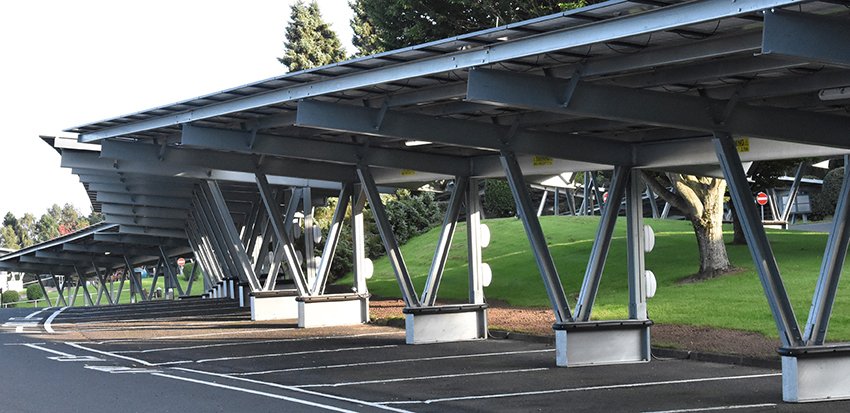
The versality of solar carports should also not be overlooked. With increasing electric vehicle (EV) sales prompting a need for more charging infrastructure, carports can provide customers with EV charging and offer overheard cover on top floor parking levels.
This provides convenient and reliable EV charging for passengers suited to the duration of their parking requirement ensure they have ample charge when they leave.
Furthermore, solar carports can have CCTV camera, LED lighting controlled via Passive Infrared motion detectors and daylight sensors built in to help create a safer, more attractive carpark for holidaymakers, tourists and business travellers alike.
MEETING CURRENT DEMAND
The advantages of solar generation truly lie in its versatility, something the aviation industry should and is able to take advantage of.
For example, the energy generated could be used to power essential maintenance, air traffic control, electric aeroplanes and aircraft technology which, alongside passenger services, can significantly help reduce carbon emissions.
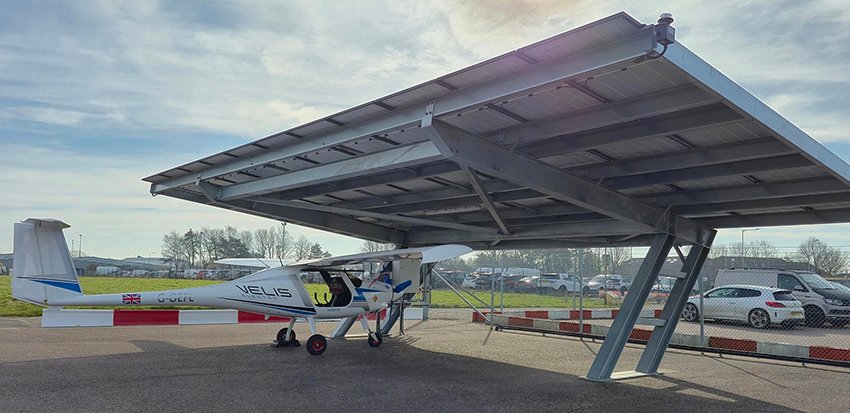
This was recently evidenced in its recent project with aviation provider Saxon Air, where a pioneering solar array was installed to provide charging to electric aircraft as part of the company’s wider sustainability strategy.
The installation, 44 solar panels and one inverter, generates 18,146 kWh of renewable energy annually, cutting approximately 3,445 kg of CO2 emissions each year, and is one aspect of a fully integrated clean energy ecosystem where solar power generation, energy storage and aircraftcharging co-exist seamlessly.
Having committed to net zero by 2050, Saxon Air offer carbon offsetting and impact-reducing programmes for charter clients. Beyond ‘can-do’ sustainability, Saxon Air’s focus extends to fostering cultural change and open conversation.
Its new charging port, which integrates a solar energy array specifically tailored for electric aircraft, adds to the site’s clean energy capabilities.
In exploring the practicalities of increasing solar infrastructure, we find there are a growing number of incentives for airports.
Options such as power purchase agreements (PPAs) mean that UK airports would pay a significantly reduced rate compared to the national grid and have carports installed free of charge – allowing them to invest in other areas.
Additionally, planning permission is not required when looking to install solar carports, although airports will still have to contact the Distribution Network Operator (DNO) to secure grid capacity and export.
The installation of carports is a mandatory practice in countries such as France and Slovenia in locations where there are more than 80 spaces. This helps these nations generate sustainable power for residents while reducing their overall carbon emissions.
By following in their footsteps, airport car parks can become a necessary example for the UK and help its green transition along much faster.
BRINGING SOLAR ON BOARD
Decarbonising aviation is notoriously difficult, but airports are missing a powerful solution right beneath their feet.
Solar‑enabled car parks give airports an immediate route to lower emissions, reduce costs and strengthen energy resilience – all without compromising the passenger experience.
The opportunity is here, and it’s practical. Airports must seize it, or risk being left behind as the sector moves on.
About the author
Tom Lloyd is the sales director of RenEnergy UK