




Conflict in Middle East has huge impact on performance of region’s airports

ACI Asia-Pacific & Middle East today released a comprehensive assessment of the operational and economic impact of the ongoing military conflict in the Gulf on regional aviation infrastructure in Middle East, and it doesn’t make pretty reading.
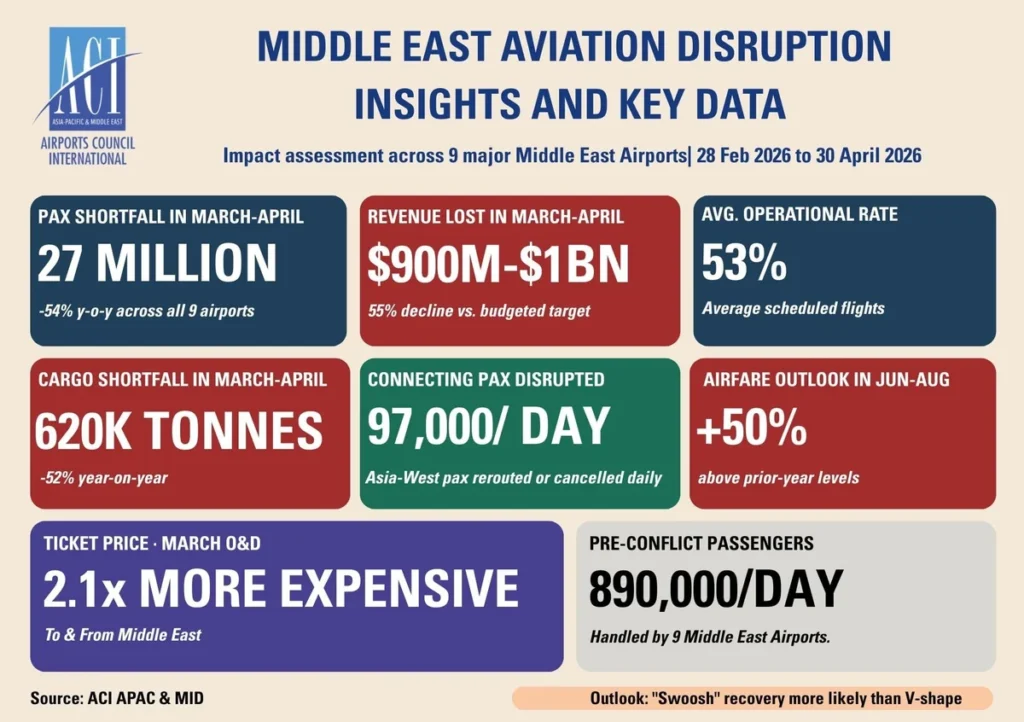
Its assessment, which covers the two-month period from the conflict’s onset through 30 April 2026, reveals that during the period nine major airports in Middle East operated just 53% of their schedule; lost up to $1 billion in revenue; and over 27 million passengers and 620,000 tonnes of cargo were disrupted in March-April 2026
In essence its findings, conducted in partnership with Flare Aviation Consulting, confirmed that the military put the global air transport network under acute stress, with Middle East airports bearing a disproportionate and sustained burden due to its role as one of the world’s most important transport corridors linking Europe, Asia, Africa, and the Americas.
The nine airports in this study collectively handled 324 million passengers in 2025, i.e. about 70% of the total traffic in the Middle East over the same year, and disruptions in this corridor have consequences across the global aviation network.
The financial impact constitutes a structural cash flow challenge for hub operators, many of whom carry significant fixed cost obligations in support of long-term infrastructure investment programmes.
ELEVATED AIR FARES
According to ACI’s assessment, the disruption has been particularly evident on Asia-West (Europe, Americas and Africa) long-haul routes.
Direct fares, once priced at a modest 20% premium over indirect routings via the Middle East, more than doubled in March, reaching 185% of the 2025 indirect-via-Middle East baseline.
Even by July-August, airfares to and from Middle East were priced at an average of 50% above pre-conflict levels.
The primary driver behind these increases is reduced airline competition, as East-West traffic flows have shifted heavily towards European and Asian carriers, limiting capacity and pushing prices upward.
Looking ahead, ACI Asia-Pacific & Middle East believes that “airfares are expected to stay elevated in the short to medium term as market imbalances and cost pressures persist”.