



Food for thought

Jennifer Reynolds, CEO & founder of Ideation Design Group (IDG), considers how some US airports are rethinking their retail/F&B models to accommodate the airside return of non-ticketed visitors.
For decades, airport terminals have been a controlled environment defined by an overpowering sense of urgency.
Passengers move through them with purpose, and nearly every element of their design, from circulation paths to dining concepts, have been optimised around that singular user: the ticketed traveller.
This premise is beginning to change across the United States, however, as a growing number of airports are piloting programmes that allow non-ticketed visitors to pass through security and access airside spaces.
While still limited in scale, these initiatives introduce a fundamental change to how terminals function, and more importantly, for whom they are designed.
For a global industry, the implications transcend security protocols. The ripple effects are poised to reshape one of the most commercially significant aspects of the terminal environment: food and beverage (F&B).
FROM THROUGHPUT TO DWELL
Airport dining has historically been governed by speed and predictability. Concepts are designed to deliver consistent, high-volume service to travellers working within tight time constraints.
Even sit-down restaurants are calibrated for turnover, with layouts, menus, and staffing models built to accommodate fluctuating passenger flows.
The introduction of non-travelling guests disrupts this equilibrium. Bringing in users who are not bound by boarding times may arrive earlier, stay longer, and use the terminal as a destination rather than a waypoint.
This subtle but critical shift challenges long-standing assumptions about dwell time. Where airports traditionally focused on minimising friction, they are now faced with an opportunity to intentionally extend the visitor experience.
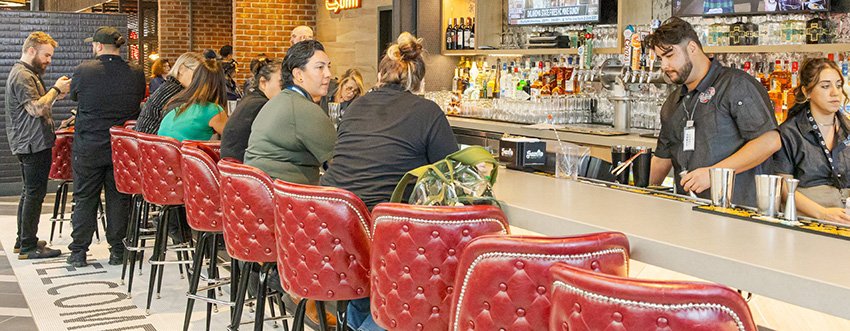
F&B spaces are at the centre of this transition, evolving from convenience-driven amenities into primary gathering points.
For F&B operators, this raises new questions: How should spaces accommodate both high-speed travellers and lingering visitors?
What balance of quick service versus full-service concepts is needed?
How does design support both, without compromising operational efficiency?
REPOSITIONING THE TERMINAL AS A SOCIAL SPACE
One of the most immediate impacts of guest access is the reintroduction of the airport as a place of connection.
Prior to security changes implemented after the September 11 attacks, US terminals routinely functioned as spaces where families and friends could accompany travellers to the gate.
This experience largely disappeared, replaced by kerbside drop-offs and separation at security.
Guest access programmes signal a partial return to the earlier model, but within a vastly different operational context.
Today’s terminals are larger, more complex, and more commercially driven. Reintegrating social use requires smart spatial planning.
For example, seating configurations must go beyond purely functional arrangements.
A mix of communal tables, lounge-style seating, and flexible dining areas can better accommodate guests with varied needs, including those sharing a meal, waiting together, and simply spending time before departure.
A CATALYST FOR LOCAL IDENTITY
As terminals welcome a broader audience, the expectations around dining experiences begin to shift. Non-ticketed visitors are less likely to view airport restaurants as a last-resort option and more likely to compare them with outside alternatives.
This makes a compelling case for airports to deepen their connections to local culture through F&B. Rather than relying on standardised concepts, there is increasing value in introducing regionally recognised brands and culinary experiences that resonate with both travellers and local guests.
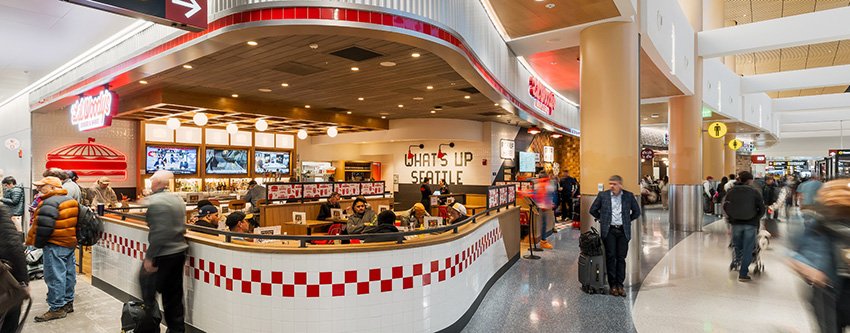
In the US, where guest pass programmes are already driving incremental foot traffic in airports such as SEA and BNA, this trend is gaining traction, with operators seeing greater incentives to invest in locally rooted concepts alongside established national brands.
DESIGNING FOR VISIBILITY AND ENGAGEMENT
As competition for attention intensifies within the terminal, design plays an increasingly strategic role. F&B spaces must now appeal to a wider spectrum of users, each with different expectations and behaviours.
Visibility becomes critical. Open kitchens, transparent facades, and clear sightlines can draw in guests who are exploring rather than navigating quickly. Wayfinding and intuitive layouts also remain essential for passengers who need to identify options that fit within their limited time.
There is a growing emphasis on experiential design that feels distinct, memorable, and worth seeking out. This does not necessarily mean more elaborate or expensive environments, rather it involves a thoughtful use of materials, lighting, and branding that adds character while remaining durable and easily maintainable.
Durability, too, becomes even more important as increased access leads to higher volumes of use. Materials need to withstand constant traffic without sacrificing aesthetics, requiring a careful balance between performance and visual appeal.
OPERATIONS IN A DUAL-USE ENVIRONMENT
While the opportunities are significant, the introduction of guest access also introduces complexity. Airports must now manage a more diverse user base without compromising security or operational flow.
For food and beverage operators, this translates into new demands on staffing, service models, and supply chains. Peak periods may become less predictable, influenced not only by flight schedules but also by local visitation patterns.
Flexibility is key. Concepts that can shift seamlessly between high-speed service and more relaxed dining will be better positioned to succeed. Technology may also play a role, from mobile ordering to dynamic seating management, helping to accommodate varying demand throughout the day.
BEYOND THE UNITED STATES
While guest access programmes are currently concentrated in the US, their implications are global.
Airports worldwide are continuously exploring ways to diversify their revenue streams and enhance passenger experience. The idea of expanding access to airside spaces presents both opportunities and challenges.
Each market will approach this differently, shaped by regulatory environments, cultural expectations, and infrastructure constraints. However, the underlying concept that reimagines the terminal as a more inclusive, experience-driven place, has broad relevance.
A NEW CHAPTER FOR TERMINAL DESIGN
The evolution of guest access marks a subtle but meaningful turning point in airport design. It challenges the industry to think beyond the traditional passenger journey and consider how terminals can serve a wider community.
F&B will play a central role in this transformation. As one of the most adaptable and visible components of the terminal environment, it has the potential to bridge the gap between efficiency and experience, between movement and connection.
The success of these initiatives will ultimately depend on balance. Airports must continue to function as highly efficient transportation hubs while embracing new opportunities to create spaces that people actively choose to spend time in.
If achieved, the result is not just a better dining experience, but a more dynamic and resilient airport ecosystem that reflects the changing expectations of travellers and visitors alike.