
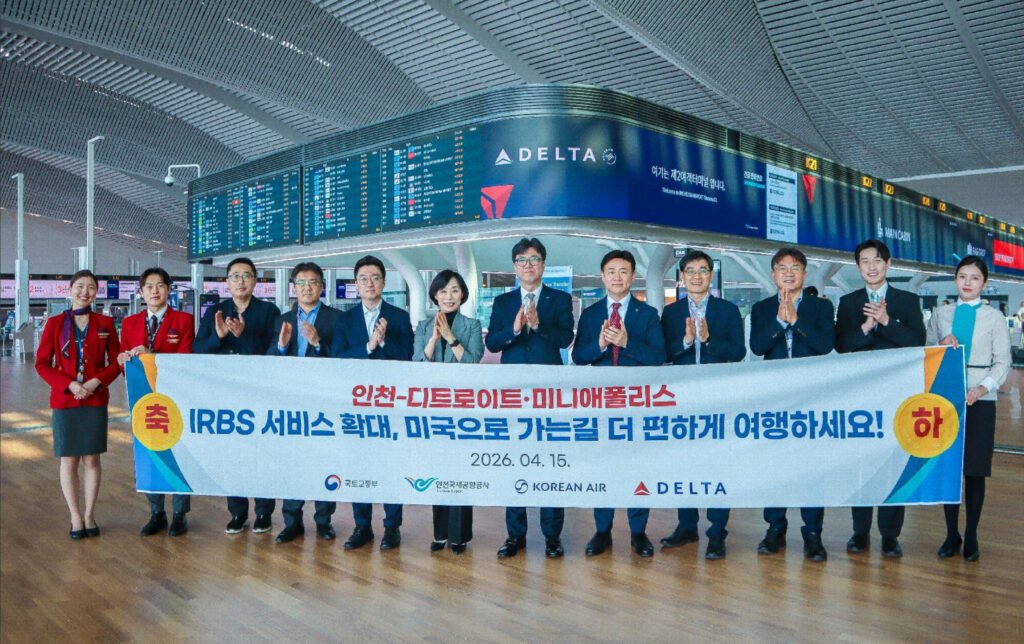
Incheon International Airport Corporation (IIAC) has extended its International Remote Baggage Screening (IRBS) service to two additional US gateway cities — Detroit and Minneapolis.
As a result, minimum connecting times at both airports is expected to be reduced by at least 20 minutes as it removes the mandatory re-screening step that had long frustrated transit passengers.
The expansion, jointly administered by South Korea’s Ministry of Land, Infrastructure and Transport (MOLIT) and the US Department of Homeland Security (DHS), builds on a pilot programme launched in August 2025 on the Incheon–Atlanta corridor.
Under IRBS, high-resolution X-ray images of checked luggage are transmitted electronically from Incheon to US Transportation Security Administration (TSA) and Customs and Border Protection (CBP) officers before the aircraft departs.

Bags that clear the remote review are transferred directly to connecting flights upon landing — passengers are no longer required to collect their luggage, pass through customs screening, and re-check it at a transfer desk.
Prior to IRBS, travellers transiting through Detroit or Minneapolis faced a minimum layover of one hour and 30 minutes to complete that process.
The programme reduces the minimum viable connection to one hour and 10 minutes — a significant improvement for passengers making tight domestic connections onwards to the US.
According to MOLIT, approximately 71,828 passengers used the Incheon–Detroit and Incheon–Minneapolis routes in 2025, of whom around 63%— some 45,235 travellers — were connecting to onward US flights, underlining the practical scale of the change.
Delta Air Lines (Delta), which operates the sole direct daily services between Incheon and both Detroit and Minneapolis, and Korean Air participated in the programme as implementing airline partners.
The two carriers worked with IIAC and US authorities to validate data transfer protocols and baggage handling integration before the April 15 go-live date.

IRBS architecture relies on Incheon Airport’s 3D explosive detection system (EDS) equipment and a secure imaging network that transmits scan data in a format accepted by US federal standards.
South Korea’s Personal Information Protection Commission (PIPC) was involved in the programme’s development to ensure passenger data is handled in compliance with Korean privacy law.
IIAC describes the system as a fundamental shift in the conventional security paradigm — moving from a destination-country re-check model to a departure-point clearance model.
According to IIAC, for airport operators and airline planners, the IRBS model carries implications beyond passenger convenience.
For example, it eliminates re-check queues at US hub airports reduces demand on landside baggage infrastructure and transfer desk staffing, potentially improving gate utilisation and on-time performance for downstream domestic segments.
For connecting carriers operating at Detroit and Minneapolis, fewer late-arriving bags mean fewer mishandled baggage incidents attributed to tight transfer windows.
The programme also applies to third-country passengers who originate outside Korea, transit through Incheon, and continue to IRBS-enabled US destinations.
This extends the benefit to passengers from across the Asia-Pacific and beyond who use Incheon as a transpacific gateway.
IIAC has confirmed plans to extend IRBS to Seattle (SEA) and Los Angeles (LX) before the end of 2026, in co-ordination with MOLIT and US authorities.
Cho Yong-su, IIAC’s head of operations, described the expansion as part of a broader commitment to seamless travel.
While the Ministry’s airport policy director, Lee Sang-heon, framed the Detroit and Minneapolis expansion as a direct product of the bilateral trust established through the Atlanta pilot, and signalled that further extensions would follow as operational confidence grows.