




Tunnel vision

Editor, Joe Bates, takes a closer look at a pioneering new cargo screening solution from Nuctech and the opening of a smart cargo hub at DXB.
Air cargo transports around $8.3 trillion worth of goods across the globe each year, accounting for approximately 33% of world trade by value, according to IATA.
Yet, despite its huge importance in facilitating trade and supporting the health and wellbeing of the world’s population – think pharmaceuticals, vaccines and medical equipment – innovation in screening consolidated cargo containers has been in short supply over the years.
Traditionally, cargo has been inspected manually which has created significant challenges in terms of maintaining both security and operational efficiency.
Manual unpacking, for example, is a time-consuming and labour-intensive process that can cause significant delays. While the use of 2D X-ray technology to screen consignments can lead to blind spots because of image overlap.
But all this could be about to change as Nuctech’s CTitan cargo solution has taken the security inspection of air cargo containers at airports to another level by effectively removing the need for routine manual inspections.
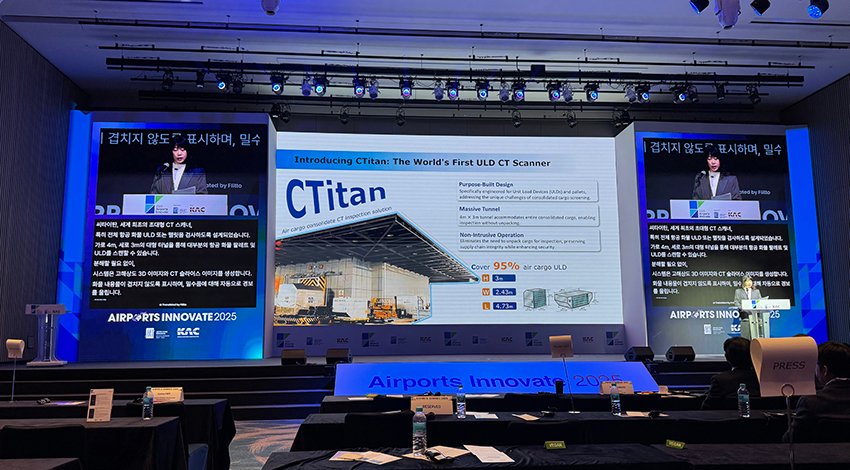
It is different because it is the world’s first CT inspection system designed specifically for air cargo containers, enabling non-intrusive screening of entire ULDs and pallets without unpacking.
Powered by innovative linear CT and dual-energy material recognition, it generates high-resolution 3D images in real time and eliminates blind spots caused by overlap, greatly enhancing the detection of explosives, lithium batteries, and concealed contraband.
In addition to transforming the efficiency of cargo screening at airports, it reduces the need to manually handle shipments, effectively lowering costs, accelerating throughput and theoretically optimising airport workflows.
Screening an entire consolidated cargo container without opening it up is possible because ULDs can fit inside CTitan’s 4m x 3m X-ray tunnel, which automatically detects explosives and other dangerous or prohibited content.
And it has already proved that it can screen cargo containers so quickly and efficiently that it has reduced cargo security processing times for a Boeing 747 freighter at Shenzhen Bao’an International Airport (SZX) in China from an average of four hours to an hour and 10 minutes with less people, less space, and less equipment.
To be more precise, it previously took 100 workers, 10 X-ray scanners and “a lot of machine-learning” to security screen a B747F at SZX. Now it takes five people and one third of the space.
In the case of Shenzhen Bao’an, one of the world’s biggest cargo hubs, this led to the airport processing between 20 and 25 ULDs an hour.
Talking about the success of CTitan’s introduction at SZX and the potential future use of the technology at the Airports Innovate conference in Busan, South Korea, last November, Nuctech’s head of overseas solution development, Lin Lin, said: “This fills a critical gap in global aviation security, creating a new category of certified equipment.”
Lin – who noted that CTitan could not have been developed without Nuctech’s collaboration with the Civil Aviation Administration of China and airport industry support – said: “CTitan is built for the future with cutting edge technology.
“Traditional inspection methods rely on operators to use their eyes to distinguish image overlaps. CTitan allows operators to clearly see everything. This is where technology moves from signal detection into intelligent risk prevention.
“This is not only a simple equipment upgrade, but a fundamental shift in air cargo inspection. It is moving the industry from a scan and reassemble model to a scaling up and consolidation workflow. This solution can optimise workflows, increase cargo handling efficiency, and free up valuable asset-space in the airport.”
She concluded: “CTitan is no longer just a concept. It’s a proven, certified and operational solution that is actively changing air cargo inspection today.
“It proves that we can enhance security and efficiency simultaneously, and the continued development of AI will enable more intelligent screening that will allow us to stay ahead of emerging threats for export, imports and transport cargoes.
“Looking ahead, the potential is even greater. We envisage a future where this technology is distributed across the entire logistics chain, from warehouses to checkpoints, creating a seamless data driven network.”
NEW SMART CARGO SCREENING HUB AT DXB
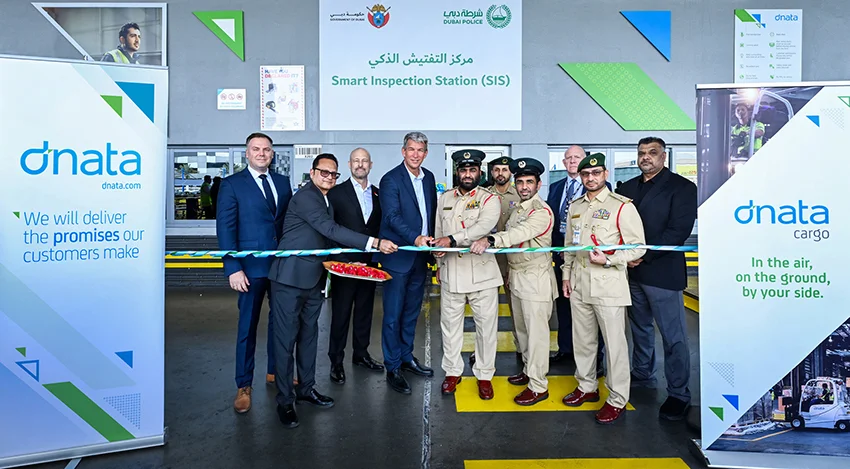
Meanwhile in Dubai, global air and travel services provider dnata has unveiled a new centralised screening control room at its Dubai International Airport (DXB) cargo facility.
The pioneering new complex has been developed in partnership with Dubai Police and marks a major step in the digital transformation of air cargo operations, combining real-time automation with enhanced security oversight.
What is so special about it? Well, it means that now, from a single high-tech command centre, Dubai Police officers can remotely operate and monitor six X-ray screening machines across dnata’s warehouse.
Each device is connected to One Cargo, dnata’s digital cargo management system that automates key business and operational functions. This allows for instant data sharing, streamlined workflows, and faster decision-making.
“This project is a milestone in dnata’s journey towards smarter, more efficient cargo handling,” states Guillaume Crozier, dnata’s chief cargo officer.
“Through close collaboration with Dubai Police, we’ve introduced a model that strengthens security, boosts efficiency, and reflects Dubai’s commitment to innovation.”
Previously, screening was conducted at multiple warehouse locations, leading to higher resource use and reduced efficiency. The new centralised approach consolidates all processes into one hub, reducing screening time and improving throughput by around 3% annually.
According to dnata, the new system reduces manual touchpoints, enables advanced analytics, and helps optimise resource use, lowering unnecessary cargo movement and fuel consumption inside the facility.
Dnata serves more than 120 airline customers and handles an average of 60,000 tonnes of cargo a month at its DXB facility.