


The aviation industry likes to talk about seamless travel, but for many passengers, that promise still ends at the border, writes Valour Consultancy’s John Devlin.
Even as airports continue to modernise check-in, security and boarding – often at different speeds and with varying degrees of success – a single friction point at immigration can undo hours of careful optimisation elsewhere in the journey.
The uncomfortable truth is that the technology needed to transform border control already exists. What remains misaligned is not innovation, but authority: between airports and governments, between operational reality and policy, and between passenger expectations and how borders are still designed to function.

Over the past decade, biometric technologies have moved decisively from pilot phase to operational infrastructure across airports worldwide. Facial recognition is now embedded at scale, supporting everything from bag drop and security to boarding and lounge access.
Data from Valour Consultancy’s Seamless Passenger Journey report shows biometric deployments accelerating globally, supported by a market expected to be worth $15.8 billion over 10 years as airports pursue efficiency, resilience and improved passenger experience.
Progress, however, has been uneven. While airports increasingly view biometrics as a journey-wide enabler, border control remains constrained by fixed processes, national systems and legacy assumptions about how identity should be checked.
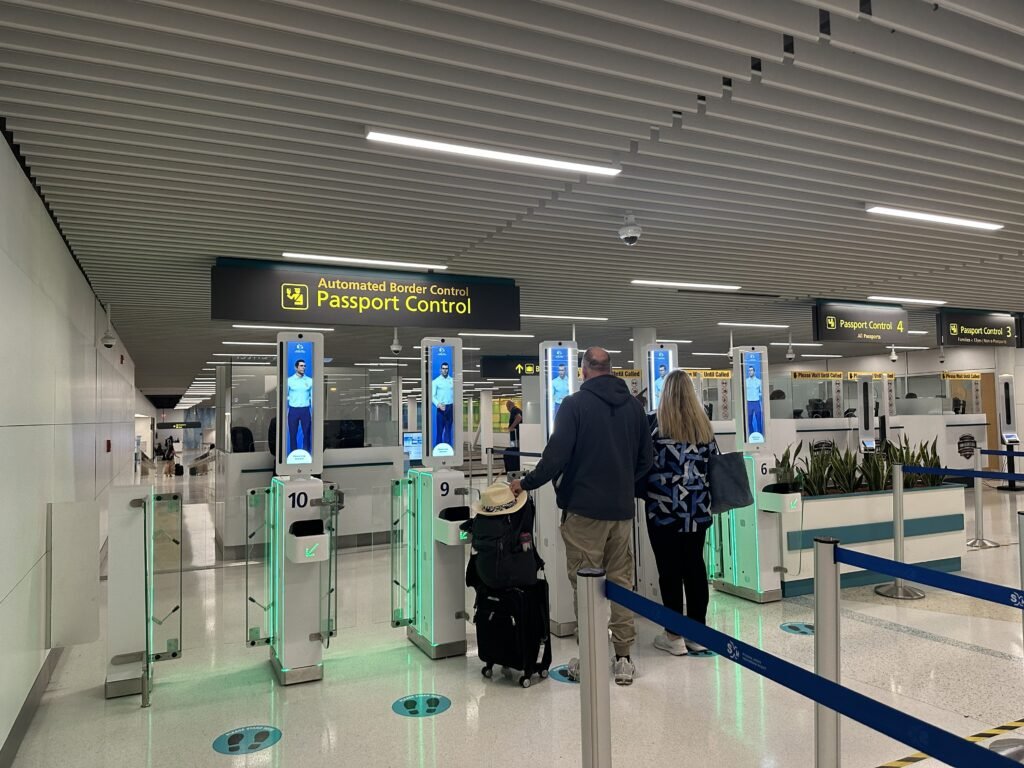
Automated Border Control (ABC) eGates have expanded significantly, with over 2,100 added in the past five years, and continue to deliver measurable throughput gains, but they are still largely deployed as isolated control points rather than as part of a continuous passenger flow.

This tension is now being brought into sharp focus by large-scale regulatory initiatives, none more so than Europe’s Entry/Exit System (EES), which drove spending of at least €915m.
Often described as a digital upgrade, EES is better understood as a stress test for the aviation ecosystem. Enrolment requirements, biometric capture, data quality and exception handling introduce new operational demands, particularly during peak periods.
Airports are being asked to absorb more sovereign border processes within commercial environments that were never designed for them.
In response, the concept of biometric corridors has gained traction. Rather than concentrating identity checks at a single moment, biometric corridors distribute verification across the journey, linking airline, airport and border processes into a more continuous model of identity assurance.
Early deployments – with early reports of traveller throughput as high as 30+ per minute – suggest this approach can reduce congestion, improve compliance and ease perceived friction – but only where stakeholders are aligned.

And alignment remains the industry’s biggest challenge. Technology is not the limiting factor. Interoperability, governance and trust are. Questions around data ownership, liability, standards and passenger consent remain unresolved, particularly where responsibility shifts between public and private stakeholders.
Border agencies must balance security, sovereignty and political accountability, while airports are measured on efficiency, satisfaction and commercial performance. Too often, these objectives collide.
Preliminary findings from Valour Consultancy’s forthcoming Smart Borders report suggest investment priorities are beginning to shift. Hardware-led deployments are giving way to platform-based approaches that emphasise orchestration, data integration and adaptability.
At the same time, the border control market is broadening, with digital identity providers, biometric specialists and mobility platforms entering a space once dominated by a small number of incumbents.
The direction of travel is clear. Borders are moving from static control points to dynamic systems embedded within the passenger journey. Success will depend less on deploying the next biometric modality and more on designing frameworks that allow identity to be trusted, reused and governed across multiple touchpoints.
As borders become the defining constraint – or enabler – of seamless travel, the next phase of the industry will be shaped not by who has the best technology, but by who can make it work together.
About the author
John Devlin is a director at Valour Consultancy; a market intelligence firm focused on airports, border management, biometrics and digital identity supporting airports, vendors and investors navigating the transition to seamless, data-driven passenger journeys.
Due to publish later this spring, the firm’s first report of 2026 entitled Smart Borders: The Future of Land, Sea and Air Borders has been developed and scoped with input from leading stakeholders in order to provide a detailed understanding of the latest trends and future developments aiding the introduction of smart border programmes.