




Energy transition: The nuclear alternative

Thomas Roddey, vice president, business development for commercial nuclear at AtkinsRéalis considers what real fuel resilience looks like for future airports.
Airports sit at the leading edge of the energy transition. They are among some of the most energy-intensive pieces of infrastructure in the economy, while also being expected to decarbonise operations, electrify vehicle fleets, support new fuels and maintain absolute resilience.
Airport power demand will only increase because of the adoption of new fuels, charging infrastructure and widespread electrification of operations.
That combination of demands means the question is no longer which fuel wins, but how multiple energy sources can be co-ordinated into a resilient system that is able to deliver continuously, securely and at scale.
There is an acute need for resilient energy supply across the economy, and airports bring this challenge into sharper focus.
Nuclear power, particularly new nuclear technologies, is increasingly being recognised as the backbone within a technologically diverse, resilient energy system.
WHY RELIABILITY MATTERS FOR FUTURE AIRPORT DEMAND
Nuclear plants routinely operate at full power for 18 to 24 months continuously. Very few other sources of generation can do that.
The wind does not always blow. The sun does not always shine. Nuclear plants operate 24 hours a day, every day, across the entire fuel cycle, regardless of geography.
For infrastructure like airports, where power interruptions are not just inconvenient for tens of thousands of customers but potentially safety-critical, that level of predictability matters.
In a future system that includes more intermittent and emerging sources, nuclear energy can provide stability by providing baseload generation around which other generation capabilities can remain supportive.
SMRS AND MICROREACTORS FIT AIRPORT MICROGRIDS
Airports are, by nature, self-contained energy ecosystems naturally suited to microgrids, with clearly defined boundaries, predictable demand and critical loads that simply cannot fail. That makes them fundamentally different from much of the wider grid.
Similarly, modern nuclear plants are also fundamentally different from those that have gone before them, and they are no longer entirely bespoke, first-of-a-kind builds.
Modular design aims to improve efficiency in development and deployment and can make new nuclear far more economically viable than previous generations.
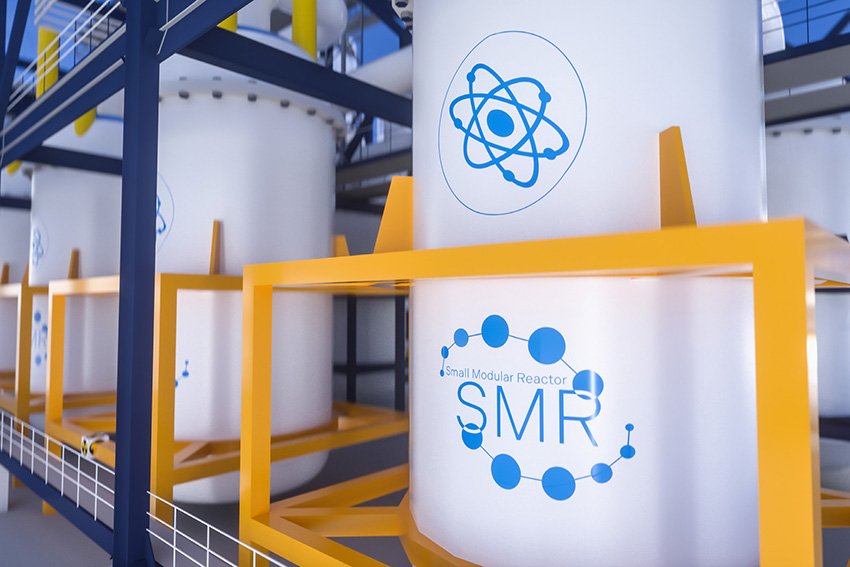
You have almost certainly heard of one technology of this kind; small modular reactors, known as SMRs.
As they move towards commercial deployment, SMRs and microreactors will be well-suited to the kind of infrastructure environment that airports occupy.

They could provide power for electric buses and service vehicles, terminals, lighting, data systems and, eventually, electric aircraft support infrastructure. Crucially, they could allow airports to scale in a way that matches how demand grows.
Rather than starting with a gigawatt-scale plant, a 20-megawatt small reactor could be used, and units then added incrementally as demand increases.
I often describe it like lightbulbs: if you need more light, you don’t build a new power station, you just plug in another lamp. That ability to add capacity in steps reduces upfront risk, avoids over-commitment and builds resilience through redundancy rather than relying on a single point of failure.
In my view, nuclear doesn’t replace other power generation sources in this model. It can underpin them, providing continuous power and stability while other energy sources, including electricity, hydrogen and sustainable fuels, evolve and scale around it.
WHY NEW NUCLEAR NOW?
The demand signal is already here. Power demand from AI data centres, industry and transportation is growing faster than we can bring new generation online through conventional routes.
Once a nuclear plant comes online, however, the amount of output it delivers from a single unit is significant.
What makes this moment different is the alignment we are seeing across the market. Advanced reactor designers, venture capital, evolving regulatory approaches and renewed interest from engineering and construction organisations are all converging at the same time.
These conditions are not perfect, but they are credible in a way they have not been for decades.
It is also important to be clear-eyed: no small modular reactor has yet been commercialised on a utility grid.
Early projects must prove delivery discipline and integration as much as technology, but for airports planning over multi-decade horizons, the real question is whether energy systems are being designed early enough to meet future demand safely and reliably.
FROM AMBITION TO RESILIENCE
Energy generation resilience is not about choosing a single technology, it is about designing diverse systems that can operate continuously under stress, adapt over time and absorb shocks without failure.
Nuclear energy’s value in that system comes down to economics, reliability and scalability.
For future airports, the most pragmatic path forward is integrated planning: multiple energy sources, co-ordinated from the outset, with resilience, integration and delivery treated as design principles rather than afterthoughts.
That is how energy systems move from aspiration to operation, and how airports remain both sustainable and secure as demand continues to rise.