



Talking tech

Share

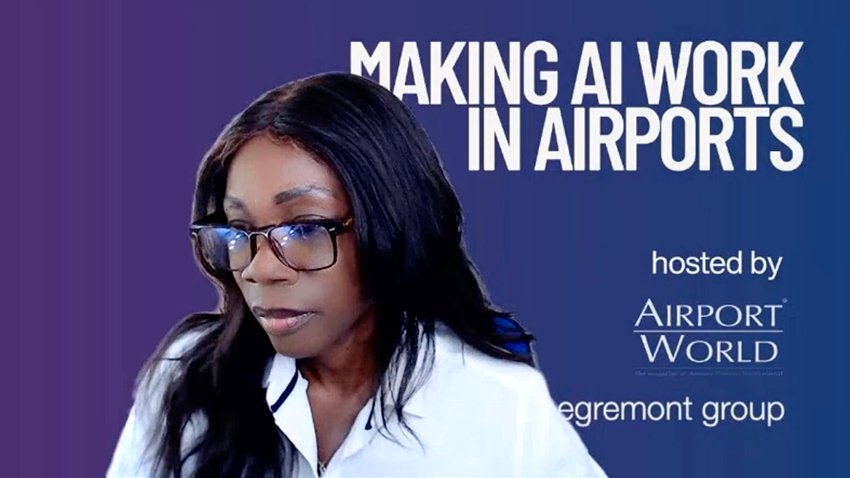
We review the highlights of our recent ‘Making AI Work in Airports’ webinar, which covered the huge potential of artificial intelligence and the environment needed to encourage its future development.
Watched by over 300 delegates from 40 countries, our recent ‘Making AI Work in Airports’ webinar shone the spotlight on where value is emerging in the use of artificial intelligence at airports and what it takes to successfully deliver it.
The event, hosted by the Egremont Group in partnership with Airport World, provided an early taster for the types of discussionswe can expect at December’s AI in Airports Conference in London.
In the hot seat were Maurice Jenkins, chief innovation officer at Miami International Airport; Sharon Prior, founder and CEO of Inovivo and former director of technology at Heathrow; and Nick Crane, the Egremont Group’s senior consultant for airport operations transformation.
Introducing the discussion, Egremont’s Crane explained that the webinar formed a wider part of the AI and Airports initiative.
“AI in Airports is a growing industry initiative that’s bringing together airport leaders, technology experts, and innovators to explore how artificial intelligence is reshaping airports,” said Crane.
“Our ambition with this is simple, really. AI has leapt upon us from a practical perspective, and what we’re aiming to do is bring the industry together to share practical experience and accelerate the responsible adoption of AI across airports, improving life for all of us that work within airports and all of our passengers as well.”
In his opening remarks, MIA’s Jenkins stated that technology would play a key role in helping the aviation industry cope with the expected more than doubling of passenger traffic over the next ten years.
“We realise that traditional brick and mortar works very well, but it can only take you so far. So, the question comes into play, how do we leverage technology, and how do we create and be more innovative to improve our business processes within our airport ecosystem,” mused Jenkins.
“My charge and my challenge for what I do for my airport and other board engagements around the world is looking at how we can establish enhanced frameworks of leveraging technology innovation into an operational environment to create better efficiencies and business process improvements.”
Pryor, who founded her boutique AI native transformation company last year, opened by admitting that she was always excited to talk about tech, and learnt a lot about artifical intelligence and the benefits it can bring an organisation during her time at Heathrow Airport.
WHERE IS AI DELIVERING VALUE TODAY IN AIRPORTS?
Jenkins noted that AI is already creating value for airports, perhaps most obviously by helping them become predictive and less reactive in terms of operational decision-making.
He cited using AI to gather commercial data from duty free sales, improve turnaround times and get better at predicting passenger flows, gate optimisation and stand utilisation as just some of the ways MIA is leveraging the technology today.
“For me, I think the biggest opportunity isn’t just about creating what I call a smart airport, it’s the chance to create a predictive airport,” he said. “I want to be able to sweat the assets and leverage our infrastructure more to go ahead and provide better value-added resources and opportunities for our airport ecosystem.”
Prior agreed with Jenkins that AI will be key for the industry to move from reactiveness to predictiveness and being able to predict what’s ahead and coming our way.
Talking about artificial intelligence in general, she noted that “80% of AI is data” and that, to a certain extent, the industry still underestimated the value of data collected at airports and isn’t good at sharing it.
She also felt that too often airports focused their attention on technology selection rather integration with other systems and sharing data.
“I was having a conversation with a GCC airport about a decision to change their ACDM, and they’re talking about the tech, and what facilities that technology needed to have. What they weren’t really thinking about was how the data was going to flow between all the major actors,” said Prior.
Agreeing with Prior about the value of data and the need to share it, Jenkins commented: “Everyone says that data is king and is worth more than gold and oil and every other resource sitting out there, but it has no value unless it’s ingested and used in the ecosystem.”

WHAT DOES IT TAKE ORGANISATIONALLY TO MAKE AI WORK?
Both agreed that the adoption of artificial intelligence requires trust in its capabilities, clear protocols for action, and good governence and guardrails.
And, in this respect, human oversight and organisational buy-in is essential to the success of any initiative, starting with leadership from the top and across all departments.
“This will sound strange coming from me, but AI is not a technology initiative,” said Prior. “It is the new thing. It is a great capability. It enables a lot of businesses to really perform much better than they currently do, but it has to be taken out of being an IT-led initiative.
“This is a transformation agenda and it sits at the heart of any organisation. In my opionion, if AI sits almost exclusively in the technology function, it stays small. Not because people don’t see the value, but because they’re still doing their day and thinking in the way that they’ve always thought and operating under the business model they’ve always operated under. This needs leadership from the top and almost co-sponsorship of programmes.
HOW CAN AIRPORTS MOVE FROM PILOTS AND EXPERIMENTATION TO SCALE TO DELIVERY?
Prior and Jenkins accepted that scaling AI from pilot programmes to operations can be a difficult, which is why initiatives need to demonstrate clear business ownership, measurable outcomes, strong data foundations and the ability to be integrated into daily workflows.
In terms of what separates initiatives that gain traction and those that remain an isolated proof of concept, Jenkins stated that concepts had to be scalable, measurable and potentially generate a ROI in some capacity.
He said: “We’ve done AI pilots. We understand AI’s capabilities. Let’s go from pilots to applications that we can now scale, that are measurable, and then with that you get that first test bed with an executive sponsor.”
He revealed that a recently completed pilot project now means that mounds of data, drawings and paperwork about environmental processes and projects at MIA that used to take days or weeks to find is now available in minutes because of the use of aritifical intelligence.
WHAT SHOULD AIRPORT LEADERS BE PRIORITISING OVER THE NEXT 12 TO 24 MONTHS?
Inovivo’s Prior said: “If advising an airport today, I’d say, first, get the data house in order. I don’t mean a multi-year data transformation programme, but you have to have a targetted piece of work on two or three data domains that underpin the highest value AI use case that has to be the first thing to be done.
“The second point for me is this is about people as well as well the operating model. So, invest in changing the operating model, not just the tech. That means the training, the change management, revised roles and responsibilities, and have clarity around the accountability
of AI driven decisions.
“Thirdly, I’d say build a small, very small cross-functional team that owns the AI agenda end to end, so not just the technology, it’s got to be a fusion team of technologists, operators, and commercials sitting together. We are not talking about a centre of excellence that writes papers, but a very small SWAT team that actually delivers something and shifts outcomes.”
Industry veteran Jenkins said: “I think over the next 24 months, the strongest things I could actually recommend is to look at some small operational problems and solve them exceptionally well. Let’s do a great job at looking at that, and make sure it’s something that’s tangible, that’s truly attainable, and look at that to scale.”

From MIA’s position, Jenkins noted that he was looking at five verticals – operations control, passenger flow, cargo analytics, predictive maintenance, and workforce productivity.
With regards to cargo, he said: “When we came out of COVID, the one thing that truly satisfied or saved this industry as much as possible was cargo, but we’re not talking about now, so I want to put a little bit more of a core emphasis in cargo and cargo analytics.
“We could learn a lot by looking at some of that data, and helping to build in more predictability and manageability of leveraging AI within the cargo space as well, because I think that’s tangible.
“We can also do more with regards to predictive maintenance to help us manage our resources better. The finance folks will love that.”
Host, Nick Crane, believes that there are five key takeways from the highly engaging and informative June 30 webinar. They are:
1. Sequencing matters as much as ambition. The airports pulling ahead are not necessarily the most technologically advanced; they are the ones that have resolved data ownership, governance and trust before scaling.
2. Predictive beats reactive. The greatest value is realised where AI helps airports anticipate demand, disruption and operational challenges before they happen.
3. Organisation matters more than technology. Leadership, governance and strong data foundations are proving more important than the AI tools themselves.
4. AI is a business transformation. Successful initiatives have clear ownership, measurable outcomes and operational buy-in.
5. Start small and scale. Focus on high-value use cases, prove the business case and expand from there.