

GOING GLOBAL

Share
Joe Bates finds out more about the history, plans and future ambitions of a handful of global airport investors at different stages of their development and investment cycles.
The news that owner, Global Infrastructure Partners (GIP), is set to pocket close to £3 billion later this year from the sale of a 50.01% stake in London’s Gatwick Airport tells you everything you need to know about the continued appeal of airports to investors.
The deal, set to be rubber stamped in mid-2019, represents a tidy return for GIP which paid £1.9 billion for the airport in 2009, although it has invested £1.9 billion on upgrading Gatwick’s infrastructure and facilities since then, and with the new shareholders, will spend a further £1.1 billion over the next five years.
While the global market might not be quite as hot as it was 10 to 15 years ago when traditional airport operators first began to join forces with or compete directly against new cash-rich entrants like pension funds to buy airports outright or purchase shares in them, deals such as the recently announced London Gatwick transaction, MAG’s stated interest in Sofia Airport in Bulgaria and Groupe ADP’s 2018 purchase of a controlling stake in Airport International Group (AIG), operator of Jordan’s Queen Alia International Airport, show that airports remain firmly on the radar of investors.
And investments are becoming increasingly diverse, with concessions for standalone projects now firmly on the agenda such as the ground-breaking PPP projects in the US for LaGuardia’s new Terminal B and the concession to revamp and operate the Great Hall in Denver International Airport’s Jeppesen Terminal.
This article focuses on five airport operators/investors at various stages in their investment cycles in the global arena. We discover more about what they own, operate and manage and talk to their respective CEOs about their business development strategies and possibly what comes next in terms of new airports, facilities and services.
The five in the spotlight are ‘mature’ investors VINCI Airports; TAV Airports and Fraport AG; relative newcomer to the scene, the CCR Group; and a familiar name that is back in the game after a spell of concentrating on its UK airport assets, Ferrovial Airports.
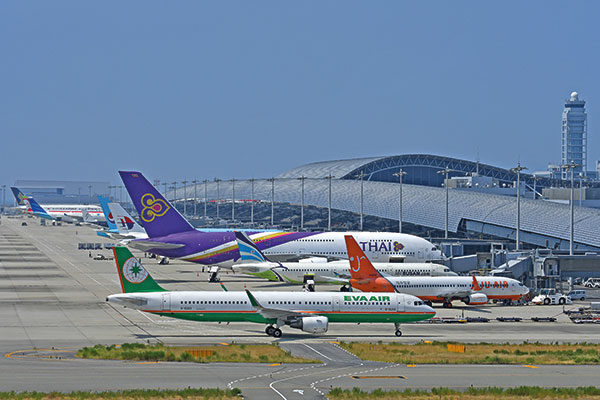
Osaka’s Kansai International Airport joined VINCI’s portfolio in April 2016.
VINCI Airports
World Headquarters: Rueil-Malmaison, France.
Airport investor since: 1995.
Airports 100% owned and operated: Belfast International Airport in the UK courtesy of wholly-owned subsidiary Airports Worldwide (AWW).
Others: VINCI Airports holds a 50-year concession to operate, build and develop the 10 Portuguese airports of Lisbon, Porto, Faro and Beja on the mainland; Ponta Delgada, Horta, Flores and Santa Maria in the Azores; and Funchal and Porto Santo in Madeira.
In Japan, VINCI Airports has a 40% stake in Kansai Airports, operator of Osaka’s Kansai and Osaka (formerly Itami) airports, and a long-term concession to operate and develop Kobe Airport.
In Cambodia, it owns 70% of the shares in Cambodia Airports, which operates Cambodia’s three international airports of Phnom Penh, Siem Reap and Sihanoukville.
In Latin America, it has a 40% stake in the Nuevo Pudahuel consortium responsible for operating Santiago’s Arturo Merino Benítez International Airport in Chile; a 45% shareholding in Coriport, operator of Costa Rica’s Liberia-Daniel Oduber Quirós International Airport; 100% owns Aeropuertos Dominicanos Siglo XXI (AERODOM), which has the concession for six gateways in the Dominican Republic, including capital Santo Domingo’s Las Américas International Airport and Gregorio Luperón Airport in Puerto Plata; and holds the concession for Deputado Luís Eduardo Magalhães International Airport in Salvador da Bahia, Brazil.
At home in France, a VINCI Airports-led consortium has a 60% stake in Aéroports de Lyon (ADL), operator of Lyon-Saint Exupéry and Lyon-Bron. It also manages the French gateways of Clermont-Ferrand Auvergne, Chambéry Savoie Mont Blanc, Grenoble Alpes Isère, Toulon Hyères, Poitiers Biard and Ancenis (courtesy of mid-to short-term contracts), Nantes Atlantique and Saint-Nazaire Montoir (through an 85% stake and long-term concession), and Rennes Bretagne and Dinard Bretagne due to a 49% interest in the consortium responsible for operating the airports until 2024.
Elsewhere in Europe, VINCI Airports holds the 25-year concession to manage and upgrade Nikola Tesla Airport in Belgrade (Serbia) and a 51% stake in Portuguese airport retailer, Lojas Francas Portugal (LFP), which operates more than 30 retail outlets across 10 Portuguese gateways managed by VINCI Airports.
In North America, through AWW, VINCI Airports operates and develops five airports – Orlando Sanford International Airport in Florida courtesy of a concession contract that runs until January 2039; Hollywood Burbank Airport and Ontario International Airport in California; and Macon Downtown Airport and Middle Georgia Regional Airport in Georgia. The AWW portfolio also includes partial management contracts at three additional American gateways: Atlantic City International Airport in New Jersey; Raleigh Durham International Airport in North Carolina; and Hartsfield-Jackson Atlanta where it manages part of the international terminal.
Plans to expand/reduce portfolio: Always looking for new opportunities.
News: VINCI Airports officially took over the concession for Belgrade’s Nikola Tesla Airport on December 22, 2018, and is close to pulling off the biggest single airport deal in its history after agreeing to pay Global Infrastructure Partners (GIP) £2.9 billion to acquire a 50.01% stake in London Gatwick. The transaction, which is expected to be ratified in mid-2019, means that VINCI Airports will boast a network of 46 airports in 12 countries across the globe.
Speaking at the time of the deal, VINCI Airports CEO, Nicolas Notebaert, said: “The creation of synergies and the sharing of best practices is included in our core values and the entire VINCI Airports network will benefit from the world-renowned management and operational excellence of Gatwick Airport, which has continued its growth despite a very constrained environment.
“As a new industrial partner, VINCI Airports will support and encourage operational efficiency and traffic growth, while leveraging its business development expertise to continue to improve passenger satisfaction and experience.”
VINCI Airports added eight new airports in Europe, the US and Central America to its portfolio in August 2018 when it acquired Florida-based Airports Worldwide (AWW). The new additions are in the UK (Belfast); the US (100% ownership of Orlando Sanford and full management contracts for California’s Hollywood Burbank and Ontario airports and Macon Downtown and Middle Georgia Regional in Georgia); Costa Rica (Liberia-Daniel Oduber Quirós); and Sweden (Stockholm Skavsta).
To complete the Belgrade airport transaction in December 2018, VINCI took out €420 million in loans from 10 different institutions that included the World Bank’s International Finance Corporation (IFC), the European Bank for Reconstruction and Development (EBRD), DEG (KfW Group) and UniCredit Kommunalkredit and CIC merchant banks. The financing arrangements constitute a milestone in Belgrade airport’s development and is one of the largest financial transactions ever carried out in Serbia.
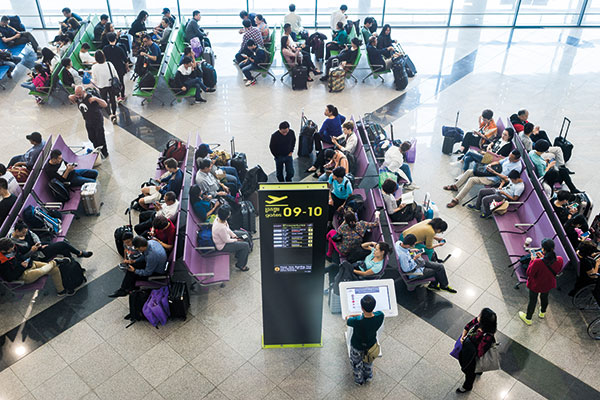
VINCI has a 70% stake in Cambodia Airports, which operates the country’s three international gateways, including Phnom Penh, pictured above.
The big spender
VINCI Airports is set to add London Gatwick to its fast-expanding portfolio after agreeing to pay owners GIP £2.9 billion to take a controlling 50.01% stake in the UK gateway. The deal, struck in December 2018, is expected to be ratified later this year.
What will VINCI Airports bring to the table at London Gatwick and will this immediately be obvious to passengers?
“Under the custodianship of GIP and its co-shareholders, London Gatwick has improved significantly. The offering to consumers and service quality measures have improved substantially, significant capital investment has been made in the infrastructure, processes have been optimised and new airlines and routes introduced. We intend to continue this good work,” says VINCI Airport CEO, Nicolas Notebaert.
“As Gatwick’s new industrial partner, VINCI Airports will also support and encourage traffic growth and leverage our international expertise in the development of extra-aeronautical activities to further improve the airport’s commercial offering, where there is still great potential.”
There is simply no denying that VINCI Airports has been one of the big spenders in the airport investment market over the last few years, and Notebaert refuses to rule out adding to its portfolio in 2019.
“The pursuit of our development leads us to examine all international investment opportunities, either through participation in tenders, partnerships or acquisitions,” he tells Airport World.
“Where does the US fit into our growth strategy? The US is a very interesting market for many reasons. While it is the largest aviation market, it is still somewhat uncharted territory with very few airport concessions. At the same time, many US airports need to be modernised or renovated, which means that there is potentially a strong need for private investment.
“The acquisition of the Airports Worldwide portfolio is quite strategic in this regard because it enabled VINCI Airports to establish a presence/entry point in this market.”
VINCI Airports has always prided itself on being a long-term investor in airports and Notebaert insists that the company has no plans to abandon this business strategy despite my suggestion that it might make sense for the company to divest itself of some of its assets if it keeps expanding its portfolio.
He says: “Airport concessions are a major focus in our group’s development strategy, and as our recent acquisitions have not impacted on our capacity to invest in future opportunities, we have no need to divest of our existing assets and intend to remain the long-term partner that delegating authorities around the world have come to trust for the development of their airports. We believe in the development potential of our airports and in our ability to create value.”
Notebaert believes that the airport investment market has changed significantly in the 20 years that VINCI Airports has been operating in the global arena.
“We are seeing less and less resistance from public authorities to privatisation projects, and that the trend is global, both in emerging and mature markets like Japan or France,” reveals Notebaert.
“Airports are also increasingly being perceived as popular assets by investors. This means we are able to secure very good financing and refinancing. In Brazil, for instance, we were able to reach an agreement with Banco do Nordeste (BNB) on the financing of Salvador airport’s expansion and modernisation project, which is the first full non-recourse loan implemented for airport financing in Brazil.”
He notes that VINCI fared equally well in the Dominican Republic where it has managed to gain very favourable terms for the refinancing of its existing debt following its 100% purchase of airport operator, Aerodom.
Another thing that VINCI Airports has learned, says Notebaert, is that winning a concession is only the beginning of a long process, the success of which can only be measured over the long-term by the quality of the integration of new airports and the teams that operate them daily.
He adds that another vital lesson to take onboard is the fact that all airport projects are different. “While airport operating standards are global, all airports and regions are unique, with different cultures, challenges, operational modes and governance models and must be treated this way,” says Notebaert.
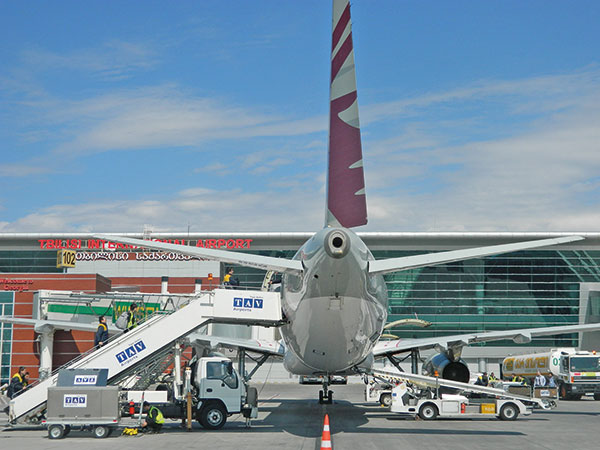
TAV has a controlling 80% stake in the company responsible for operating Georgia’s Tbilisi International Airport.
TAV Airports Holding
World headquarters: Istanbul, Turkey.
Airport investor since: 1997.
Airports 100% owned and operated: Ankara Esenboğa, Izmir Adnan Menderes, Milas-Bodrum and Alanya-Gazipasa in Turkey and Skopje Alexander the Great and Ohrid St Paul the Apostle airports in Macedonia.
Others: TAV has a 49% shareholding in Turkey’s Antalya Airport with equal voting rights; a controlling interest in the companies responsible for operating Tbilisi (80%) and Batumi (76%) airports in Georgia and a majority 67% stake in both Monastir Habib Bourgiba and Enfidha-Hammamet airports in Tunisia.
In Saudi Arabia, the TAV-led Tibah Airports consortium (TAV, Saudi Ogerand and the Al Rajhi Holding Group each hold a 33.3% stake) has a 25-year concession to operate Medina’s Prince Mohammad bin Abdulaziz International Airport.
In Europe, TAV has a 15% stake in the ZAIC consortium which has a 30-year concession to operate and develop Zagreb Airport in Croatia. Its consortium partners in Zagreb include ADP International, Bouygues Bâtiment International (BBI), Croatian construction company, Viadukt, Marguerite Fund and IFC. Elsewhere, TAV operates the commercial spaces at Latvia’s Riga International Airport.
Plans to expand/reduce portfolio: TAV is part of the consortium with Groupe ADP and Bouygues Batiment that has been invited for negotiations to discuss possible concessions to modernise and operate Cuba’s Havana and San Antonio de los Banos airports. The company has previously expressed an interest in buying shares in Sabiha Gokcen Airport in Istanbul, Turkey, and admits to eyeing airport privatisation opportunities in the Middle East, Eastern Europe, Africa and the CIS countries.
News: TAV Airports acquired a 49% stake in Antalya Airport operator, ICF Antalya (now Fraport TAV Antalya), early last year as it began to plan for life without Istanbul Atatürk ahead of its scheduled March 2019 closure. The latest deals mean that TAV and its subsidiaries/partners – global airport operator Groupe ADP holds a 46.12% stake in TAV Airports – have a footprint of 76 airports in 21 countries.
Next chapter for TAV
The opening of Istanbul’s new airport and imminent closure of Atatürk means that for the first time in 19 years, Turkey’s biggest airport won’t form part of TAV Airports’ global portfolio.
Atatürk ended the last full calendar year of its life as Turkey’s international hub to the world by handling a record 68 million passengers and 454,000 flights in 2018.
Its closure leaves TAV Airports with quite a hole to fill, but as CEO, Sani Sener, reveals, it is a scenario that they are more than ready for after preparing for it for the last five years. “As no single project can replace Atatürk, our strategy has focused on the organic growth of our existing portfolio, and inorganic growth through winning new airport projects and promoting our service companies to grow beyond TAV,” says Sener.
“As of now, this strategic change has paid off. The addition of Antalya Airport – which is the second busiest in Turkey in terms of international traffic – and the expansion of our global footprint to 62 other airports through our service companies, has recovered almost half of our expected losses.”
Sener says that TAV’s investment criteria focuses on two main points. “Firstly, we strive to create added value for all our stakeholders in a sustained manner. Secondly, we won’t invest in any project that is beyond our financial capabilities and operational abilities,” he reveals.
“As a public company, we’re responsible to our partners, shareholders, employees and business partners Therefore, good governance, responsible investing and accountability, are at the heart of our business conduct.
“Within this framework, we are looking for new opportunities on a global scale. ACI expects a 4.1% compound annual growth rate in global air traffic between 2017 and 2040. Accordingly, major investments will be needed in airport infrastructure to meet the demand.
“With a unique business model to provide integrated services in all areas of airport operation and a successful track record of PPP and BOT projects, TAV is well placed to benefit from this trend.”
What key lessons has TAV Airports learned from operating in the global arena for over 20 years? “Seizing the moment and taking the right opportunity at the right time is very important,” remarks Sener. “We realised and understood the value of airports early on in the privatisation process and recognised the growth potential of air travel.
“This foresight and the resilience of the aviation industry, which has seen passenger numbers continue to grow despite economic, political and social impacts worldwide, has helped establish TAV as a global brand.”
He goes on: “It is easy to forget that when we entered this business, Turkey’s airports were only handling 30 million passengers per year. Today, the figure is over 200 million. Our first airport, Ataturk, used to welcome 10 million passengers per year, and now it has 68 million passengers per year. We captured and forecasted this tremendous growth. This is the primary reason for the success of TAV.”
Sener also believes that TAV’s ability to manage and complete projects on time, on budget and with “desired quality” have proven key to the company’s success as has its commitment to sustainable development.
He concludes: “We have placed ourselves in a superb strategic position and therefore the future is now all about smart growth strategies.”
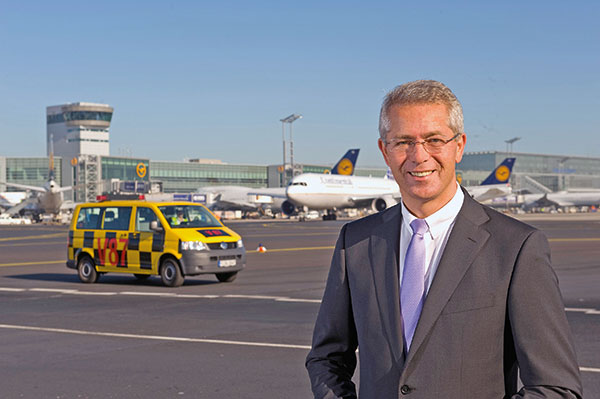
Fraport’s Dr Stefan Schulte says that his company makes targeted investments in airports that have considerable growth potential.
Fraport AG/Frankfurt Airport Services Worldwide
World Headquarters: Frankfurt, Germany.
Airport investor since: 1997.
Airports 100% owned and operated: Frankfurt Airport in Germany and Ljubljana–Jože Pučnik Airport in Slovenia.
Others: Through its 73.4% majority stake in Fraport Greece, Fraport AG operates 14 regional airports in Greece that include Thessaloniki, Aktion, and Kavala on the mainland and the island airports of Corfu; Kefalonia; Kos; Mykonos; Rhodes and Zakynthos.
Elsewhere in Europe, Fraport has a 25% stake in Northern Capital Gateway, the operator of St Petersburg–Pulkovo Airport in Russia; a majority 60% shareholding in the Fraport Twin Star Airport Management consortium responsible for running Bulgaria’s Black Sea gateways of Burgas and Varna; and owns 51% of Antalya Airport concessionaire, Fraport TAV Antalya, in Turkey.
In Latin America, Fraport has a controlling 70.1% interest in Lima Airport Partners (LAP), which operates Jorge Chavez International Airport in Lima, Peru, and through 100% owned Fraport Brasil holds long-term concessions to manage and develop Fortaleza’s Pinto Martins International Airport (25 years) and Porto Alegre’s Salgado Filho International Airport (30 years) in Brazil.
In Asia, Fraport AG has a 24.5% share in Xi’an Xianyang International Airport in China and a 10% shareholding in the DIAL consortium formed to operate and develop Delhi’s Indira Gandhi International Airport in India. Fraport is also a minority partner (18.75%) in Tradeport Hong Kong Ltd, operator of a high-tech logistics centre at Hong Kong International Airport.
In the US, it wholly-owns Fraport USA, a concessions developer for airport shopping and F&B areas. The company currently operates at five US airports – Cleveland, Pittsburgh, Baltimore/Washington, Nashville and New York-JFK where it has a contract with JetBlue for Terminal 5.
Plans to expand/reduce portfolio: Fraport continues to look for new opportunities around the world and further expansion is on the cards with Fraport admitting that it is closely watching the markets in Brazil and elsewhere in Latin America.
News: Last year, Fraport added two Brazilian airports (Fortaleza and Porto Alegre) to its portfolio, while fully divesting its small minority stake in Hanover Airport in Germany. Fraport USA launched new concessions at New York-JFK in April 2018 and at Nashville in February 2019. As a result, the Fraport Group is now active at 30 airports worldwide, including the five Fraport USA locations.
Talking about Fraport Brasil taking over the concession for Fortaleza and Porto Alegre airports in January 2018, Dr Stefan Schulte, chairman of the executive board, says: “Our mandate is to enhance the passenger experience while strengthening the role these airports play for their respective regions and stakeholders.”
International pioneer
Fraport AG has a long track record of investing in airports outside of Germany, ensuring that its international assets today play a key role in the company’s overall success.
“Achieving traffic and financial growth – at Frankurt and globally – is one of our five core goals underlying Fraport’s corporate mission,” notes Dr Stefan Schulte, chairman of executive board of Fraport AG.
“For the Group, in particular, this means continuously expanding Fraport’s international portfolio and increasing revenue gained from the international business over the long-term.
“We do this by making targeted investments in airports that have considerable growth potential and by systematically leveraging potential for development and improvement, as well as by transferring our expertise from Frankfurt to our airports worldwide.
“Ultimately, the aim is to position the Fraport Group on an even broader and stronger foundation for long-term profitability – for the benefit of employees, customers and partners.”
In fiscal year 2017, international activities and services segment (which includes Fraport’s international investments) accounted for 27.8% of the Fraport’s Group revenue and 32.4% of its EBITDA.
He notes that Fraport Greece’s ambitious €415 million construction programme at its 14 Greek regional airports is in “full swing”, with completion of all the planned upgrade projects expected by the end of 2021. They include a new terminal at Thessaloniki Airport with work starting on the project in September 2018 as part of a €100 million enhancement package.
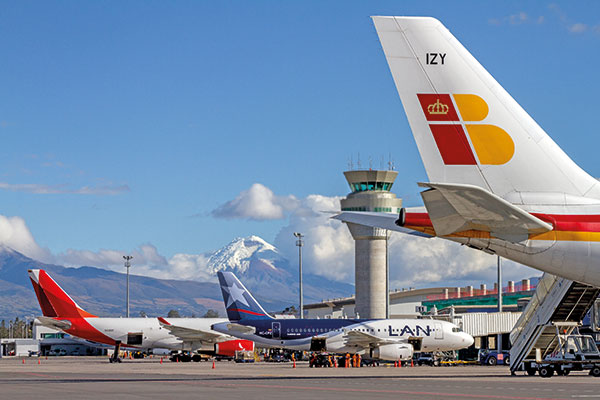
Quito’s Mariscal Sucre International Airport is one of the most modern gateways in Latin America.
CCR Group
Head office: Saõ Paulo, Brazil.
Airport investor since: 2012.
Airports 100% owned and operated: None.
Others: CCR Airports, the wholly-owned airports division of the CCR Group, has a 75% stake in the private consortium which has a controlling 51% interest in the concessionaire awarded the rights to operate Brazil’s Belo Horizonte International Airport for 30 years.
Elsewhere in Latin America, it has a 50% stake in Corporacíon Quiport, operator of Quito’s Mariscal Sucre International Airport in Ecuador; and a 97.25% interest in Costa Rica’s San José–Juan Santamaria International Airport courtesy of operator, AERIS Holding Costa Rica.
In the Caribbean it owns 79.8% of the shares in Curaçao Airport Partners NV (CAP), which operates Curaçao International Airport.
CCR also has a 70% stake in Total Airport Services (TAS), an aviation service company that provides cargo, passenger, ramp, ground handling and warehousing services at eight US airports that include Hartsfield-Jackson Atlanta (ATL), Chicago O’Hare (ORD), Los Angeles (LAX) and San Francisco (SFO).
Plans to expand/reduce portfolio: CCR Airports states that it is potentially interested in any project that meets the company’s investment criteria and commitment to infrastructure development.
News: CCR purchased Airports Worldwide Holding BV’s shares in AERIS Costa Rica in May 2018 to take a controlling 97.5% interest in the company responsible for operating Costa Rica’s capital city gateway.
Although a growing force in the airport market with 2,400 employees and annual revenues of $267.4 million, CCR Group’s huge network of toll roads and other interests in railways and ports in Latin America means that airports still account for less than 10% of its gross revenues.
Careful expansion for the CCR Airports
Created to manage the airports under the responsibility of the CCR Group, CCR Airports now has major or controlling stakes in the operators of four airports in Latin America and the Caribbean and a 70% shareholding in US airport focused service company, Total Airport Services (TAS), which has a presence at eight airports across the country.
In Eduardo Camargo, CCR Airports has a CEO with experience of operating in the global arena having previously been responsible for representing CCR in the international market from 2007 to 2009.
He notes that over the last two decades the CCR Group has stood out for its capital discipline and precise analysis for the acquisition of new assets, and believes that this strategy serves it well in the airport industry.
“We believe that there are good opportunities for investments in the global market, however, every project needs to be analysed on an individual basis to ensure that it aligns with the governance and capital discipline policy that have made the CCR Group one of the largest players in the Latin American market,” says Camargo.
“In recent years, CCR Airports has taken advantage of some timely opportunities to place it as one of the main airport operators in the region. We recently increased our share in Juan Santamaria International Airport, in San Jose, Costa Rica, for example, and another important action in this sense was the acquisition of Total Airport Services (TAS) in 2015, as it expanded the company’s operations to the United States, one of the largest global markets.”
Does CCR Airports view its airport acquisitions as short or long-term investments?
“Infrastructure projects are very much seen as long-term investments due to the intense cycles of work and investment involved over the period of the concession agreement,” Camargo tells Airport World.
“Our expansion to date has been in the Americas, and we now have teams based in Houston in the United States and São Paulo in Brazil, but this doesn’t mean that the company can’t see good opportunities in other markets in other parts of the world.
“The acquisition of TAS in the United States shows the direction that CCR Airports intends to explore businesses in the near future, expanding our territory and services.”
Talking about the lessons CCR has learned from operating in the global market, Camargo says: “I believe there’s no secret formula for success. Companies must achieve their goals based on a concrete model of management and corporate governance, engaging their internal audience.
“CCR is a 20-year-old company, with a history of success based on clearly defined rules and strong commitment to enhancing infrastructure. In the case of airports this means better facilities, improved security and services and a better airport experience. That’s what encourages us to keep exploring new markets, territories and challenges.”
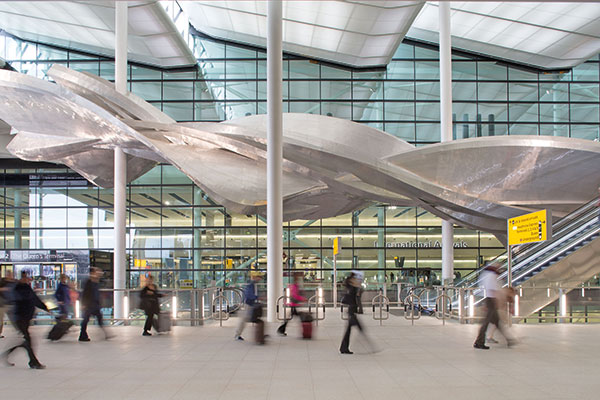
London Heathrow handled a record 80.1 million passengers in 2018.
Ferrovial Airports
World Headquarters: Madrid, Spain.
Airport investor since: 1998.
Airports 100% owned and operated: None.
Others: Ferrovial Airports has a 25% stake in London Heathrow Airport and a 50% interest in AGS Airports which owns and operates the UK gateways of Aberdeen, Glasgow and Southampton.
In 2017, the company re-entered the US market when its Great Hall Partners consortium was awarded a 34-year contract to redevelop and operate the Great Hall in Denver International Airport’s Jeppesen Terminal. Ferrovial Airports has a majority 80% stake in the consortium.
Plans to expand/reduce portfolio: After consolidating its current portfolio, Ferrovial Airports is actively looking to identify new opportunities in the global market, placing a particular focus on the US.
Back in the game
It is easy to forget that Ferrovial Airports was once one of the biggest global airport operators on the planet with a portfolio of assets across Australasia, Europe, Latin America and the US.
Indeed, the company has been involved in the aviation industry since 1998 and has more than 20 years’ experience of investing, developing and operating 34 airports around the world. Its former assets included interests in Aeropuertos del Sureste (ASUR), BAA, Bristol and Belfast airports in the UK, Cerro Moreno International Airport in Chile and Sydney Airport in Australia among others.
However, after a period of consolidation when it shed most of its assets either because it had no choice (the UK’s Competition Committee forced it to sell Gatwick, Stansted and Edinburgh airports) or by its own doing to help raise funds to invest in Heathrow and AGS Airports, Ferrovial Airports is once again looking to expand its global portfolio.
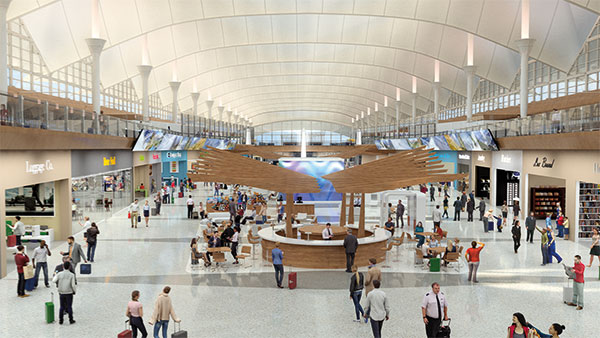
The shape of things to come for the Great Hall in Denver International Airport’s Jeppesen Terminal.
So what tempted Ferrovial Airports to re-enter the global airport investment market at Denver in 2017 and how will the project work in terms of targets and development timescales?
CEO, Jorge Gil, opens by pointing out that Ferrovial never left the global stage, noting that it participated in a number of privatisation processes around the world before winning the Denver Great Hall concession.
“First, I would like to state that our involvement in the remodelling and commercial operation of the Jeppesen Terminal at Denver International Airport did not happen by chance, the fact is that we never left the global airport investment market.
“Over the last six years we have participated in a number of airport transactions such as Puerto Rico, Chicago Midway or Westchester in the US, and other privatisation processes around the world.
“We closely monitor growth opportunities where we are confident that we could create solid, lasting value for all stakeholders involved. The Denver Great Hall concession is one such example of this strategy.”
Talking specifically about Denver, he says: “Our goal for Denver’s Great Hall is simple. We want to create an airport experience that meets the demands of tomorrow’s travelling public and, working in partnership with Denver International Airport, gives each passenger a journey through the facility that’s tailored to their individual needs and tastes.
“To achieve this, we will deliver a new check-in area and arrivals zone, increase the shopping and food and beverage offer, relocate and expand security areas, update terminal systems and technology, and improve building access and passenger flows.”
He admits that Ferrovial Airports would potentially be interested in other similar P3 type projects in the US. “We are a global airport investor and operator and we will continue to monitor opportunities on a global scale,” reiterates Gil.
“Ferrovial provides an integrated approach to development through industry-leading capabilities in design, finance, build, operation and maintenance of infrastructure throughout its lifecycle.
“The US is a strategic growth market for Ferrovial Airports as we expect public-private partnerships (P3s) to arise in the coming years. We have recently opened our US office in Austin that will allow us to be closer to key airport industry stakeholders.
“We also believe that our track record and experience in investing and operating different types of airport uniquely positions us as key player ready to contribute to the much-needed transformation of the US’s aging airport infrastructure.”
He believes that P3s can provide a variety of benefits to cities and municipalities as by partnering with the private sector, public bodies can transfer risks they would normally have to cover themselves.
Other benefits, says Gil, include gaining efficiencies in the design, construction, finance, operation and maintenance of infrastructure assets; access to wider opportunities in terms of CAPEX and asset monetisation, with better access to alternative funding and financing sources; and boosting job creation opportunities for the local community.
According to Gil, P3’s can also act as the catalyst to transform the passenger experience; improve an airport’s commercial offerings while increasing commercial revenues; and find innovative and efficient solutions to lead the transformation of airports.
He notes that Ferrovial’s toll-roads division has carried out a number of successful P3 projects globally.
“There are several approaches to investing in the US that can vary from full privatisation, partial privatisations, terminal management, and long-term lease to design-build-finance-operate-maintain models (DBFOM),” says Gil.
“We have the flexibility to adapt to any of those models. It’s an airport-by-airport approach. We create value for passengers by identifying unique tailor-made solutions for every airport, community, city, region and nation we serve.”
What is Ferrovial’s criteria for investing in an airport and does it view each acquisition as short or long-term investments?
“We only invest in airports in which we believe our long-term, integrated approach can help meet passenger expectations while creating value for customers, employees, shareholders and the communities in which we operate,” states Gil.
“That means we study opportunities on an asset-by-asset basis. We are convinced that traffic records will continue to grow and that the expected rise in demand will help create more airport privatisation opportunities in different regions for us.
“At Ferrovial Airports we create partnerships for the long-term. We are active members of the community and work collaboratively with governments, private businesses and local citizens to achieve their social, economic and environmental objectives.”
Is Ferrovial Airports concerned that BREXIT will have an adverse effect on its UK airports and therefore the airport business as a whole?
“We still don’t know how BREXIT will be implemented and how it will eventually roll out. Although we are closely monitoring its advances, we are not yet in a position to be sure of its impact on the UK airport industry,” explains Gil.
“Having said that, we do not expect BREXIT to cause many disruptions in our airports. So the key question regarding uncertainty over BREXIT is the potential impact it will have on the UK economy and thus its impact on air-traffic demand.
“Nevertheless, Heathrow is a very robust and resilient asset and should be able to easily navigate through that period of uncertainty.”