


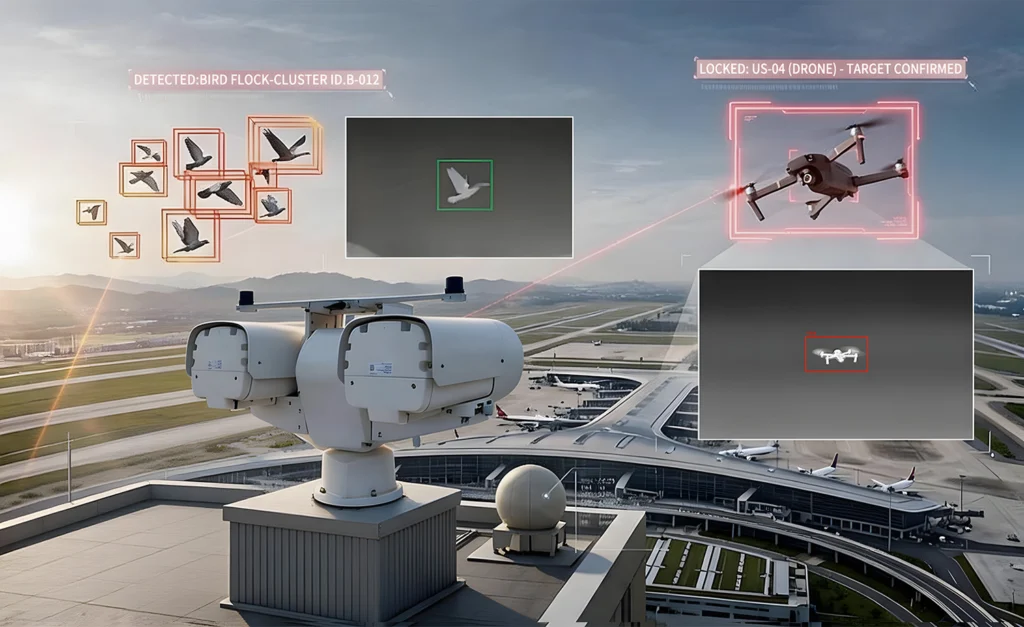
As airports expand and surrounding airspace grows more complex, monitoring low-altitude activity has become increasingly important to aviation safety.
Birds entering flight paths and unauthorised commercial drones operating near airport facilities can create hazards, requiring airport operators to identify aerial targets promptly and coordinate appropriate responses.
For an international civil airport in East Asia, these concerns prompted a security system upgrade in 2026, which involved the installation of Raythink | Raytron Industrial’s low-altitude monitoring solution featuring its multi-spectrum PTZ cameras.
The solution works alongside the airport’s radar and other response systems to help address risks posed by bird activity and unauthorised commercial drones.
The airport serves up to five million passengers per annum, has two runways and covers an operational area of approximately 10–15 square kilometres.
Its extensive outdoor environment and continuous flight operations make reliable monitoring of low-altitude activity an important operational requirement.
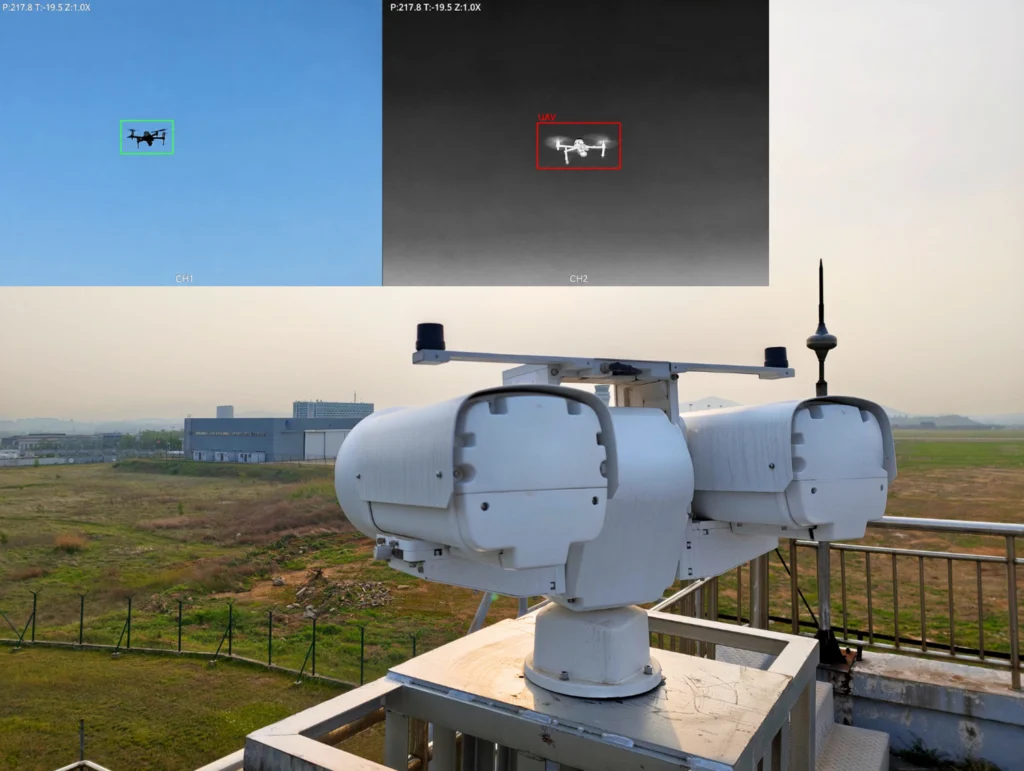
Raythink notes that conventional visible-light cameras alone can struggle to monitor small aerial targets against complex backgrounds, especially at night or under changing lighting conditions.
Therefore, a more integrated approach was needed, combining radar-based detection with optical and thermal imaging to verify and track targets.
INTEGRATING RADAR DETECTION WITH MULTI-SPECTRUM IMAGING
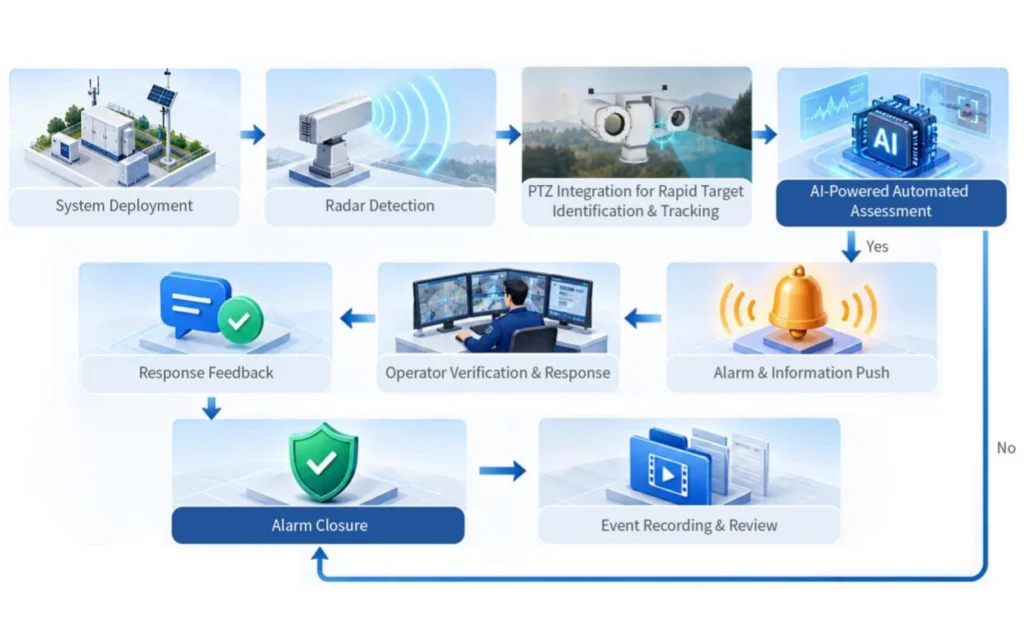
To meet these requirements, Raythink provided a coordinated monitoring architecture that combines radar, multi-spectrum PTZ cameras, and complementary mitigation systems.
Each component serves a distinct role within the broader airport security framework. Radar provides wide-area aerial detection and target location, while Raythink’s multi-spectrum PTZ cameras deliver AI-powered target classification and tracking. The associated deterrence and countermeasure systems support the airport’s response procedures for different types of aerial hazards.
This co-ordinated architecture bridges the gap between target detection and actionable visual information. With its high-speed pan-tilt mechanism, the Raythink PTZ camera can turn toward the target location in as little as 0.5 seconds after radar detection, helping it keep pace with fast-moving aerial targets such as birds and drones.
The Raythink PC6 Series Multi-spectrum PTZ Cameras combine thermal and visible imaging to support target verification and continuous tracking in daytime and nighttime conditions. Thermal imaging provides an additional sensing channel when visible-light images offer insufficient detail, while the visible channel supplies complementary scene information to help operators assess the target.
By combining radar detection with multi-spectrum imaging, the system supports more coordinated monitoring, helping operators move from initial target detection to visual assessment without relying solely on manual camera searches.
PROJECT RESULTS AND FEEDBACK
During the initial trial operation, the integrated system successfully issued early warnings for multiple bird-flock intrusions and drone-approach events. These results demonstrated its ability to support the airport’s low-altitude monitoring and risk assessment procedures.
By integrating radar, Raythink multi-spectrum PTZ cameras, bird deterrence equipment, and counter-drone systems, the project established a coordinated workflow covering detection, identification, tracking, and response.
Operators could visually verify detected targets and support appropriate responses based on target type. Recorded video also provided a basis for subsequent event review and analysis.
The system integrator highlighted Raythink PTZ cameras’ role in connecting radar-based detection with visual verification and downstream response equipment. It noted: “The integration of radar and Raythink’s PTZ cameras gives our operators a clearer view of detected targets and helps us respond more efficiently to bird and drone events.”
After the initial deployment, the project team plans to optimise coordination between system components further and expand monitoring coverage to meet operational requirements, laying the foundation for future airport security upgrades.
EXPLORE THE FULL CASE STUDY
Discover more about this airport security project and how Raythink | Raytron Industrial thermal imaging technology supports low-altitude monitoring. Download the full case study.