




AIRPORT WORLD 2026, ISSUE 04

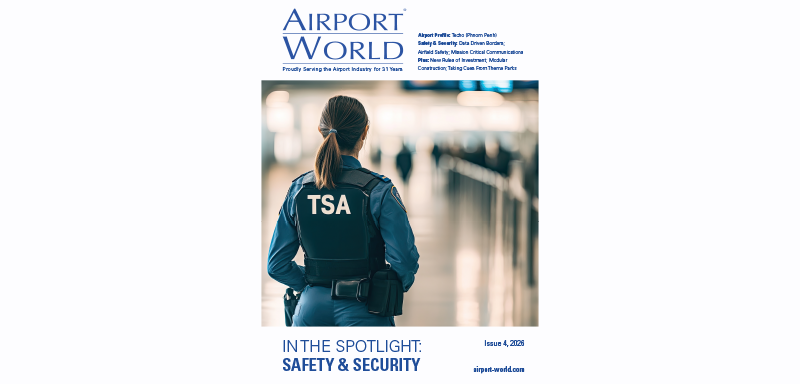
Airport Profile: Techo (Phnom Penh)
Safety & Security: Data Driven Borders; Airfield Safety; Mission Critical Communications
Plus: New Rules of Investment; Modular Construction; Taking Cues From Theme Parks
Clear and present danger
Ensuring the safety and security of the world’s airports is a never ending challenge, writes Joe Bates.
The cyber attack on Manchester Airport Group in the UK and reports of 227 illegal drone flights near Ho Chi Minh City’s Tan Son Nhat International Airport in just 13 days this summer provided another reminder, if ever one was needed, that the safety and security threat to the world’s airports remains a clear and present danger.
The MAG attack led to the personal data of around 8.7 million people being posted online by the hackers, although they failed in their attempt to extort a ransom from the airport group, which operates Manchester (MAN), London Stansted (STN) and East Midlands (EMA) in the UK.
Contact details, vehicle registrations and postcodes were stolen in the breach that appears to have accessed databases containing Wi-Fi log in and car parking details.
Reflecting on the incident, Graeme Stewart, head of public sector at Check Point Software, noted: “We warned after the attacks on the automotive sector last year that aviation needed to move onto a war footing. This feels like the moment that warning becomes very real.
“Aviation needs to behave as though a sustained campaign has begun, because waiting for an attack that stops planes moving before treating this as serious would be a dangerous mistake.”
Cyber attacks arguably pose one of the biggest security challenges ahead for the technology dependent aviation industry which has traditionally focused more on physical threats.
Indeed, as you will be able to read more about in this ‘safety & security’ themed issue of Airport World, airports continue to invest in new technologies and processes and procedures to combat everything from hidden weapons and explosives in baggage to the relatively new threat of drones.
From an airfield safety perspective, ACI, IATA and CANSO recently launched a pioneering joint initiative to reduce the risk of runway incursions, which remain a global challenge for the industry (see page 20).
Other airfield related stories under the spotlight in this issue include Bengaluru-Kempegowda’s runway safety initiatives; and the use of autonomous vehicles/robots for a growing number of activities on aprons, taxiways and runways.
The themed section also includes features about cyber resilience, digital borders, mission critical communications, and the EU’s new Entry/ Exit System.
Elsewhere in the issue we have features about how airport sustainability goals can impact on their PPP appeal; and the impact new technology will have on the way future airport facilities are designed and built.
Our main airport feature is on Techo International Airport, Cambodia’s new gateway to the world, which has made a hugely favourable impression on both passengers and the airlines in its first year of operations.
If that’s not enough, we also have articles about whether airports need to embrace a little theme park magic when it comes to managing queues and enhancing the customer experience; and the benefits of modular construction.
We round the issue out with our ‘business exchange’ pages and sustainability news about hydrogen-powered ground equipment trials in the UK and the new fleet of electric buses at Sydney Airport in Australia.
I hope you’ll agree that it’s another cracking issue of your favourite airport magazine.