

Keith Hui, FAIA, HOK’s regional leader of aviation and transportation considers the case for the creation of sensory terminals that are a welcome space for all.
Public spaces should be universally accessible and enjoyed by everyone.
As one of the most complex and high-stress public environments, airports welcome people of all ages, abilities and backgrounds – often under strict time constraints and in sensory-dense settings.
The World Health Organization estimates that 16% of the global population lives with a significant disability, and roughly one in five people is considered neurodivergent.
For travellers experiencing physical, cognitive or sensory differences, navigating an airport can be especially challenging. Accessibility now means more than mobility. It also covers sensory, cognitive and neurological needs.
The aviation industry is beginning to rethink how terminals support these travellers. Accessibility should be embedded throughout the traveller journey, from circulation and respite spaces to wayfinding, lighting, acoustics and materiality.
While sensory rooms are an important step forward, they often isolate support into a single space. What if, instead, airports became sensory terminals with inclusive design strategies that benefit everyone?
Below are five inclusive design approaches drawn from recent terminal projects that make airport journeys more physically accessible and sensory friendly, benefiting all travellers.
1. RAMPS FOR LEVEL CHANGES
Lifts in airports are often located away from central circulation, forcing travellers who rely on them to bypass key public spaces.
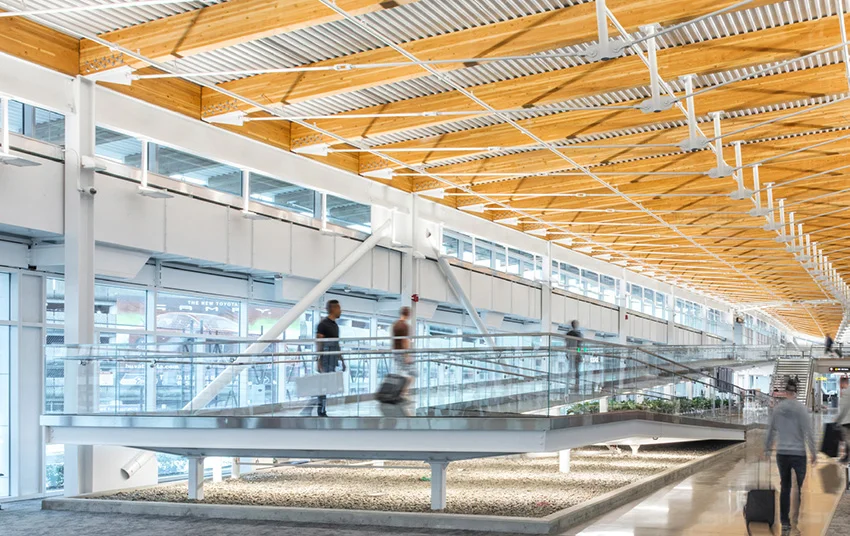
Ramps for level changes allow users to enjoy the same experience as everyone else, including retail, dining, public art and other amenities without detours. They are also simpler to maintain and more reliable compared with lifts and escalators.
At Seattle-Tacoma International Airport’s (SEA) Concourse D Annex, HOK’s design added a central ramp connecting levels within the six-gate hardstand facility. The ramp improves accessibility while maintaining a clear, continuous traveller journey.
2. AREAS FOR RESPITE
Workshops with airport stakeholders and surveys reveal that travellers with reduced mobility want more opportunities to pause and rest, especially along long routes between check-in, gates and arrivals.
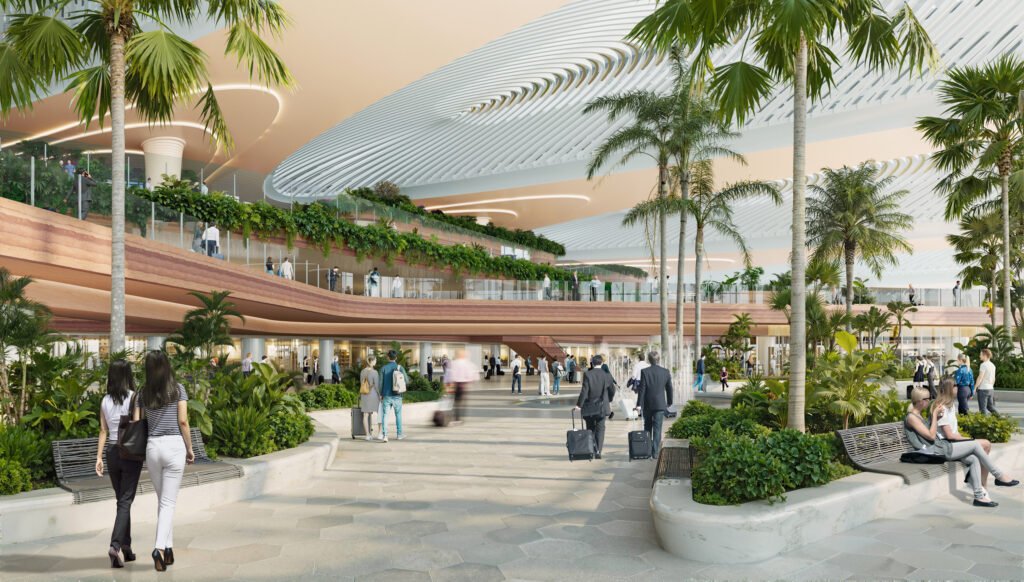
Effective respite spaces include varied seating, biophilic and organic elements, curated artwork and culturally grounded design features to create a relaxing environment.
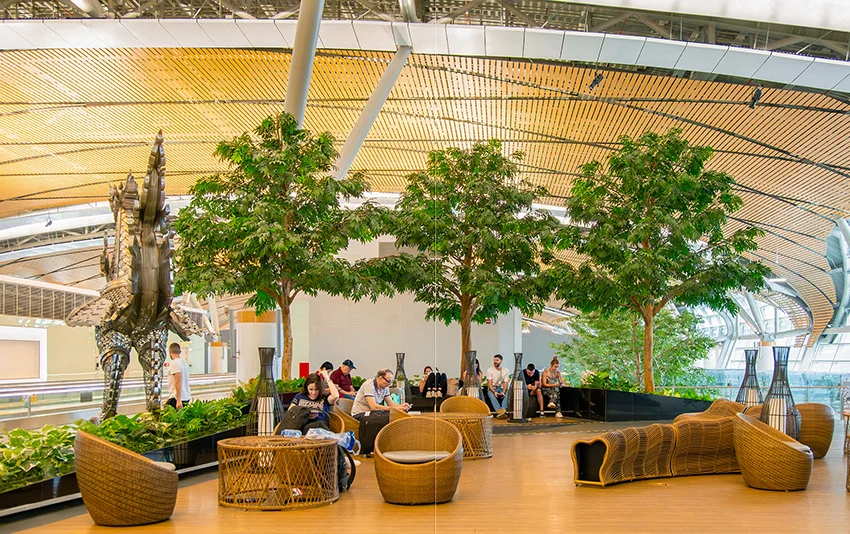
At Suvarnabhumi International Airport in Thailand, lounge “living rooms” are strategically placed along the length of a new 900-metre midfield satellite concourse.
These spaces feature live plantings, wooden accents, expressive lighting, culturally reflective artwork and textured surfaces such as woven rattan seating, a material native to southern Thailand.
In Vietnam, HOK’s design for the new Phu Quoc International Airport includes respite spaces that reflect the tropical environment.
A post-security grand hall features a gently meandering pathway with seating, palm trees and native vegetation. A viewing gallery also lets travellers pause in a daylit space to watch aircraft taking off and landing.
3. INTUITIVE WAYFINDING AND TECHNOLOGY
With dense signage, announcements, screens and long corridors, airports can easily overwhelm travellers. Designers can reduce information overload by streamlining visual cues and prioritising wayfinding.
Clear sightlines, simple patterns, consistent visuals and logical adjacencies reduce reliance on excessive messaging.
Digital tools further support this by delivering personalised, real‑time updates such as navigation and gate status directly to travellers. This gives them more control over how they receive information and engage with retail and dining.
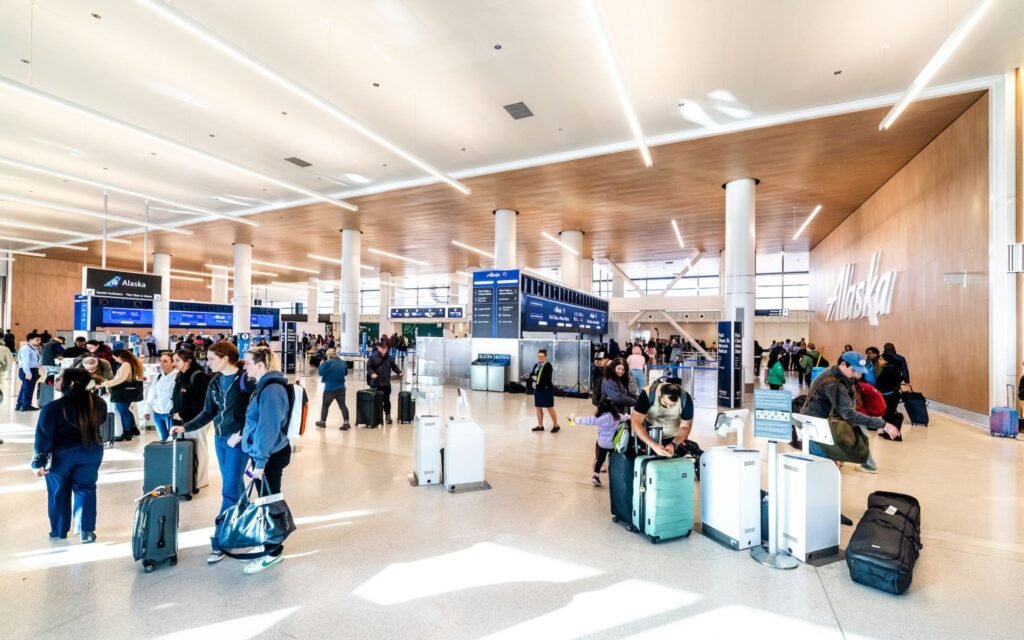
At SEA’s North Main Terminal renovation for Alaska Airlines, HOK’s design prioritised intuitive wayfinding by removing redundant entry points, underutilised equipment and a mezzanine level. These changes transformed the check‑in hall into a double‑height space with clear sightlines that help travellers immediately understand where to go next.
SEA is also piloting new bag-tag and automated bag-drop technology, giving travellers more choice in how they check baggage while reducing queuing and congestion. The result is a terminal that communicates through space first, with technology supporting, rather than competing with, the experience.
4. THOUGHTFUL LIGHTING AND ACOUSTICS
Lighting and sound play a critical role in shaping the comfort and clarity of an airport. When carefully co-ordinated, lighting can define spaces, create ambience and support task‑focused activities, while acoustic strategies reduce sensory overload, especially for sensory‑sensitive travellers.
Warm, biophilic lighting in lounges encourages relaxation, while neutral white artificial light in security processing promotes focus.
Complementing these strategies, acoustically absorptive materials, textured surfaces and varied finishes help minimise reverberation and reduce competing background noise.
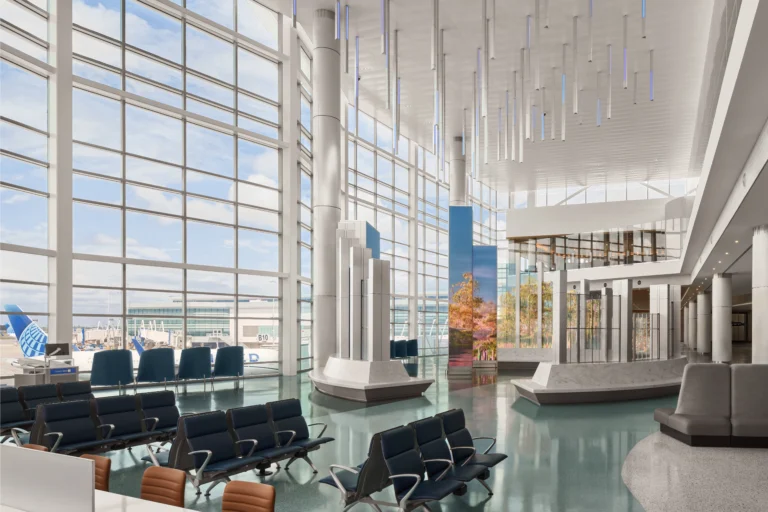
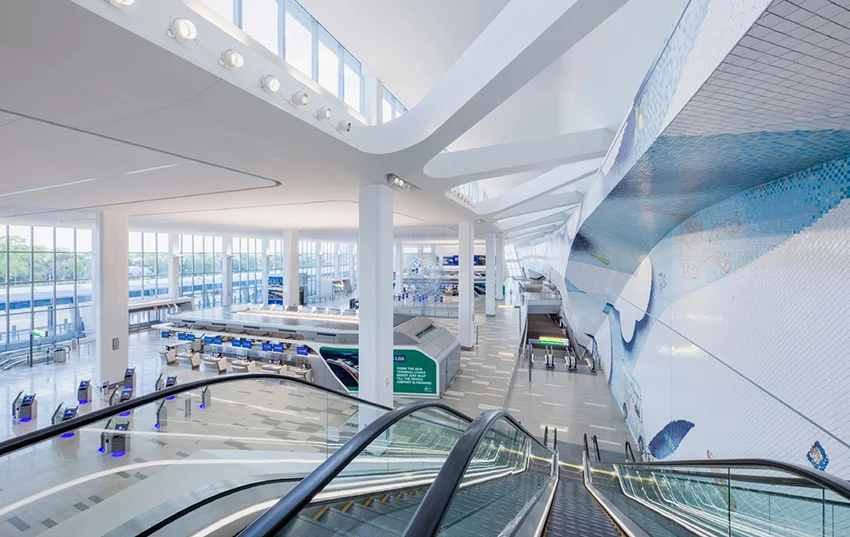
At LaGuardia Airport’s new Terminal B, full height glazing at the terminal entry introduces daylight and views to the outdoors. A clerestory window above the check-in circulation area reinforces directional movement and highlights art and organic architectural elements.
These light‑filled spaces are paired with material strategies that help control sound, preventing large areas from becoming acoustically overwhelming.
5. BRING TRAVELLERS BACK TO NATURE
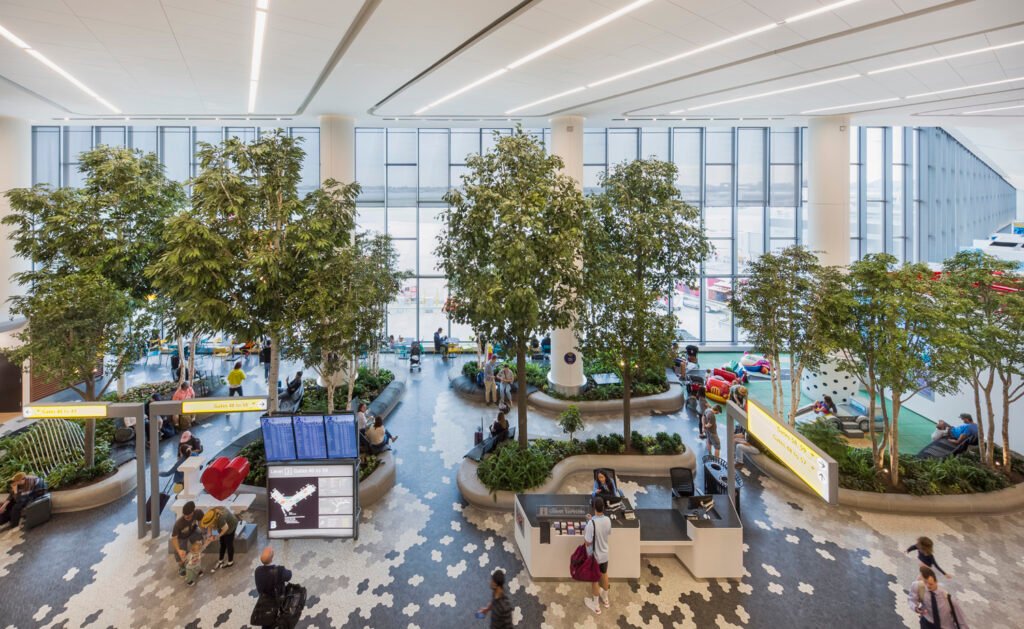
Biophilic design mimics nature through colour, forms, textures and patterns. Incorporating these elements into a terminal helps humanise the airport experience and create a calmer, more intuitive environment.
Exposed wood, warm earth-toned palettes and nature-inspired furnishings introduce visual softness into airports. Organic patterns in carpets, lighting and wall treatments also subtly reference the natural world. These strategies support neurodivergent and sensory‑sensitive travellers while enhancing comfort, dwell time and overall perception of the terminal.
In Northern California, HOK is designing the new Monterey Regional Airport with nature in mind. The five‑gate terminal features a mass timber structure that reflects the region’s landscape, along with earthy materials and warm accents. A lush pre‑security courtyard further connects travellers to the outdoors.
CREATING A MORE ACCESSIBLE AIRPORT FOR EVERYONE
Accessible airports are created by designing the terminal as a cohesive, sensory-supportive environment. Circulation is intuitive, places for pause are embedded throughout the journey, and light, sound, materials and technology work together to reduce stress and improve clarity.
These strategies support travellers with a wide range of physical, cognitive and sensory needs while enhancing comfort and ease of navigation for all passengers.
While accessibility is the foundation, inclusion is about designing terminals for everybody who passes through them. Designers should create spaces where every traveller feels considered, not just accommodated.
For airport operators, the value is clear. Terminals that are easier to navigate improve traveller flow, reduce friction and strengthen performance.
As expectations for accessibility and passenger experience continue to evolve, sensory-informed inclusive design will become a defining feature of high-performing airports.