

A new 5G mission-critical communication system has enhanced safety and operational efficiency at China’s Xi’an Xianyang International Airport, writes Hytera’s Leo He.
Xi’an Xianyang International Airport’s new 5G MCX mission-critical communication system was delivered in partnership with Hytera.
The system supports high-bandwidth, high-reliability operations across all departments and covers four terminals and other key facilities spread across the gateway’s 24 square kilometre campus.
The partnership with Hytera was part of the airport’s Phase III expansion project to boost capacity and operational efficiency, with the airport deploying a digital-first communication system to meet the growing demands of safety, co-ordination, and real-time responsiveness.
And the project’s impact has been independently recognised, last year receiving an innovation award at the 2025 Digital City Forum organised by the China Information Association.
The recognition effectively affirms the airport’s leadership in smart airport development and highlights the project’s value as a replicable benchmark within broader digital city construction.
OBJECTIVES
From the outset, Xi’an Xianyang International Airport faced a challenge common to many large aviation hubs: communication systems were fragmented, difficult to scale, and increasingly misaligned with the airport’s growing operational complexity.
The project objective was not simply to upgrade technology, but to build a unified, future-ready communication platform capable of supporting frontline operations, centralised command, and emergency response in real time.
TECHNOLOGY DEPLOYED
In total, 1,116 Hytera PNC560 5G MCX devices – a mission-critical smart device that combines the productivity of a smartphone with the reliability of a professional radio – were deployed across twelve critical departments, including air cargo logistics, ground handling, the Operations Control Centre (OCC), security, maintenance services and passenger services.
The smart terminals enable airport staff to perform multiple functions in the field — from scanning cargo and submitting digital work orders to initiating voice or video calls with command centres.
Each device leverages the high-speed 5G network to ensure low-latency communication, precise positioning, and secure data exchange, all of which are essential for the airport’s daily operations.
X’ian Xianyang International Airport stated: “By deploying a dedicated 5G private network, 5G-enabled smart terminals, and a converged communication dispatch platform, we have enabled core airport operations – from command and emergency response to security, firefighting, and ground services – to operate with real-time digital mobility.
“This project resolved long-standing interoperability challenges and established an integrated communications foundation that supports both current operations and future evolution.”
While Hytera’s West China regional director, Haiming Ding, noted: “Every successful critical communication deployment starts with a deep understanding of customer needs.
“For Xi’an Xianyang International Airport project, we worked closely with the airport team to deliver a reliable and intelligent communication solution that improves co-ordination and operational efficiency.”
OUTCOMES AND BENEFITS
The broadband system integrates voice communication, HD video, real-time positioning, digital work orders, and security inspection scanning, transforming inspection, emergency response, and collaborative dispatch from a “passive reporting” model to “active situational awareness.”
In pilot operations with the Xi’an Xianyang International Airport maintenance team, system management and response times improved by up to 80% compared with legacy private network operations, enabling faster decision-making and more co-ordinated field operations.
And by retiring traditional narrowband radios and independent spectrum leases, and consolidating onto a unified broadband communication platform, the solution enabled hardware reuse, centralised operations management, and reduced losses.
As a result, combined savings from spectrum rental and manual inspection costs are approximately $55,221 per year, demonstrating the solution’s operational and financial effectiveness with real-world regional validation.
RELIABLE COMMUNICATION WHERE IT MATTERS MOST
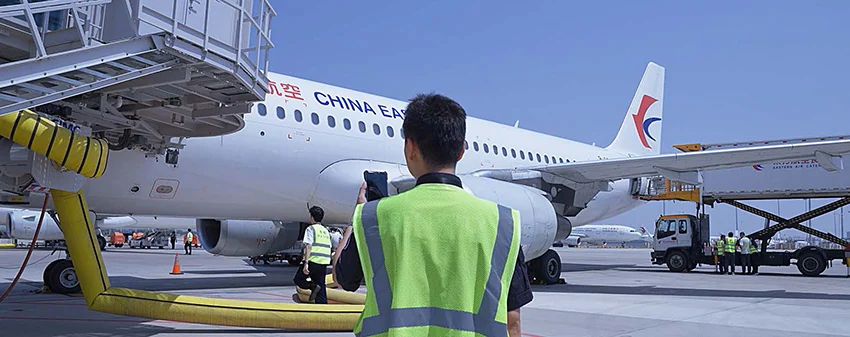
A dedicated 5G private network now provides stable, uninterrupted coverage across baggage handling areas, aircraft aprons, and service roads – environments where reliability is critical but traditionally difficult to guarantee.
Real-time push-to-talk and multimedia messaging allow ground crews to co-ordinate loading, unloading, and transport with greater precision.
As a result, baggage transfer efficiency has improved, operational errors have been reduced, and on-time performance has become more predictable, directly contributing to a better passenger experience.
SECURITY AND EMERGENCY RESPONSE
Security and inspection teams now operate with dynamic patrol routing, instant alerts, and one-touch emergency video calls.
When incidents occur, frontline personnel can transmit live real-time frontline situation awareness to command units immediately, enabling faster assessment and more informed decision-making.
Each terminal is equipped with an emergency button that triggers cross-department co-ordination, instantly engaging fire, medical, and police teams. This capability has strengthened both daily safety management and the airport’s ability to respond decisively under pressure.
AIRPORT OPERATIONS CENTRE: PRECISION, VISIBILITY, AND ACCOUNTABILITY
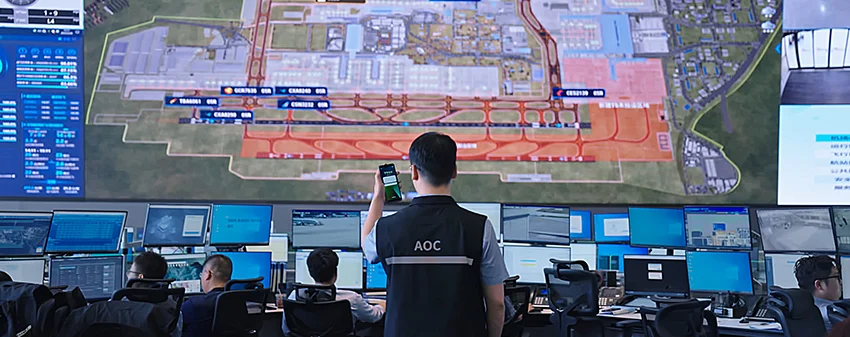
At the Airport Operations Centre, high-precision positioning and centralised dispatch provide decision-makers with full situational awareness.
Whether responding to severe weather disruptions or reallocating resources during peak travel periods, the AOC can track personnel movements, issue precise instructions, and maintain complete communication records.
This ensures accountability, traceability, and disciplined command execution across all departments.
SCALABLE SOLUTION AND SETTING NEW BENCHMARKS
As Phase III of the airport’s expansion progresses, this communications foundation will support Xi’an Xianyang International Airport’s evolution into a multimodal transportation hub, seamlessly connecting air, rail, and highway networks.
Through this initiative, Xi’an Xianyang International Airport has demonstrated how mission-critical communication technology can move beyond basic connectivity to become a true enabler of efficiency, safety, and resilience.
The project has arguably set a clear benchmark for digital airport transformation – one that is practical, scalable, and ready to support the future of global aviation.
Xi’an Xianyang International Airport is the largest airport in Northwest China handling around 50 million passengers annually.