



Finding room to grow

Airport modernisation in a constrained environment is a challenging balancing act, but not an impossible one, explains Crawford Burden, AECOM’s aviation lead for Europe & India.
Increasingly, today’s airports are being forced to grapple with the twin challenges of rising passenger demand and ageing infrastructure, requiring the sector to expand or upgrade – or some combination of the two.
While new runways and terminals often dominate the headlines, large-scale expansion is not always feasible –whether due to available space, cost or public scrutiny.
This means many airports must find ways to optimise the assets and facilities they already possess, which can in some instances be even more challenging.
Airports operate around the clock under intense operational and regulatory pressure. This can make them one of the most demanding environments in which to deliver major infrastructure programmes – and also explains why expansion is often the preferred route.
For boxed-in airports, however, constrained by their surroundings, upgrading critical systems, reconfiguring spaces and introducing new infrastructure within a live operational environment – often within tight windows and with no tolerance for disruption – is necessary.

For it to work first time, targeted modernisation must come down to two priorities: prioritising efficiency and improving sustainability.
DESIGNING FOR EFFICIENCY IN A LIVE ENVIRONMENT
When expansion is constrained, the challenge is to do more with less, and therefore improving efficiency becomes the most effective way to increase capacity.
By looking at the airport as a connected system, operators are identifying improvements across airfield operations, terminals and baggage handling, unlocking significant gains.
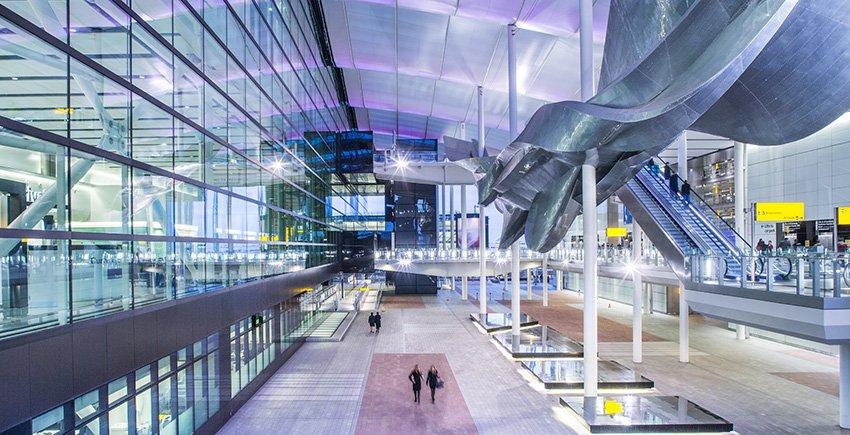
At Heathrow Airport’s Terminal 2, for example, we’ve supported upgrades to the baggage system within a fully operational terminal. It’s the kind of work passengers rarely see, but it has a direct impact on their journey.
Baggage systems are highly complex and tightly integrated with airline operations. Introducing new technology and increasing capacity in that environment requires precise planning, testing and co-ordination.
We are also part of the project and construction management office team at Athens International Airport. Here, we are responsible for the delivery of a complex fourteen million passenger expansion in a highly constrained live environment, where capacity, operational integrity and commercial revenue performance must be maintained throughout the programme.
In both cases, work must be sequenced carefully, often taking place overnight or in short operational windows. Every intervention must be aligned with airline schedules, security requirements and passenger flows.
There is little room for error, and success depends on close collaboration between the airport, its partners and the expert delivery team.
The same principles apply on a larger scale. Most international airports expect to see passenger volumes grow significantly in the coming years, with global traffic projected to double by 2045 from the 10.2 billion expected in 2026, according to ACI World.
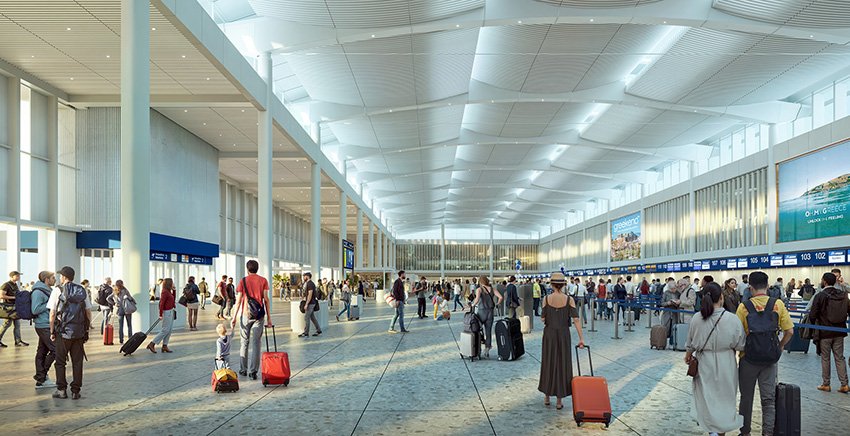
To support that growth, many airports are now grappling with airfield upgrades, terminal improvements and expanding gate capacity, all delivered within a live operating environment.
What is important in both cases is not just the scale of investment, but how it is delivered. Efficiency gains come from co-ordination.
By aligning design, construction and operations, it is possible to improve throughput, reduce congestion and create a smoother passenger journey without major physical expansion.
Passengers may not notice a new taxiway or a reconfigured baggage system, but they will notice shorter queues, more reliable departures and a more intuitive journey through the airport.
In that sense, efficiency is not just an operational goal. It is central to the overall passenger experience.
INCORPORATING SUSTAINABILITY INTO INFRASTRUCTURE
Sustainability goes hand-in-hand with modernisation and, for airports looking to expand or upgrade, it should form the crux of their future planning.
Today’s passengers have greater expectations for environmental sustainability, as the aviation sector comes under increasing scrutiny for its emissions and carbon impact.
The most effective approach is to treat sustainability as part of the infrastructure itself, rather than as an overlay. That is particularly important when working in live environments, where retrofit solutions must be integrated into existing systems without affecting operations.
Airports looking to introduce new sustainability initiatives, such as low-carbon energy systems, expanded electric vehicle infrastructure and on-site renewable power generation, need to take care not to treat these projects as standalone measures.
Instead, they should be designed to sit alongside operational upgrades, seeking to improve both environmental performance and long-term resilience.
Delivering this kind of change in a live airport is not straightforward. Energy systems have to be upgraded while maintaining supply. New infrastructure must be introduced without disrupting critical services.

It requires careful planning, and a clear understanding of how the airport functions as a whole.
There is also a direct link to passenger experience. Better climate control, improved air quality and more efficient buildings contribute to a more comfortable environment.
At the same time, reducing energy demand and improving system performance helps airports manage costs, boost resilience and increase agility when responding to future pressures.
A DIFFERENT MODEL FOR AIRPORT GROWTH
Modernisation and sustainability might seem basic considerations, but they’re much more than that – they’re a way of living within operational means without sacrificing future growth.
Success here requires a different mindset. Programmes must be flexible, allowing airports to adapt to changes in demand, technology and regulation.
Delivery teams need to work closely with airlines and regulators to ensure that improvements are introduced without compromising performance.
The most successful projects are those that combine long-term vision with practical delivery based on innovative and leading-edge planning and design. They recognise that airports are living systems, where every change has an operational impact.
Getting that balance right enables airports to grow while continuing to deliver on services and the passenger experience.