

Vivek Gurjar considers how modular delivery is helping airports expand capacity while protecting operations, the passenger experience, and revenues.
Airports have always been built around movement, but the facilities themselves have rarely been easy to change.
Passenger volumes rise, airline needs evolve, security requirements shift, and aging terminals demand renewal. At the same time, the airport must remain open.
Gates cannot easily be taken out of service, passenger routes cannot become construction corridors, and every delay can ripple through airline schedules, concession activity, and the wider transportation network.
That tension is reshaping how airport expansion is delivered. Modular construction, once considered a specialised alternative, is becoming a preferred strategy for complex aviation programmes because it allows airports to add significant capacity with far less interference with daily operations.
Its greatest value lies not in prefabrication alone, but in turning construction into a parallel process rather than a strictly sequential one.
FROM CONSTRUCTION METHOD TO OPERATIONAL STRATEGY
In an aviation setting, modular construction begins by dividing a terminal or expansion into large building segments.
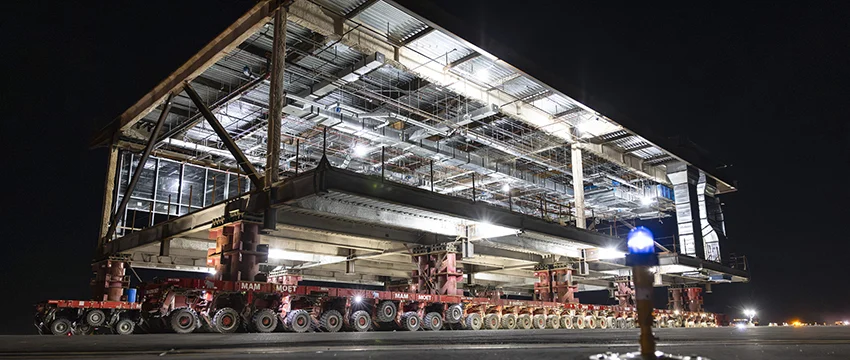
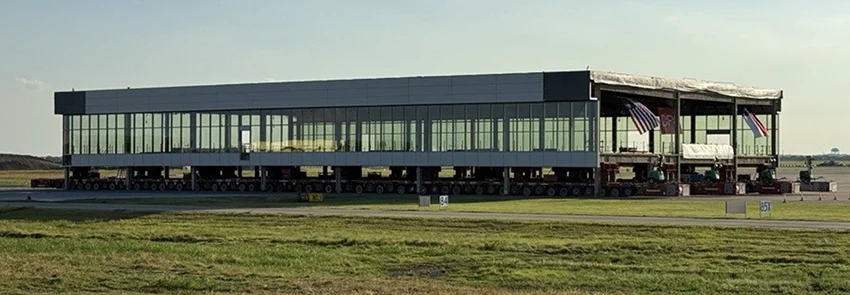
Those modules are assembled in a fabrication yard near the airport, typically to at least a core-and-shell level, then transported on self-propelled modular transporters to the terminal site and connected into a continuous facility.
Depending on the project, the modules may arrive with concrete slabs, fireproofing, roofing, curtain wall, mechanical and electrical systems, and portions of the interior already installed.
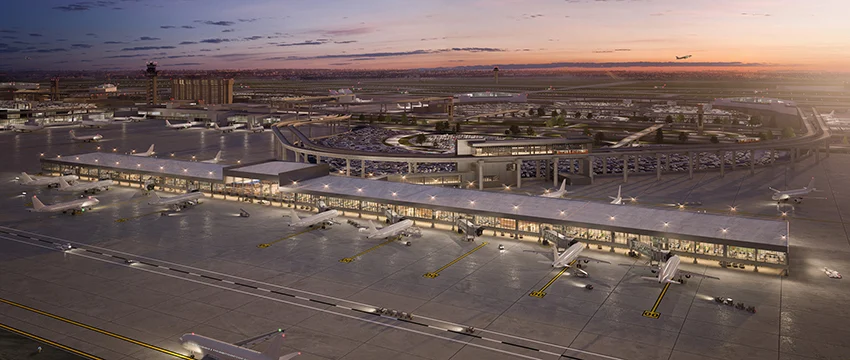
The scale can challenge common assumptions about modular building. At Dallas Fort Worth International Airport (DFW), modules have ranged from smaller elevated sections installed over the Skylink rail system to terminal pieces measuring approximately 140 by 275 feet.
One Terminal F module weighed about 2,750 tons and stood 60 feet tall. At that size, modular construction bears little resemblance to a collection of standardised boxes. It is a major infrastructure project assembled from carefully planned components.
That shift in scale leads to the more consequential shift in project sequencing.
REPLACING A LINEAR SCHEDULE WITH PARALLEL WORK
Traditional terminal construction often proceeds in a long chain. Environmental reviews and permits must advance, old utilities must be located or relocated, hidden conditions must be addressed, foundations must be completed, and only then can the building rise.
At older airports, excavation may expose infrastructure installed decades earlier and poorly documented in available records, further complicating an already lengthy schedule.
Modular delivery allows a substantial portion of the building to be delivered elsewhere while site work continues. Crews can fabricate the structural frame, enclosure, roofing, and building systems as approvals progress and foundations are prepared at the terminal.
Once the receiving site is ready, completed modules can be moved into place, often at night during carefully controlled operational windows.
In a three-year programme, this approach can conservatively save four to six months. In one DFW example, an empty foundation site was transformed by installing terminal modules within roughly 15 days.
The lesson is not that the work disappears. In some respects, teams are co-ordinating two construction sites. The advantage comes from performing critical activities concurrently and relocating much of the work away from the airport’s most constrained areas.
Compressing the schedule matters because time at an airport is inseparable from operational capacity.
PROTECTING GATES, PASSENGERS, AND REVENUE
Every gate taken out of service has an operational and financial consequence.
Long-term work zones can also force adjacent gate closures, alter aircraft circulation, disrupt baggage and service routes, and complicate passenger movement. By reducing the duration of intensive work at the terminal, modular construction can return gates and other revenue-producing spaces to service sooner.
The benefits extend beyond the secure side of the airport. Conventional projects generate a steady flow of deliveries, equipment, and worker transportation.
Those vehicles can compete with passengers on already congested arrival and departure roads, creating delays and a poor first impression before travellers reach the terminal.
Moving fabrication to a controlled yard reduces traffic within the active campus and separates construction logistics from the passenger journey.
Contractors benefit as well. Crews working airside may lose productive time to remote parking, busing, security procedures, and badging requirements.
Airside work can also carry insurance requirements beyond the reach of smaller specialty firms.
A nearby fabrication yard provides easier access, reduces travel time, and enables more work to be done under conventional conditions. That can broaden competitive bidding and create opportunities for disadvantaged and smaller businesses that might otherwise be unable to participate in a major airport programme.
Those gains, however, depend on decisions made long before the first module begins to move.
MAKE THE MODULAR DECISION EARLY
Modularity should be evaluated at the outset of planning, not introduced after design is substantially complete.
The structural system, module breaks, temporary bracing, transport route, lifting or support conditions, and final connections all influence the architecture and engineering.
When a contractor proposes modular delivery late, the design team may have to retrace completed work, eroding the schedule advantage the approach was meant to create.
Design-build is especially well-suited to this work because designers, engineers, builders, and transport specialists can make co-ordinated decisions from the beginning.
When a construction manager at risk is used, the construction manager need to be engaged at approximately the same time as the design team. Early participation helps the team identify which portions of a programme should be modular, establish an appropriate fabrication yard, study the route to the terminal, and align fabrication with site readiness.
Experience also matters. Large modules must function as temporary structures during lifting and transportation, then as permanent buildings after installation.
Specialised engineering is required to model those different conditions without adding unnecessary material. On a recent airport peer review, an experienced modular engineering team identified nearly $10 million in steel that could be removed while maintaining required performance.
The example illustrates why owners need to seek teams that understand both the opportunities and the distinct technical demands of the process.
Early integration also provides the framework for protecting design quality.
QUALITY AND DESIGN REMAIN FULLY IN PLAY
Modular construction does not require a cookie-cutter terminal. Modules may be rectangular, angled, curved, or combined with conventionally built portions.
Indeed, an entire terminal need not be modular for the project to benefit. Teams can select the areas that provide the greatest schedule or operational value and use traditional construction elsewhere.
Nor does off-site work lower the standard of care. Fabrication in a controlled environment can improve quality, but large modules require additional checks at each critical stage.
Owners, contractors, inspectors, and engineers verify the work during fabrication, when modules are lifted onto transporters, after the move, and once they are set and connected at the terminal.
These inspections confirm that the building has maintained its structural integrity through temporary loading conditions and transport.
The method can also support long-term maintainability. Airport teams are extending modular thinking beyond terminal shells to restrooms, electrical rooms, mechanical rooms, and other repeatable spaces.
Standardised and catalogued components can simplify replacement and reduce the need to close an entire facility when one part fails.
This combination of flexibility and rigor explains why modular delivery is moving into the mainstream.
A NEW STANDARD FOR AIRPORT GROWTH
The next generation of airport development will be judged not only by the facilities it produces, but by how effectively those facilities are delivered while the airport keeps moving.
Modular construction offers a practical response to that test. It overlaps fabrication with approvals and site preparation, shortens disruption at the terminal, expands access to the work, and brings gates and passenger amenities online sooner.
Success requires more than choosing a construction technique. Owners aim to identify the opportunity early, select experienced partners, and organise the delivery model around continuous collaboration.
When those conditions are in place, modularity becomes an operational tool that protects the present while creating capacity for the future.
For airports facing relentless demand and little tolerance for downtime, that is rapidly becoming the standard by which expansion strategies will be measured.
LONDON STANSTED AIRPORT’S NEW SKYLINK WALKWAYS
London Stansted Airport will partner with Farrans and embrace off-site construction for the delivery of its new skylink walkways, writes Joe Bates.
The new skylinks are an integral feature of the airport’s transformation programme, creating new walkways to directly connect the terminal to existing satellite buildings that are home to the departure and arrival gates.
The centrepiece of the programme is a three-bay extension to the existing terminal that will transform the customer experience.
Work will begin with the pre-assembly of skylink sections taking place ‘offsite’ in a vacant airport hangar on the northside of the airfield.
This method of construction will save time, and by reducing working at height, creates a safer working environment, as well as reducing congestion in busy airport operational areas.
Once each section is completed, they will be transported overnight from the construction hangar across the airfield on self-propelled modular transporters (SPMTs) to minimise disruption to the airport’s operation.
Rob Stewart, London Stansted’s capital delivery programme director, noted: “We now move to the construction phase of the work, where Farran’s expertise and experience of delivering airport projects in busy operational environments will be invaluable.”
About the author
Vivek Gurjar, PE, is a principal and national aviation leader with Rogers DeSimone Structural Engineers, LLC. He can be reached at vgurjar@rogersdesimone.com