



Happy talk!

Share

From disruption management to ancillary revenue generation, AI communications are critical to the airport passenger experience, writes Pierre Cuquemelle.
When communication fails during disruptions, the impact ripples through every corner of airport operations.
Customer service teams face angry passengers armed with conflicting information from multiple sources. Ground staff waste valuable time correcting misinformation rather than solving problems. And security checkpoints can become bottlenecks.
Every hour of disruption extends operational recovery times and potentially inflicts damage to an airport’s reputation and traveller loyalty.
Travel anxiety peaks during disruptions, and unclear communication amplifies stress. Passengers who feel informed and supported, even during delays, report higher satisfaction scores than those kept in the dark during minor schedule changes.
This emotional impact reinforces the need for proactive, effective two-way communication.
BUILDING PROACTIVE COMMUNICATION SYSTEMS
In my opinion, the shift from reactive to proactive communication requires more than new technology – it demands a fundamental rethinking of how airports view their role in the passenger journey.
Indeed, rather than simply responding to problems as they arise, an ever increasing number of airports have recognised the need to building systems that anticipate passenger needs and deliver information before it’s requested.
This approach starts with data integration. Modern airports generate enormous volumes of real-time data; the challenge isn’t collecting it, but connecting it, synthesising information from all stakeholders into coherent, actionable messages for specific passenger segments.
This includes collaborating between other airports and airlines, even competitors, to create more continuous passenger journeys.
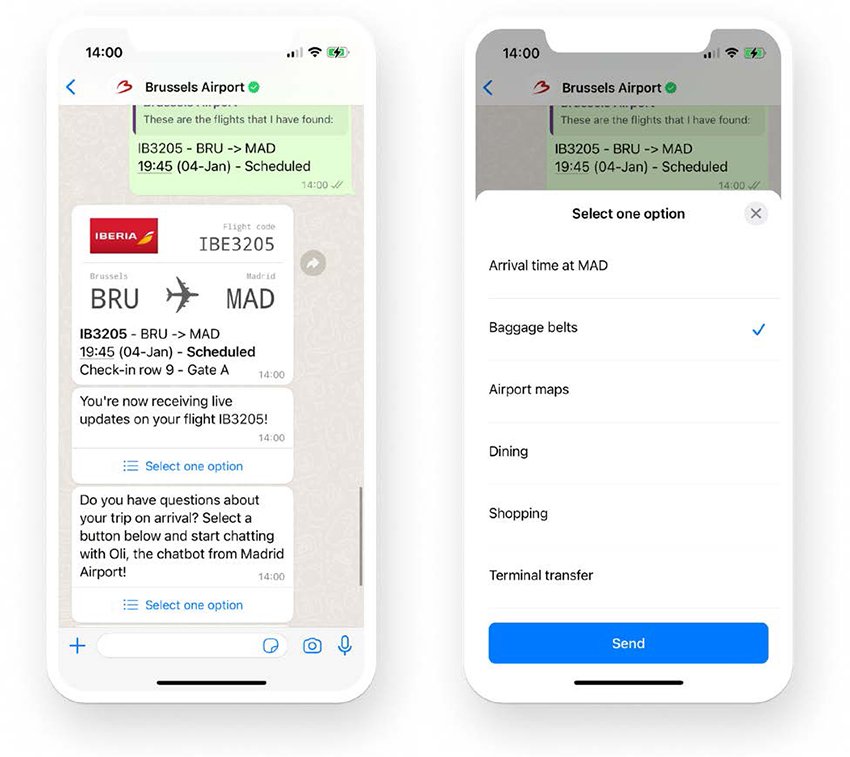
Conversational AI platforms are emerging as a solution to this challenge. The recent combination of 15below and Airport AI, for instance, aims to create unified communication systems that can process multiple data streams and deliver contextual responses through natural language interfaces.
Airports and airlines can even customise the tone and language of the chat experience to align with their brand values. Sydney Airport in Australia and Brussels Airport in Belgium are examples of airports that do just this.
These systems do more than just answer queries; they anticipate needs based on passenger context and journey stage.
A family travelling with young children needs different information than a business traveller racing to make a connection. The family, for example, might benefit from updates about quiet zones and kid-friendly dining options during their extended wait.
While the business traveller needs precise timing on security queues, lounge availability, and rebooking options. Proactive systems recognise these distinctions and tailor their communications accordingly.
Timing proves equally critical. The most sophisticated communication platforms understand the optimal moment for delivery. A gate change notification sent too early might be forgotten; too late, and passengers miss their flights.
Machine learning algorithms help airports identify these patterns and automate message timing for maximum effectiveness.
This automation extends beyond simple notifications. Conversational AI creates a self-service model for passenger support that reduces operational costs while improving response times.
Rather than joining queues at information desks, passengers can receive instant, accurate answers through digital interfaces that feel intuitive and human, freeing customer service staff to handle more complex service needs.
INTEGRATION THE FOUNDATION OF EFFECTIVE MESSAGING
The greatest barrier to effective disruption communication isn’t technology, it is organisational silos. Airlines, airports, ground handlers, and retail concessions often operate separate communication systems with limited integration.
This fragmentation becomes painfully apparent during disruptions when passengers need unified and authoritative information.
Breaking down these silos requires AI-powered platforms that can aggregate data from multiple sources and distribute it through various channels. These systems must be robust enough to handle surge traffic during disruptions, yet flexible enough to accommodate the diverse requirements of different stakeholders.
Arguably, addressing this integration challenge by bridging the traditional divide between airline and airport channels rather than maintaining misaligned messaging systems is the solution.
This approach requires airlines and airports to establish common communication protocols, service standards, and above all, data sharing.
Successful integration also extends to consumer-facing channels. Passengers today expect consistency whether they’re checking airport websites, mobile apps, social media, digital displays or speaking with staff.
In fact, many passengers prefer to communicate through channels they use for trip planning with family and friends, like WhatsApp or Facebook Messenger.
This omnichannel approach requires sophisticated content management systems that ensure updates propagate instantly across all platforms.
REVENUE OPPORTUNITIES IN CRISIS COMMUNICATION
While communication is sometimes viewed as a cost centre, forward-thinking airports are discovering its revenue potential.
When passengers feel informed and supported during delays, they are more likely to engage with airport services rather than simply endure the wait.
While targeted messaging during disruptions can drive specific commercial behaviours.
For instance, a passenger notified of a two-hour delay might receive suggestions for nearby restaurants with available seating, special offers at retail outlets, or day-pass options for premium lounges.
These aren’t random promotions, but carefully curated recommendations based on the passenger’s profile, location, and available time.
The data generated through disruption communication also has intelligence and business value. Understanding how passengers respond to different message types, channels, and timing helps airports optimise both their communication strategies and their commercial offerings.
Which passengers are most likely to purchase lounge access during delays? What message formats drive the highest engagement? These insights inform everything from retail placement to service design.
THE FUTURE OF PASSENGER EXPECTATIONS
The aviation industry stands at an inflexion point. Passengers that have grown accustomed to real-time updates from ride-sharing apps and food delivery services now expect similar transparency and immediacy from airports. This isn’t a temporary trend but a permanent shift in baseline expectations.
Within the next five years, accurate information during disruptions will be the baseline passenger expectation – they’ll also demand predictive insights.
Passengers will want to know not just that their flight is delayed, but the probability of further delays, expected recovery times, and personalised recommendations for alternative travel options. They’ll expect this information to be contextual, considering their onward connections, hotel bookings, and ground transportation arrangements.
Meeting these expectations requires airports to stop viewing communication as an operational support function and start treating it as core infrastructure – as essential as runways, terminals, and baggage systems.
This means sustained investment in communication platforms, data analytics capabilities, and staff training. It means establishing clear governance structures for crisis communication and regular testing of response protocols.
The airports that make this transition successfully will not only weather disruptions better, but they’ll turn them into opportunities to demonstrate service excellence.
In an industry where disruptions are inevitable, the ability to communicate effectively during these challenging moments becomes a competitive advantage.
About the author
Pierre Cuquemelle is the CEO and co-founder of Airport AI, a conversational AI platform built for airports. To learn more, visit 15below.com.