



Unlocking the power of artificial intelligence at airports

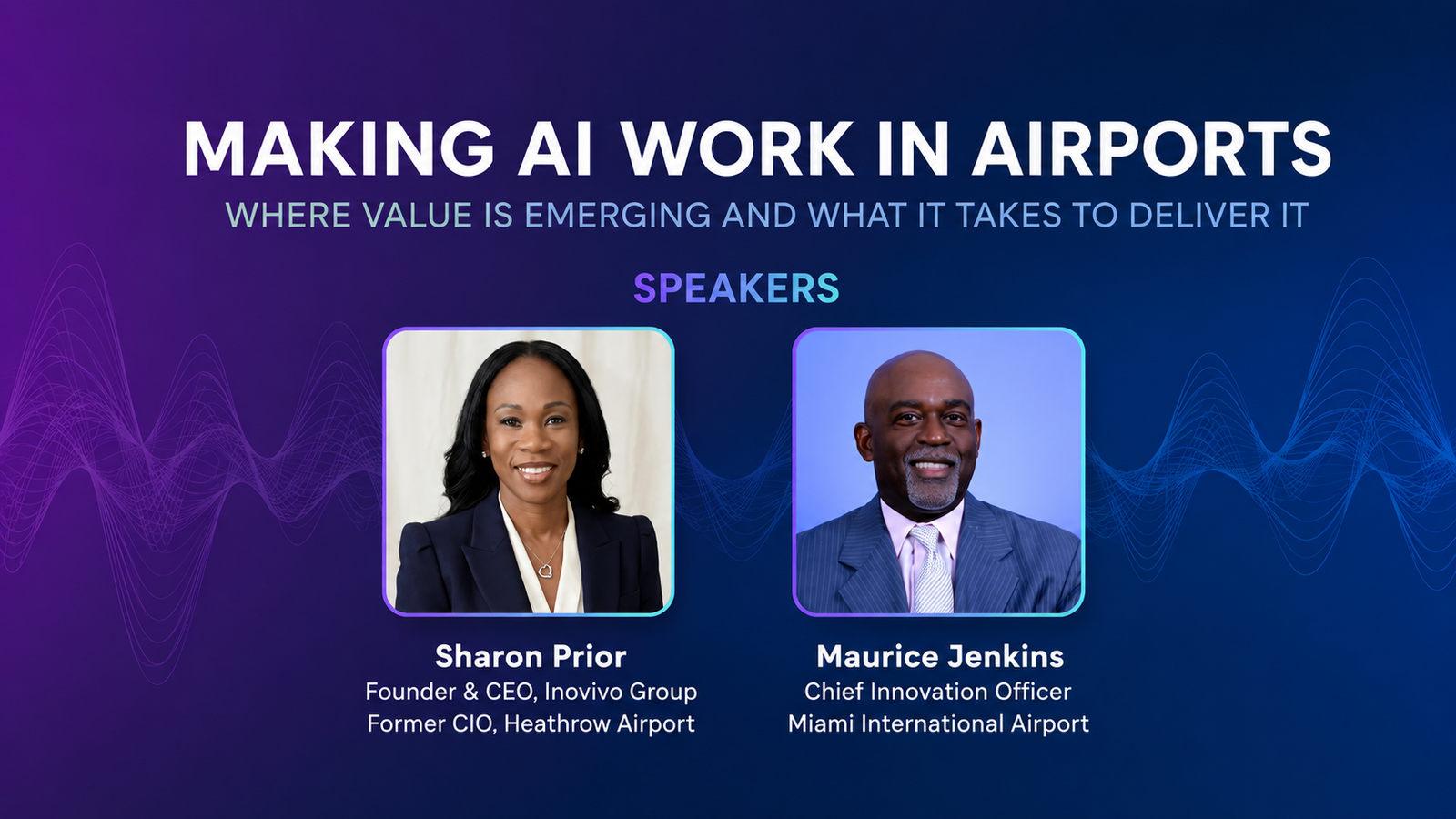
Yesterday’s ‘Making AI Work at Airports’ webinar hosted by Egremont Group in partnership with Airport World focused on practical ways AI is providing value in airports and what it takes to successfully deliver it.
In the hot-seat were Maurice Jenkins, chief innovation officer at Miami International Airport; Sharon Prior, founder and CEO of Inovivo and former director of technology at Heathrow; and Nick Crane, the Egremont Group’s senior consultant for airport operations transformation.
Topics covered included the industry shift from being reactive in airport operations to a more proactive, problem-solving approach driven by predictive planning, enabled by AI and data-driven insights.

We learned that artificial intelligence is already already delivering value in areas such as passenger flow prediction, gate and stand optimisation, predictive maintenance, and commercial decision-making (e.g., retail analytics).
The importance of data. Success with AI depends on high-quality, well-governed, and accessible data. Structured data and clear data flows between airport functions is critical.
The human factor. The adoption of artificial intelligence requires trust in in its capabilities and clear protocols for action. Human oversight and organisational buy-in is essential to successful, starting from the top down.
Organisational readiness and leadership. AI initiatives should be led by cross-functional teams, not just IT leaders or the IT department. Leadership must prioritise data readiness, governance, and operating model changes.
Scaling AI from pilot programmes to operations. To move beyond pilots can be a difficult one, which is why initiatives need clear business ownership, measurable outcomes, strong data foundations, and integration into daily workflows.

Top priorities for airport leaders:
• Invest in operating model changes, including training and role clarity.
• Build small, cross-functional teams to drive AI initiatives.
• Focus on solving small, tangible operational problems exceptionally well.
• Prioritise areas like operations control, passenger flow, cargo analytics, predictive maintenance, and workforce productivity.
Data sharing and collaboration. Breaking down data silos and creating a common data environment are vital for effective AI deployment across airport stakeholders.
IT should act as an enabler and partner, not the sole owner of AI initiatives. Democratising technology and fostering collaboration across functions is key.
In conclusion, unlocking AI’s value in airports requires organisation-wide engagement, robust data practices, and a focus on practical, scalable solutions.
More than 300 people signed up for yesterday’s webinar, which served as a early scene setter for the upcoming AI in Airports conference in London this December.
You can read a more in depth report of the webinar in the upcoming June/July issue of Airport World, out next month.
To find out more about AI in Airports, visit: airportworld.ai