

Cambodia Airports CEO, Julien Bert, talks to Joe Bates about switching operations to Phnom Penh’s new $1.5 billion gateway to the world, Techo International Airport.
The opening of Techo International Airport (KTI) last September changed everything for air travel to Cambodia as the gateway is bigger and better than its predecessor and certainly equipped for future expansion.
In short, the airport boasts a state-of-the-art 240,000 square metre terminal building, single 4,000 metre long runway and cargo facilities that between them are capable of handling up to 15 million passengers and 175,000 tonnes of cargo per annum.
And with future expansion – its master plan includes proposals for a second pier and additional runway subject to demand – the new airport could eventually accommodate up to 50 million passengers yearly.
“The new airport is definitely a big step up in terms of size, capacity and technology and allows us to think big for the future,” admits Cambodia Airports CEO, Julien Bert.
Located 25 kilometres south of Phnom Penh, good road connections make it is quicker and easier to get to KTI from the city centre than to its predecessor on the outskirts of the capital due to traffic congestion.
Travelling between Techo International Airport and central Phnom Penh by road typically takes around 40 minutes, and that could be even shorter in the future with the addition of a dedicated high-speed lane for buses.
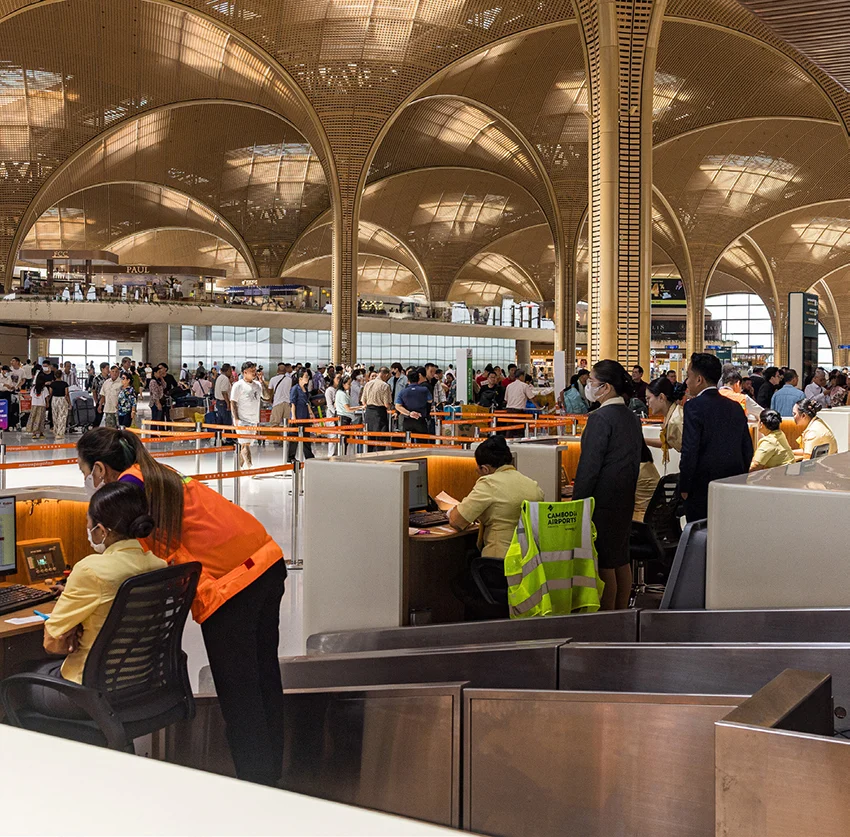
KTI is certainly a big improvement from the old airport in terms of its technologies, which include biometrically enabled eGates at immigration, self-service kiosks and automated baggage drop machines as well as the latest smart security equipment.
The airport has 32 gates, most of which are served by double bridges, and 23 stands capable of handling Code E aircraft or simultaneously accommodating two Code C aircraft.
It is also equipped with an Airport Operations Control Centre (AOCC) that connects all the different IT systems, technologies and facilities and the people that are responsible for monitoring them across the airport site.
Now Cambodia Airports aims to use its 30 years of experience of operating in Cambodia and the support of VINCI Airports – one of the biggest airport operators in the world – to grow passenger numbers and enhance KTI’s role as a cargo and logistics hub by leveraging its strategic location and new facilities.
THE BIG MOVE
Although the move from Phnom Penh International Airport (PNH) to KTI happened overnight on September 9, 2025, Cambodia Airports had been planning the move for over two years.
Indeed, Bert previously worked as VINCI Airport’s general manager for the transfer to KTI before becoming CEO of Cambodia Airports in April this year, so was well prepared for the move of 3,500 different stakeholders, 3,150 staff and more than 30 airlines to Techo International Airport.
He says: “Well, the first thing to say is that after months of preparation, ORATs (Operational Readiness, Activation and Transition) that involved hundreds of tests of new equipment and systems and thousands of hours of training for our teams, we were well prepared for the overnight transfer.
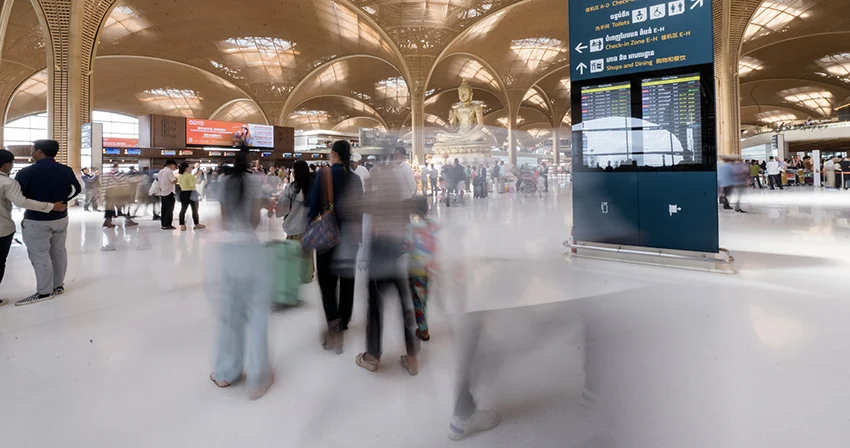
“Yes, there were challenges, and like at the opening of any new facility not everything went perfectly, but we had no big issues, and overall it all went pretty smoothly despite some of the systems, equipment and facilities not being 100% ready on opening day.”
He adds that, as anticipated, it did take staff and the airlines a few hours to get used to their new, much bigger surroundings, but notes that it was really just a question of adapting to the new environment and some more sophisticated technologies.
“At the end of the day, I measure success through on-time performance, as that’s what it is all about really, and our OTP at KTI is better than it was at PNH,” says Bert.
“So, I think this has allowed the airlines and passengers to focus on the big, beautiful new airport and the new facilities it offers them.
“We have yet to get the annual results of an ASQ survey as the airport only opened last September, but early passenger feedback is favourable with people saying things like it is ‘beautiful’, ‘quick’ and ‘spacious’.”
TRAFFIC MIX
As the direct replacement for Phnom Penh International Airport, KTI instantly became Cambodia’s biggest airport and international gateway to the world.
International flights currently account for close to 98% of all passengers passing through the airport, with domestic services around 2% and transfer traffic less than 1%.
The mix makes KTI an O&D airport, and this isn’t likely to change anytime soon due to the location of some of the Asia’s biggest hubs on its doorstep – Bangkok Suvarnabhumi (BKK), Guangzhou Baiyun (CAN), Kuala Lumpur (KUL), Singapore Changi (SIN) and Seoul Incheon (ICN).
As a result, these destinations are among the top five routes served from KTI, while Siem Reap, home to Cambodia’s world-famous Angkor Wat temple complex, and Sihanoukville are the most popular domestic destinations.
Home carriers Air Cambodia and Cambodia Airways are the biggest operators at KTI due to their extensive regional networks beyond Cambodia that include China and most neighbouring countries across Southeast Asia.
Spring Airlines, AirAsia Cambodia and China Southern complete the top five airlines in terms of market share.
Legacy carriers serving KTI include Air China, Asiana, Cathay Pacific, China Eastern, Emirates, Etihad, Korean Air, Malaysia Airlines, Qatar Airways, Thai Airways and Turkish Airlines.
Sky Angkor Airlines also counts KTI as its home base operating scheduled flights to Bangkok, Macau, Seoul and the Mainland Chinese cities of Changsha, Chengdu and Quanzhou as well as seasonal services to Gaya in India.
The mix all adds up to a total of 30 airlines operating flights to 40 destinations across Asia and the Middle East, including 16 cities in China.
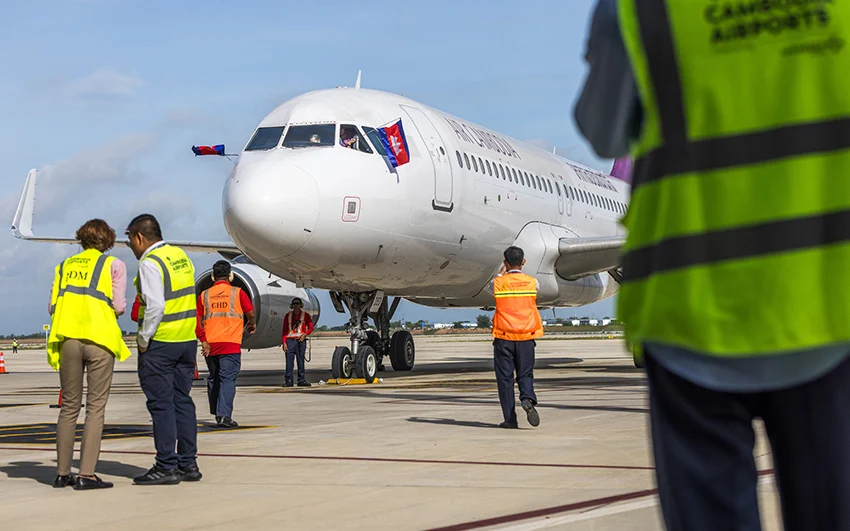
Bert expects the new airport to become the catalyst for attracting new airlines and services to Cambodia, although he notes that its route development ambitions aren’t currently being helped by geo-political events on its doorstep and further afield.
“I am hopeful that the new airport will bring additional capacity when the market picks up and we once again see the appetite from the airlines to expand their networks,” he comments.
PASSENGER NUMBERS AND CARGO GROWTH
Between them, PNH and Techo International Airport handled a total of 5.3 million passengers in 2025, and Bert expects something similar this year because of the “geopolitical disruption” in the Middle East and “regional tensions” that have impacted on airline networks and tourism to Cambodia.
He did, however, reiterate that Cambodia Airports continues with its marketing efforts to expand the route network from KTI and Sihanouk International Airport (KOS), its other gateway in the port city of Sihanoukville in the southwest of the country.
“We projected growth before we faced these challenges and we remain confident that it will happen, it is just a little difficult to make traffic forecasts in the current operating climate,” noted the cautiously optimistic Bert.
“But, what I can tell you is that our marketing teams are putting a lot of effort into growing our route network at Cambodia Airports and across the VINCI Airports network, working at regionaland national levels and across different countries to continue to develop and diversify our routes and destinations.”
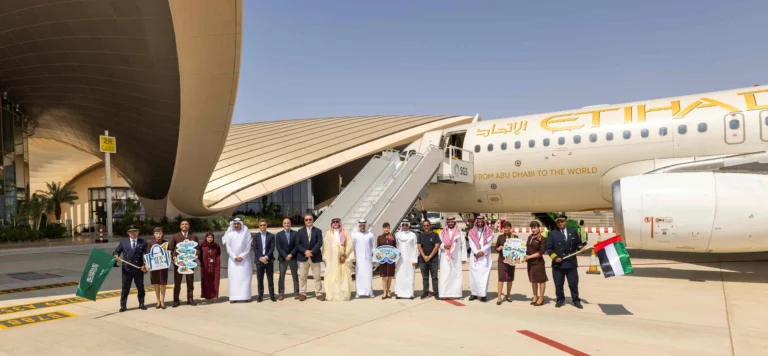
He cites last year’s opening of new Etihad and Turkish Airlines routes at KTI as one example of how Cambodia Airports has benefited from synergies of working with VINCI Airports, whose global network now covers more than 70 airports across 14 countries that between them handle in excess of 330 million passengers per annum.
“The Etihad route came about after direct discussions between VINCI and Etihad, with the airline launching the new service at KTI less than a month later,” enthuses Bert.
“I am expecting that our passenger numbers this year will not be far from what we handled in 2025, but hopefully with slight growth.”
Traffic stats show that numbers across Cambodia’s three international airports (KTI, KOS and the Yunan Aviation Industry Investment Group operated Siem Reap-Angkor International Airport) fell by 6% in the first five months of 2026, but a shining light for Cambodia Airports has been cargo, which is positively booming.
Indeed, cargo volumes across the three airports soared by 34% to 38,951 tonnes during the same period, with the bulk of shipments being handled at Techo International Airport.
The increase, ironically fuelled by the same regional disruption that is currently having an adverse impact on passenger traffic, has led to cargo volumes rising by 40% at KTI this year compared to the corresponding period last year at PNH.
In essence, the closure of Cambodia’s land border crossings with neighbouring Thailand has seen cargo and logistics companies turn to airfreight to export shipments out of the country that have traditionally gone by road.
As a result, freighters and bellyhold cargo on passenger flights have effectively replaced the thousands of trucks that used to transport garments and textiles, footwear, electrical machinery and other goods to Thailand and beyond every week.
The unexpected development has resulted in a decision being made to expand the airport’s cargo facilities to ensure that it is equipped to keep up with demand.
Bert says: “Our cargo facilities upon opening were initially pretty similar to what we had at Pochentong [the old name for PNH] because the design was made at a time when volumes were much, much lower than today, but things have changed, and we now need more capacity.
“The decision to treble the size of the airport’s cargo facilities will add more capacity, give us more flexibility to manage all kinds of goods, and potentially become a cargo hub.”
To give you an idea of just how cargo volumes have soared in the last six to eight months, KTI is on target to handle more than 100,000 tonnes of freight this year compared to the 50,000 to 80,000 tonnes traditionally handled at PNH.
This follows cargo hitting an all-time high in 2025 when 93,000 tonnes passed through the combination of KTI and PNH before it closed.
SIHANOUK INTERNATIONAL AIRPORT
Cambodia’s only other international gateway after Techo and Siem Reap-Angkor Wat is Sihanouk International Airport in the south of the country, which is experiencing strong traffic growth, although admittedly from a low base as it continues to recover from the COVID pandemic.
The 170,000 passengers that passed through its facilities in 2025 represented a huge 85% upturn on the previous year, but it is still a long way off the record 1.68 million that used it in pre-pandemic 2019.
Its recovery continues this year with passenger traffic 100% up on the first half of 2025, leaving Bert optimistic about its future growth as it bounces back as a tourism destination and develops its cargo operations.
His confidence is based on the tourism appeal of the region’s beach resorts and tropical islands in the Gulf of Thailand and the airport’s cargo and logistics potential because of its location close to Sihanoukville’s deep-sea port, Free Trade Zone and fast motorway connection.
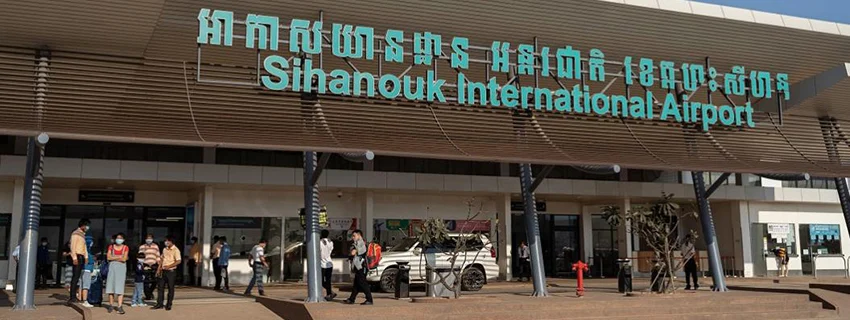
Sihanouk International Airport has gained Level 3 certification in ACI’s Airport Carbon Accreditation programme.
The programme plays a key role in supporting the decarbonisation efforts of airports worldwide, and the global efforts of the aviation sector to achieve net zero carbon emissions by 2050.
COMMITTED TO CAMBODIA
Bert says that the main objectives for Cambodia Airports this year, and going forward, is to focus on further strengthening its expertise in the aviation ecosystem.
Summing up, he comments: “At the end of the day, Cambodia is one of the most dynamic countries in Asia in terms of annual GDP growth and we are excited to be here and to play our part in developing its airports.
“We have been in Cambodia for over 30 years and have a very deep knowledge of the aviation ecosystem and enjoy good relationships with the authorities, airlines and many different agencies.
“Our strategy is to continue to strengthen our expertise and maintain our operational excellence in all layers of the ecosystem, starting with more partnerships in terms of education, training and innovation. This is key for us and key to the future success of Cambodia’s airports.”
TRADITIONAL DESIGN OF PASSENGER TERMINAL
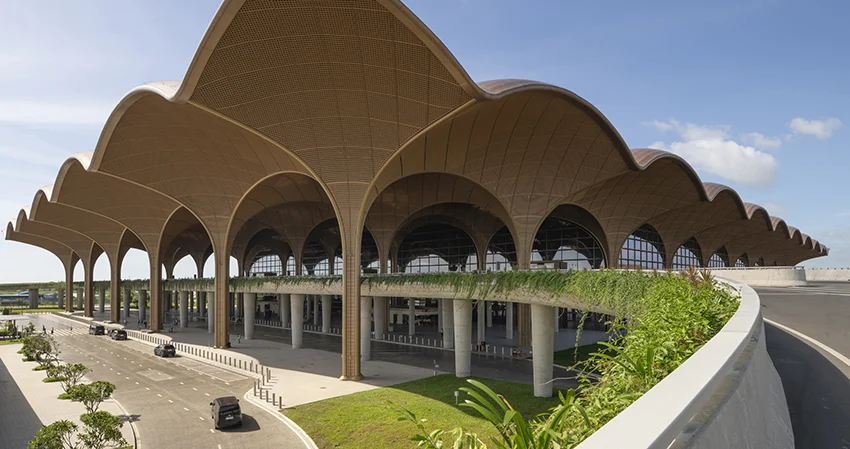
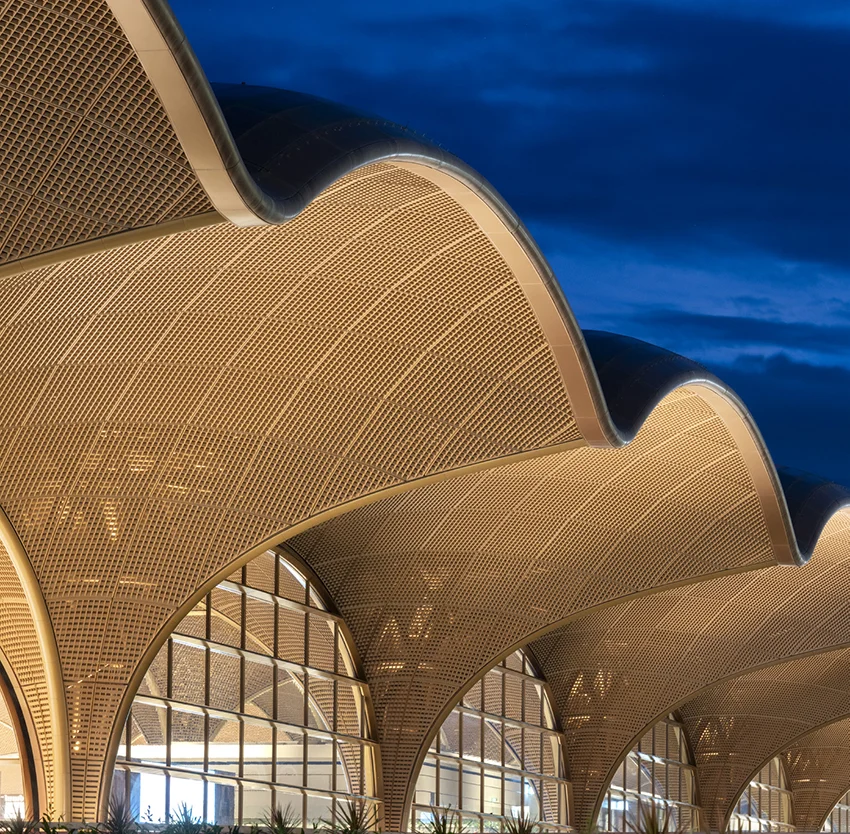
The new terminal is a thing of beauty, with Foster + Partners stating that its design reflects Angkorian traditions “through sweeping roof canopies supported by structural trees” inspired by the rumduol – Cambodia’s national flower.
Around 180 skylights ensure plenty of natural light, while tropical landscaping, and a nine-metre Buddha statue in the Abhayamudra pose, together create a distinctive sense of place that celebrates Cambodian heritage.
The terminal building comprises a central head house and a single aerofoil shaped northern pier. A southern pier is planned and could, potentially, open in the early 2030s if justified by passenger growth.
The building’s layout is said to prioritise short walking distances – although some early passengers have complained about a 10 to 15 minute walk from the kerb to the gates as opposed to the short five minute one at PNH – and features clear sightlines and simple orientation to ease navigation.
Passenger processing, security and immigration, and retail are sheltered by a single overarching roof canopy that stretches from the kerbside drop-off to airside.
The modular roof is supported by structural ‘trees’ that each span 36 metres. The roof has an undulating form that crescendos at the centre of the building, echoing Cambodia’s spectacular palaces and temples.