


Sustainable recruitment

Share
Kully Sandhu, managing director of Aviation Recruitment Network, considers what needs to be done to restore confidence in careers in aviation.
Sustainability is more than carbon targets and greener infrastructure; it’s about building resilient teams to deliver reliable operations through cycles of growth and disruption.
Before the pandemic, aviation was viewed as a stable, long‑term career path. That perception was shaken when large-scale redundancies and uncertainty hit the headlines, and while passenger numbers rebounded, candidate confidence has not fully followed suit.
In recruitment, that gap matters. A sustainable airport workforce depends on restoring trust, modernising hiring practices, and broadening leadership perspectives to attract people not just for a job, but for a career.
Across the UK, we see hesitancy among candidates, especially for entry‑level and shift‑based roles. Many prioritise work life balance, predictable rosters, work-from-home initiatives and proximity to home.
Others have moved into sectors that offer comparable pay without the complexity of vetting or unsociable hours, with retail, logistics, distribution, and hospitality among them.
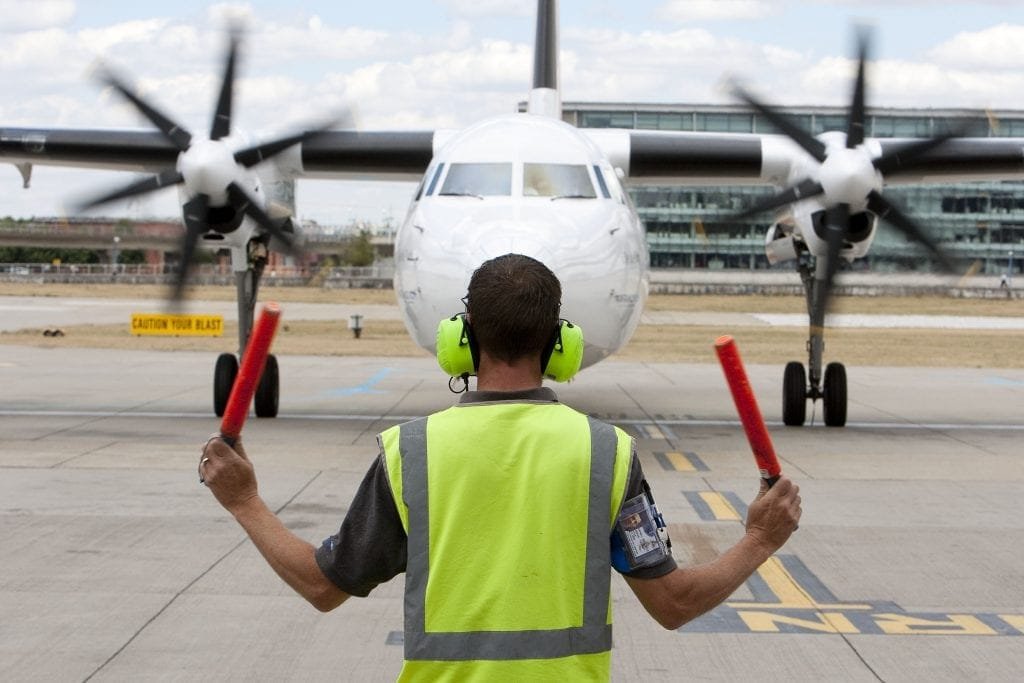
London City Airport. Image courtesy of Andrew Baker.
The result is a tighter talent market precisely where airports need capacity most: customer-facing roles, logistics, facilities, cleaning, retail and hospitality teams.
Restoring the appeal of airport work requires clear progression routes, improved scheduling, smarter travel‑to‑work solutions, and employer value propositions that speak to purpose, including sustainability.
THE AIRPORT JOB MARKET, THEN AND NOW
Pre‑COVID, aviation’s proposition centred on stability and pride in a mission-critical service. That narrative was interrupted during the pandemic.
Even as airports scaled back up, many candidates continued to associate the industry with unpredictability, and they became more discerning about contract types, guaranteed hours, and the pace of hiring.
Lengthy background checks and security clearances, while essential, have become choke points in a competitive labour market. When vetting stretches over weeks, candidates can accept offers elsewhere; by the time approvals land, too many hiring processes end with “we lost them.”
There are also geographic realities. Several UK airports sit outside dense talent catchments, where public transport is limited (especially during unsociable hours) and some employers cannot offer free parking.
Factors, like these, compound the challenge of attracting early‑career staff or those on lower incomes. In locations affected by clean‑air zones or limited parking, the cost and complexity of commuting at 4am for a shift becomes a deterrent.
Add seasonal peaks, unplanned disruption, and pay competition, and you get a recruitment environment that feels perpetually urgent, critical and reactive.

At the senior end of the market, the picture is different, but related. Airports need leaders who can blend operational excellence with digital transformation, commercial resilience, and credible environmental stewardship.
Where once the default was ‘aviation only,’ today we often see searches that include high‑performing executives from retail, rail, hospitality and logistics sectors that specialise in customer‑centric operations at scale, data‑led decision‑making and tight cost discipline.
PRACTICAL STEPS TO ATTRACT AND RETAIN STAFF
Sustainable recruitment starts with a frictionless and accessible employee experience. This includes reducing time‑to‑hire and improving the candidate journey.
Airports must streamline application journeys and unify communication across HR, recruitment, and vetting teams. Too often, fragmented systems and paper processes stall momentum.
A modern, mobile‑first experience with clear timelines, realistic job previews and regular updates keeps applicants engaged through background checks and onboarding.
Shared talent pools. Competitiveness within the same airport often undermines efficiency. Multiple employers chasing the same candidate pool creates duplication and delays, with applicants submitting to several vacancies simultaneously.
Instead of building a shared talent pipeline, airports risk fragmenting into isolated silos. This results in wasted time, increased costs, and erodes candidate confidence.
Make rosters work for people. Predictable shift patterns, shorter night cycles, and more frequent weekends off go a long way towards restoring trust in airport roles.
Where high volumes are needed, flexible models including part‑time, term‑time, or job‑share arrangements can open doors to under‑represented groups without compromising security or safety.
Travel‑to‑work initiatives. Shuttle buses designed for rosters, discounted parking, or partnerships with local transport providers remove a major barrier to entry.

In out‑of‑town locations, in particular, these measures can broaden talent pools and reduce attrition linked to logistics rather than satisfaction.
Pay competitively and communicate progression. Airports should benchmark locally and be transparent about pay, skill uplifts, and promotion opportunities.
Entry‑level jobs feel more like the start of a career when candidates see a clear roadmap, including training, certifications, and mobility.
Integrate sustainability into the employer value proposition. The next generation cares deeply about environmental and social impact.
Airports can connect sustainability goals to daily roles by implementing waste reduction initiatives, energy‑efficient operations, or community programmes. That clarity of purpose helps win hearts and minds, not just CVs.
Embrace technology to manage talent pools at scale. From modern CRMs to talent analytics, airports should build and nurture candidate communities rather than starting from scratch each hiring cycle.
Close partnerships with agencies experienced in regulated, high‑volume environments enable proactive pipelining, faster redeployment, and data‑driven decision‑making.
Finally, we must acknowledge the ‘hidden cost’ of recruiting. Re‑advertising, repeated vetting, and lost productivity during backfills can dwarf the perceived savings of doing everything in‑house.
Sustainable hiring means investing in partnerships and measuring success not just by cost‑per‑hire, but by retention and performance.
LOOKING BEYOND AVIATION
Is hiring outside the industry for top jobs increasingly common?
Yes, and with good reason. Airports need leaders adept at orchestrating complex, customer‑centric operations while delivering measurable progress.
Leaders coming from a retail, logistics, rail or sustainability focus, for example, can lend expertise in areas such as safety culture, asset reliability, continuous improvement, customer feedback loops, embedding carbon reduction into procurement, employee engagement and more.
Cross‑industry hiring works best when airports pair fresh perspectives with deep aviation know‑how. Blend the two and you get leadership teams that respect operational realities while innovating within them.
That combination of new thinking grounded in safety and compliance is a hallmark of sustainable leadership in our sector.


