



The Fraport Group today announced that it improved its key operating indicators over the first nine months of the 2026 fiscal year with revenue up by 3.8% on the corresponding period in 2025.
Fraport’s operations outside Germany made the largest contribution to growth, with their share of EBITDA increasing significantly.
Free cash flow nearly doubled year-on-year, reaching €93 million. However, the Group result declined as expected, mainly due to accounting effects resulting from completed expansion projects.

Fraport CEO, Dr Stefan Schulte: “The broad portfolio of the Fraport Group has proven its value. We’ve achieved a solid result at the Group level, despite a difficult market environment due to the geopolitical situation in the Middle East and steep increases in jet fuel prices.
“Our international business has been a particular driver. Fraport’s Greek airports, which were already performing strongly, have improved even further.
“In addition, our airports in Ljubljana, Slovenia, and in Brazil have experienced strong growth and are now only slightly below pre-pandemic levels.
“By contrast, passenger numbers in Frankfurt have stagnated. Growth in Frankfurt continues to be restrained by excessively high regulatory costs and a reduction in flight offerings, particularly following the shutdown of CityLine.
“In view of the strength of our international business outside Germany, we are maintaining our financial outlook for the full year.”

GROUP PASSENGER NUMBERS EXCEEDED 2019 LEVELS FOR FIRST TIME
In the first nine months of 2026, total passenger numbers for the Group exceeded pre-pandemic levels for the first time, driven by growth in Fraport’s international portfolio.
Passenger numbers at Fraport airports increased by 1.7% year-on-year to around 146 million overall. New records were set by the Greek airports (+ 5.1%) and Lima (LIM) in Peru, with volumes at the South American hub advancing by 2.8%.
Significant increases were also seen at the Fraport airports in the Slovenian capital, Ljubljana (+15.7%), as well as in Brazil (+9.1%) and Bulgaria (+6.1 %).
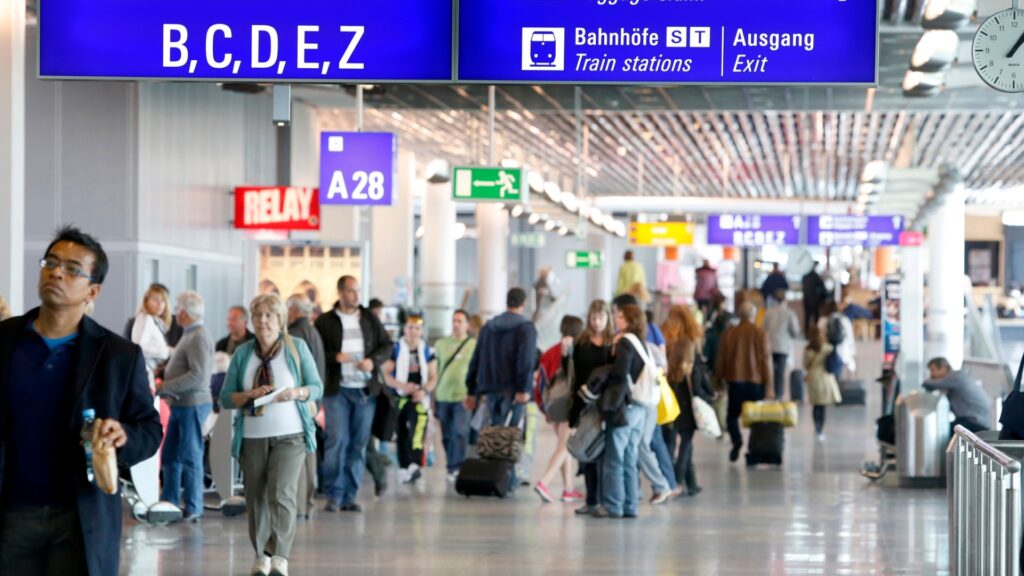
However, as Schulte has already stated, passenger traffic in Frankfurt remained flat, declining by 0.2 percent year-on-year to 47.5 million.
Nevertheless, at the same time, Frankfurt Airport delivered “a very good operational performance”. This benefited punctuality in particular, which improved by about six percentage points year-on-year during the busy summer travel period.
Overall punctuality levels at FRA were around 74%, outperforming other major European aviation hubs in Amsterdam, Paris, and Madrid.
FINACIAL FACTS & FUGURES
Strong growth in Fraport’s international portfolio was also the main driver behind the rise in the Group’s key financial indicators.
Group revenue increased by €125.7 million, or 3.8% year-on-year, to €3,466 million during the first nine months. Adjusting for revenues resulting from construction and expansion measures at Fraport’s international subsidiaries (in line with IFRIC 12), Group revenue improved by 4.7% to €3,350.1 million.
The largest revenue increases, adjusted for IFRIC 12, came from the Fraport Greece (up €39.3 million) and the Lima (up €33.9 million) subsidiaries.

Despite a one-off effect in the previous year which reduced expenses by €50 million, Group EBITDA increased by 2% to €1,178 million – a new record high.
The EBITDA share attributable to Fraport’s international business rose significantly, from 43% to 48% during the reporting period. When considering the third quarter on its own, the international share even rose to 54% (Q3/2025: 47 percent).
OUTLOOK FOR FULL FISCAL YEAR
Based on the performance in the first nine months of 2026, the Fraport Executive Board is maintaining its forecast for the Group’s asset, financial, and earnings position for the current fiscal year.
Passenger growth at the Group level is expected to continue, while FRA is forecast to perform at around 2025 levels.
Group EBITDA is still expected to increase year-on-year to up to €1.5 billion (2025: €1.44 billion). The forecast for the Group result is also unchanged, with the figure projected to decline to between €300 million and €400 million (2025: €468.1 million).