


How are airports organising themselves to explore the value of AI and deliver on its potential? Nicholas Crane, senior consultant, Egremont Group, provides his thoughts.
Airports are approaching artificial intelligence (AI) and innovation in different ways. Some have established dedicated innovation teams while others co-ordinate activity through existing departments.
Others have given individuals, or external specialists, responsibility for exploring and pursuing opportunities across the business.
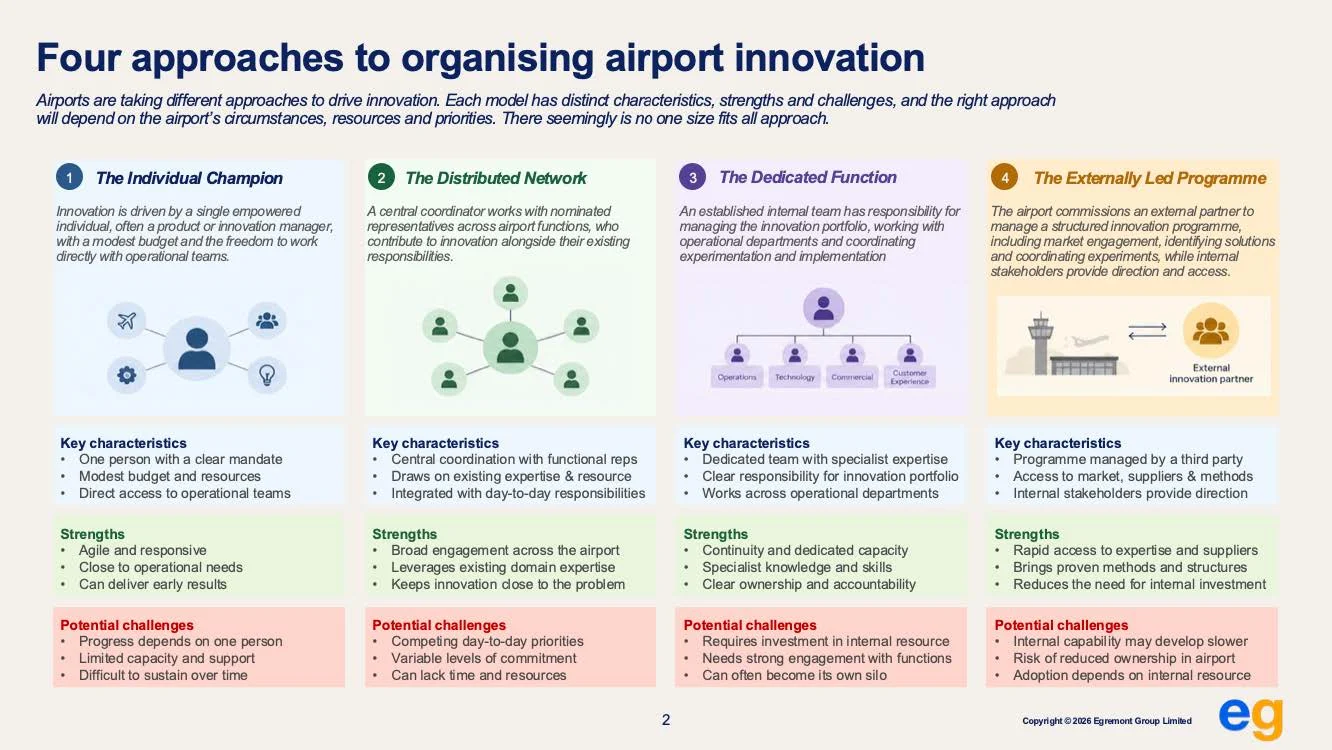
Through conversations with airport leaders, I have identified four broad approaches to how airports are organising themselves to explore AI and capture its potential value. These discussions reflect the wider shift in the industry, as airports continue to explore how AI could improve operational performance, support commercial decision-making and create new strategic opportunities.
The approaches differ in their structure, resources and relationships with operational departments. Airports are making progress through different arrangements, suggesting that no single model is necessarily preferable.
What matters is whether the chosen approach is supported by the conditions needed to translate AI and innovation into measurable value.
HOW ARE AIRPORTS ORGANISING FOR AI INNOVATION?
These approaches are neither mutually exclusive nor stages of maturity. They describe how airports have started organising responsibility and resources to identify, develop and implement opportunities, with a focus on those enabled by AI.
1. The Individual Champion
In some airports, responsibility rests primarily with an innovation or product manager, supported by senior leadership and a set budget. This individual works with departments to identify opportunities and coordinate trials of emerging technologies.
The approach can enable quick decision-making and close engagement with real operational challenges, provided the individual has strong relationships and authority to act.
Its limitation is dependence on one person’s capacity, which makes this typically unsustainable over time. What we do see though, is the individual champion as a starting point for The Distributed Network.
2. The Distributed Network
Other airports use a central innovation lead supported by representatives from operational and corporate functions, who contribute alongside their existing responsibilities.
This provides access to knowledge across the airport and helps identify where AI could address specific departmental challenges. Its effectiveness, however, depends on representatives having sufficient time and support. Competing operational priorities can otherwise slow progress.
3. The Dedicated Innovation Function
Some airports establish specialist teams combining technology, business analysis, project delivery and operational improvement expertise. These teams identify and evaluate opportunities, engage technology providers and coordinate an innovation portfolio.
A dedicated function offers continuity, capacity and accountability, but requires investment. It must also remain lean and able to move quickly, while staying connected to operational departments and focused on genuine needs
4. The Externally Led Programme
A further approach involves an external partner co-ordinating an innovation programme, from identifying opportunities and engaging technology providers to managing experiments.
This can provide specialist expertise and access to the wider AI technology market where internal capacity is limited. The airport nevertheless needs to retain ownership of its priorities and the ability to implement and sustain successful solutions.
Each of these approaches has advantages and limitations. The more useful question for most airport leaders is whether their chosen arrangement is equipped to deliver value.
What are the Conditions for Creating Value from AI?
Four conditions deserve particular attention when establishing or developing an airport innovation programme.
1. Begin with problems and opportunities, not tech.
With AI attracting considerable attention and momentum, airports are frequently presented with technologies offering new capabilities.
Understanding these developments is valuable, but starting with a solution and searching for somewhere to apply it can be unproductive.
This is because it often leads to a tool being applied to solve a presenting symptom, rather than the root cause of the problem. This then makes any benefit difficult to realise and measure.
A stronger starting point is a defined operational, commercial or strategic challenge. Where are resources being consumed unnecessarily? What constrains capacity? Which processes affect service or safety performance? Where could better information support commercial decisions?
An airport might identify an activity requiring substantial staff time, estimate the potential productivity improvement, and then assess whether AI, automation, process redesign or another intervention is appropriate.
Understanding the problem the tech is solving and quantifying the opportunity first, provides a basis for comparing options and subsequently measuring results. It also allows airports to explore AI applications without losing sight of the intended outcome.
2. Establish Direction and Leadership Support
AI adoption needs a clear connection to the airport’s wider priorities. Senior leaders should establish where effort is best directed, allocate resources and help resolve barriers between departments.
This matters particularly where AI applications depend on data held across different functions or require changes to established processes.
Visible sponsorship can sustain commitment through experimentation and uncertain outcomes, while allowing those responsible for delivery to exercise judgement about how to proceed.
3. Provide authority and resources to act
Assigning responsibility for AI and innovation is insufficient if those responsible cannot engage the wider airport. They need access to operational teams, relevant data, appropriate budgets and the authority to investigate opportunities and run trials.
The implications vary by approach. An individual champion needs access across departments; a distributed network needs protected time; a dedicated function needs effective operational relationships.
In every case, appropriate governance around safety, security, data and expenditure must coexist with sufficient freedom to test ideas. For AI applications, questions of data quality, reliability and operational accountability also need consideration.
4. Build Implementation Capability
A successful AI pilot establishes that a solution may work; it does not mean the airport is ready to adopt it. Operational processes may need redesigning, systems integrating, employees training and responsibilities changing.
These activities require implementation and transformation capacity, which operational departments may not have available alongside their day-to-day responsibilities. Innovation programmes therefore need a way to manage change and transfer ownership to the teams responsible for ongoing operation.
That capability may sit within the innovation function, elsewhere in the airport or with an external partner. The important point is to plan for it from the outset, rather than treating implementation as something to resolve after a trial succeeds.
FROM AI EXPERIMENTATION TO SUSTAINED VALUE
The four approaches demonstrate that airports have choices in how they organise innovation and AI adoption. The conditions described above help explain how those arrangements can then translate activity into results.
As AI capabilities continue to develop, airports will have no shortage of potential applications to explore. Their ability to capture value will depend on identifying worthwhile opportunities, providing the organisational support to pursue them and ensuring successful solutions become part of everyday operations.
Ultimately, progress should be assessed through the operational, commercial and strategic value delivered, and the airport’s ability to sustain these improvements over time.