


Joe Bates reports on the ups and downs of the Advanced Air Mobility market as the world awaits the launch of the first commercial services by electric vertical take-off and landing (eVTOL) aircraft.
Perhaps the best way to show how exciting and volatilethe Advanced Air Mobility (AAM) market is, would be to note that since the topic was discussed at Airports Innovate in Rome in November 2024, we have seen regulatory certification for the world’s first purpose built commercial vertiport and lost one, and so nearly two, of the biggest manufacturers of eVTOLs.
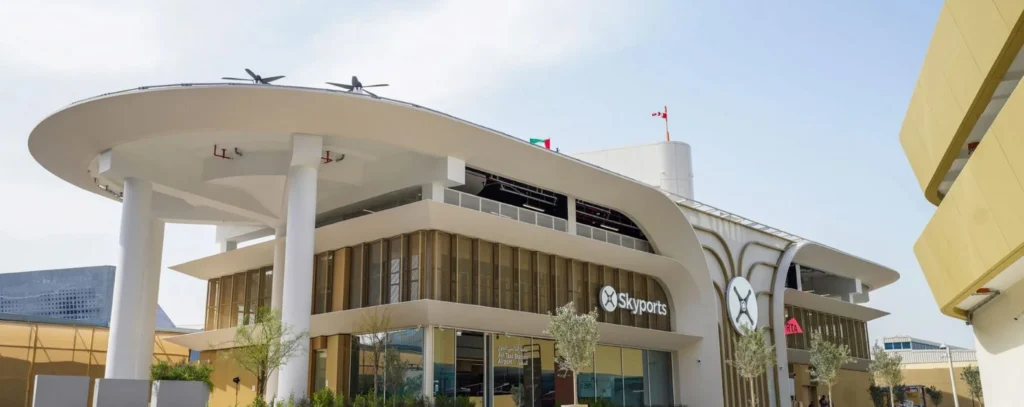
Regulatory certification for Skyports Infrastructure’s VDX vertiport adjacent to Dubai International Airport is, of course, a huge positive forward step for the adoption of eVTOLs.
And it could potentially be joined by others in Brazil, Italy, the US, France, Spain and elsewhere over the next 18 months.
But on the downside, the demise of European eVTOL company Lilium, Airbus’ decision to pause its eVTOL development programme, and Volocopter’s insolvency before it was saved by China’s Wanfeng Auto Holdings Group, have dealt a significant blow to Europe’s ambitions of launching the first commercial ‘flying taxi’ services.
European woes mean that the US now arguably leads the way in the development of eVTOLs due to the progress BETA Technologies, Archer Aviation and Joby Aviation have made this year.
Indeed, Sean Duffy, recently became the first US Transportation Secretary in history to fly in an eVTOL.
Duffy’s historic flight – which marked an important milestone in the development of these next generation aircraft – took place at BETA Technologies Inc’s headquarters in Vermont.
And in a bid to ensure American innovation leads the way, the US has introduced an eVTOL Integration Pilot Program (eIPP) to begin testing advanced air mobility vehicles and their real-world applications out in the field.
The eight selected projects span 26 states and partner with leading aircraft manufacturers, operators, and state partners.
“This is the kind of innovation I love to see: technology that’s going to fundamentally improve how people and products move,” stated Duffy.
“BETA Technologies is one of many great American companies making sure the United States leads the way in this exciting technology. From emergency organ transplants to regional air travel, these next generation aircraft have so many revolutionary applications.
“The future of flight is coming. The Trump Administration will continue to do our part to support the safe integration of these innovations into our airspace.”
BETA Technologies has completed 14 eVTOL flights across 700 miles in Florida that included routes from St Pete-Clearwater International Airport (PIE) and Albert Whitted Airport (SPG) to Tampa Internatioal Airport (TPA).
In addition Joby Aviation recently conducted a week-long series of piloted flights across Florida with its eVTOLs also touching down at Orlando International Airport (MCO) as well as SPG and TPA.

Florida is one of eight states selected for the federal eIPP announced by the US Department of Transportation in March.
The project is expected to test potential uses including passenger transportation, cargo delivery, automation and medical response.
Joby’s eVTOL uses electric propulsion and six tilting propellers and is designed to carry a pilot and four passengers at speeds of up to 200mph.
Finally, on October 30, Boeing subsidiary Wisk Aero announced the completion and operational launch of its new vertiport at Hollister Municipal Airport (HLI) in California.
The 100-foot by 100-foot vertiport will serve as a dedicated testbed for terminal area procedures, precision landing evaluation, and approach and departure profile validation.
DUBAI AHEAD OF THE GAME WITH ITS VERTIPORT
As we reported earlier this year, Dubai achieved a major AAM milestone with regulatory certification for the world’s first purpose-built commercial vertiport.
The green light from Dubai’s General Civil Aviation Authority (GCAA) for Skyports Infrastructure’s VDX vertiport next to Dubai International Airport (DXB) paves the way for the future commencement of commercial flying taxi services in the emirate.
His Excellency, Saif Mohammed Al Suwaidi, director general of the GCAA, said: “The certification is a historic achievement for the UAE and a defining moment for the future of aviation.
“It reflects the vision of our leadership, the maturity of our regulatory system and our national capability to enable innovation while maintaining the highest levels of safety.
“The UAE is not only preparing for the future of aviation; it is actively shaping it and establishing new international benchmarks for Advanced Air Mobility.”
VDX will serve as the first and primary hub within Dubai’s planned Air Taxi Network, with three additional vertiports currently under development.
EVTOL DEVELOPMENT IN ITALY
Vertiport developer UrbanV and prospective eVTOL aircraft operator Future Flight Global (FFG) have entered into a landmark agreement to develop and deploy advanced air mobility (AAM) services, beginning in Rome and expanding to global markets.
Under the terms of their agreement, they will work together on establishing vertiport and eVTOL services at Rome Fiumicino as well as at Bologna and Venice airports.
Carlo Tursi, CEO of UrbanV, stated: “We are thrilled to collaborate with FFG – a global pioneer in AAM operations. Their leadership, vision, and vast operational experience with conventional aircraft make them an ideal partner for us.
“Our collaboration combines deep infrastructure expertise with cutting-edge aviation operations and technology to create a scalable and sustainable air mobility ecosystem.”
At Airports Innovate in 2023, Aeroporti di Roma’s chief aviation officer, Ivan Bassato, outlined ADR’s plans and the bigger global picture for AAM based on UrbanV projections and global projects in Asia, Europe, the Middle East and North and South America.
ADR and UrbanV’s AAM efforts in Rome were certainly boosted by the October 29, 2026, announcement that Archer and ITA Airways had signed an agreement to develop an all-electric air taxi network across Italy.
Their plans include Rome where they believe eVTOL services could reduce the journey between FCO and the city centre to less than 10 minutes.
The partnership will use Archer’s Midnight electric vertical take-off and landing (eVTOL) aircraft with the partners targeting journeys of 10 to 20 minutes that would otherwise take 60 to 90 minutes by car.
ITA Airways, Italy’s flag carrier and a member of the Lufthansa Group, serves more than 70 destinations worldwide and is part of the Star Alliance network.
Airline CEO and general manager, Joerg Eberhart, said: “ITA Airways aims to play a pioneering role in advanced air mobility, exploring innovative solutions and collaborations that can strengthen connectivity and deliver tangible benefits for passengers.
“This agreement with Archer represents an important step in assessing how electric air taxi services could complement our network and enhance connections between airports, city centres and other strategic destinations.”