

Ivan Stevenson, associate professor for aviation management at Coventry University considers whether the green light for Gatwick’s second runway means that the UK is facing a capacity crunch.
After decades of debate about airport expansion in the UK, Gatwick seems finally set to become a two-runway airport.
Following UK government approval in 2025, the Court of Appeal has dismissed the remaining legal challenge to its Northern Runway project in August, clearing the way for development to proceed.
The economic case appears attractive. By moving the centreline of its existing Northern Runway 12 metres north and undertaking associated infrastructure works, Gatwick can bring a runway that already exists into routine use alongside its main runway.
The privately financed development is expected to cost more than £2 billion and could ultimately enable the airport to serve up to 80 million passengers annually.
Gatwick estimates that expansion will create around 14,000 jobs and generate an additional £1 billion in economic benefit each year. Wider benefits are expected through tourism, trade, connectivity and increased competition between airlines.
Yet there is an apparent paradox. Gatwick handled 42.8 million passengers in 2025 – fewer than the 46.6 million it handled in 2019. If the airport has yet to recover its previous passenger peak, why does it need another operational runway?
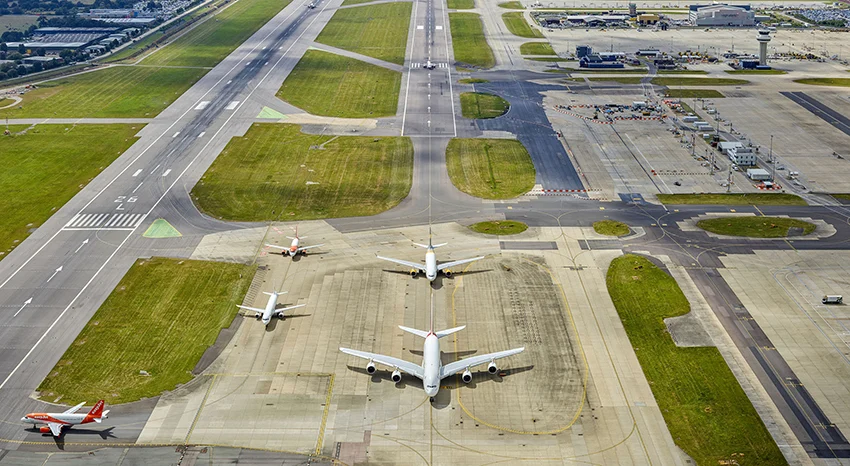
The answer illustrates a wider problem with how airport capacity is often discussed. The UK does not simply have too few runways. Capacity exists at airports around the country and even Gatwick continues to improve the productivity of its existing runway, increasing maximum scheduled movements from 55 per hour in 2025 to 57 in 2026.
The problem is increasingly one of having sufficient capacity in the places, at the times and in the markets where airlines and passengers value it most.
Heathrow provides the most obvious example. Its scarcity of slots can push airlines seeking additional London capacity towards Gatwick. This has contributed to Gatwick’s increasingly diverse long-haul network, but it also requires some caution when interpreting that growth.
For some international airlines, Gatwick may provide valuable additional London access when their preferred Heathrow capacity is unavailable; experience also suggests that services can migrate when Heathrow slots subsequently become available.
Gatwick therefore performs an important role within London’s multi-airport system without necessarily becoming a second Heathrow.
It remains predominantly an origin-and-destination airport with a strong leisure focus, while increasingly accommodating premium leisure and a geographically diverse long-haul offer. This distinction matters when considering the economic benefits of expansion.
Additional capacity at Gatwick has value because it creates opportunity: for airlines to enter markets, increase frequencies and develop new routes; for passengers to benefit from greater choice and competition; and for businesses to gain improved international connectivity.
Increased runway resilience and reduced constraints during peak periods also have economic value.
But additional passengers and aircraft movements should not automatically be treated as synonymous with economic growth.
Tourism provides a useful illustration. Increased inbound tourism undoubtedly creates economic activity, employment and export earnings.
Analysis commissioned by Gatwick forecasts that its expansion could facilitate substantial additional inbound visitor expenditure. Yet aviation capacity facilitates outbound tourism equally effectively.
In 2024, overseas residents spent £32.5 billion visiting the UK, while UK residents spent £78.6 billion travelling abroad.
There is therefore a danger in viewing continued growth in tourism as a substitute for the more difficult task of achieving sustained improvements in domestic productivity and economic performance.
Tourism is economically important, but an increasingly tourism-dependent growth strategy raises economic, environmental and social questions of its own.
The same caution applies more widely. Connectivity can enable trade, investment and economic development, but the relationship runs in both directions: successful economies generate aviation demand just as aviation can facilitate economic activity.
That makes Gatwick particularly interesting. Its Northern Runway is not a speculative new airport searching for demand. It adds capacity to an established airport serving one of the world’s largest aviation markets, largely using infrastructure and land that already exist.
The financial risk also sits principally with its private owners rather than the taxpayer.
Nor can today’s traffic alone determine the capacity Britain will need in twenty or thirty years.
Aviation is currently navigating aircraft and engine shortages, geopolitical instability, restrictions on Russian airspace and disruption across the Middle East, alongside changing passenger behaviour and the transition towards lower-carbon operations.
Inevitably, infrastructure investment has to be made amid times of uncertainty.
So, does the UK have an aviation capacity problem?Increasingly, yes, but it is more nuanced than simply needing more runway pavement.
Britain has a spatial, temporal and commercial mismatch between where airport capacity exists and where the market most values it.
Gatwick’s second runway will not resolve that problem, nor does its approval establish an economic case for unlimited aviation expansion. What it does provide is additional capacity at an airport where there is already demonstrable demand, while increasing competition, resilience and the opportunity for future connectivity.
Ultimately, that may be its greatest economic value. Airport capacity should enable a successful economy rather than become a substitute for creating one, but insufficient capacity should not be allowed to constrain the economic opportunities that do emerge.