




Capturing pollution from aircraft emissions at Copenhagen Airport


Can air quality at an airport be improved with filters that capture pollution from aircraft? That is what Copenhagen Airport is now setting out to discover.
To support this ambition, the airport is launching CPH Air Lab, a testing facility located in the heart of active airside operations. The purpose is to examine how existing filtration technologies perform in an airport environment.
The airport’s chief sustainability officer, Maria Skotte, said: “We have a strong focus on air quality and have worked for many years to reduce emissions of ultrafine particles. With CPH Air Lab, we are taking the next step by investigating whether we can also remove particles close to the source.”
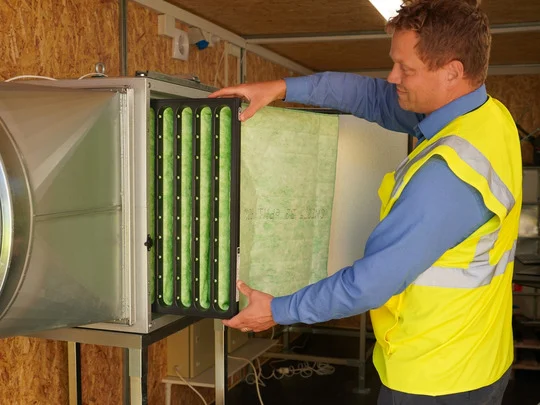
CPH Air Lab is housed in a container equipped with a large ventilation duct, a test chamber and advanced sensors that detect and measure particles.
Over the coming months, five different technologies will be tested. What they have in common is their ability to capture particles, whether by trapping them in mechanical filters, attracting them to electrically charged surfaces, or binding them to biological materials such as moss.
“Everything we are testing has originally been developed for other industries,” reveals Alexandra Halberg Hüneburg-Møller, project manager in Copenhagen Airport’s innovation team.
“That is why CPH Air Lab is so important. It gives us the opportunity to evaluate these filtration technologies using aircraft exhaust emissions in a fully operational airport environment.”
COLLABORATION WITH SCHIPHOL
The technologies that perform best in the container-based trials will qualify for further testing next year. This will involve larger-scale applications, such as integration into the airport’s blast fences, which shield surrounding areas from the powerful airflow generated by aircraft engines.
“If the technologies also prove effective in open-air conditions, the potential for further development could be significant. One could imagine blast fences functioning as air purification systems, or filtration technologies becoming integrated into building façades,” adds Hüneburg-Møller.

CPH Air Lab forms part of ASAP (Accelerate Sustainable Aviation Programme), a joint initiative between Copenhagen Airport and Amsterdam Airport Schiphol.
The programme aims to make it easier for airports to test and develop new solutions together, enabling knowledge sharing and providing a stronger foundation for future investment decisions.
The air quality laboratory is the latest in a series of initiatives undertaken by Copenhagen Airport to reduce air pollution for both employees and neighbouring communities.
Last year, the airport became the first in the world to deploy thermal imaging cameras and artificial intelligence on a large scale to monitor aircraft use of auxiliary power units (APUs). In most cases, APUs are not required while aircraft are parked, as Copenhagen Airport provides electricity and pre-conditioned air at aircraft stands.
Pilots are encouraged to use only a single engine while taxiing where operationally feasible, and airport development is planned with a strong focus on minimising taxi distances in order to reduce fuel consumption.
Skotte said: “With CPH Air Lab is not a finished solution, but it is a concrete step in our efforts to keep air pollution as low as possible.
“This work will become even more important in the years ahead as the airport accommodates more passengers while continuing to show the greatest possible consideration for employees, neighbours and the surrounding environment.”